Video: You Have Spinach in Your Teeth
If you’re already familiar with the Radical Candor framework, you know that we’ve labeled the axes “Challenge Directly” and “Care Personally”....
5 min read
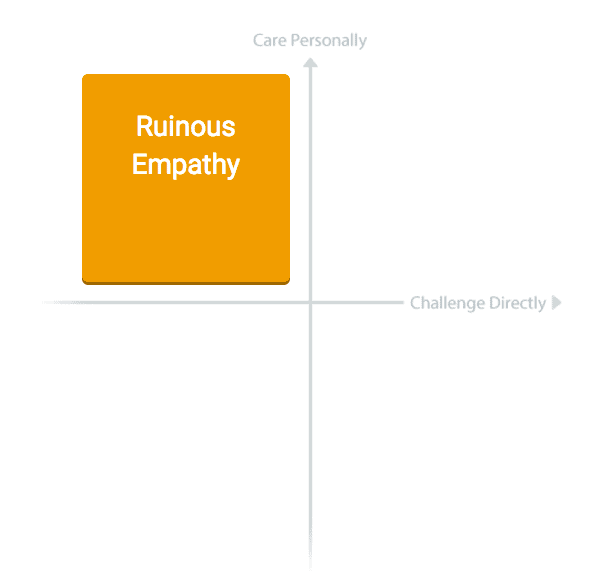
For those of you who are familiar with our Radical Candor framework, you’ll remember that Ruinous Empathy is in the upper left. High Care Personally, low Challenge Directly. It categorizes behavior in which someone is trying to be “nice” in an effort to spare people’s feelings -- by not saying what needs to be said, by lying, or by just offering a verbal pat on the back. People whose behaviors fall in this quadrant often recognize it right away when they learn about the framework. Here’s a question a reader recently asked:
I'm looking for advice on Ruinous Empathy. I am new to an HR-ish role at a small web development company. (There are 11 people on the team.) After reading about the 4 quadrants, I know that I fall in the bucket of being ruinously empathetic with my team members. I struggle with giving feedback in order to spare a team member's feelings. I'm already seeing the repercussions of hanging out in this quadrant. Do you have any advice on how to come back from a moment of Ruinous Empathy? And do you have any tips on how to move from Ruinous Empathy to Radical Candor? Thanks in advance for your time and insight.
-Tori
 Tori, thanks so much for reaching out. Your question is applicable to many of our readers.
First off - don’t despair :) You are not even remotely alone in your Ruinously Empathetic tendencies! It’s our belief that >75% of feedback mistakes get made in the Ruinous Empathy quadrant.
Second thing - Just identifying that you have this tendency and starting to think about how to make progress puts you halfway down the path to victory!
Here are some thoughts for how you can avoid Ruinous Empathy and move towards Radical Candor:
You mentioned that you know you struggle with giving feedback because you want to spare people’s feelings. Let’s dig into that thinking.
More likely than “sparing someone’s feelings,” what one is really trying to do is to avoid dealing with the other person’s emotion. Even the most carefully crafted feedback will usually elicit an emotional response. People take their work personally, and they will at times react with emotion. This is reality and is not something to avoid. Let’s embrace the discomfort here, and recognize that this is life in the office.
But let’s take your statement at face value, that you really are just trying to spare the other person’s feelings. Ask yourself, “Can I control someone’s feelings?” The answer is no. So even the attempt at trying to control someone’s feelings - whether pulling a punch on criticism or offering false praise - is somewhat of an impossible endeavor. You, like me, are no Master of the Universe, so let’s stop wasting mental and emotional energy on these things we cannot control!
And even if it were possible to spare someone’s feelings, is that really the right priority for your business and for that person? Check out our video that uses the trite example of “spinach in your teeth” to make the point that in an effort to spare someone embarrassment, you do them a great disservice. In this example, a person acting with Ruinous Empathy might say to themselves, “oh, how embarrassing it must be for Tammy to have that giant piece of spinach in her teeth - poor thing. Well, I’m certainly not going to embarrass her further by pointing it out. She’ll go to the bathroom soon and see it - can’t miss it, and she’ll be fine.” Of course, Tammy then goes to 5 meetings in a row with no bio break. 5 meetings of embarrassment!
Finally, think about whether this idea of sparing someone’s feelings actually improves a relationship. In the case above, how is Tammy going to feel about us after having attended all those meetings and realizing none of us told her about the giant piece of spinach in her teeth? Will she trust us? She might even think we did it on purpose to intentionally embarrass her. At a minimum, she probably won’t feel like we have her back.
All of this to say that the instinct to try to spare someone’s feeling is all wrong - it comes from a good place, but is a misplaced and misguided effort.
Knowing that sparing someone’s feelings isn’t the mindset you want to have, now you need to get into the mindset of Radical Candor. How are you going to break your “nice” habit and Challenge Directly?
First, before giving feedback, consider, articulate, and possibly even write down your objectives for the feedback. This is a crucial step. Once you’re clear in your mind that you are trying to be helpful and not trying to kick someone in the shins, you’ll be able to deliver your message with your good intentions even if the recipient of the feedback reacts emotionally.
Second, know that Challenging Directly is going to be a stretch for you. Your tendency is still going to be to soften the blow of your Direct Challenge, which can lead to it being unclear or not even heard. To avoid this, you might even aim for Obnoxious Aggression. Because you have strong tendencies towards Ruinous Empathy, you probably won’t get all the way to Obnoxious Aggression, but your challenge will be much stronger and hopefully clearer.
With the right mindset and preparation, you’re now ready for the tactics of giving good Radically Candid feedback. We say to use the HIP approach.
Here’s how this might play out:
“Alaina, I have some feedback for you that I I’d like to give in an effort to be helpful. Would you like to hear that feedback?”
“Yes.” (if they say no, that’s a whole ‘nother thing :-) )
“Cool. Well, here’s what I think and I’d be interested to hear what you think. I think that when you did behavior x, y, z, it affected the team in a, b, c (negative) ways. Here’s my rationale: reason 1, 2, 3.
What do you think about that?”
...and then shut up and listen with the intent to understand, not to interrupt or cross-examine. Alaina might react emotionally. She might come back at you with “well, what about your big misstep?”
At this point, you have to manage your own emotions and just listen. Check for understanding and make a note so you don’t forget, but then you need to get the conversation back on point “OK, Alaina, I hear that you think I made this big error. I want to hear more about that, and I promise we’ll talk that through - but for the moment I’d like to hear your thoughts on my original point about x, y, z impacting team in a, b, c ways. Do you have thoughts on that?”
Assuming Alaina gives you an interpretation of the facts, once again, you check for understanding, “So Alaina, I hear you saying that you think that behaviors x and y were the right call for d, e, and f reasons, but you agree that z was suboptimal? Do I have that right? What would you change?”
Next, focus on “how do you think we avoid z in the future?” Again, listen with the intent to understand and not to interrupt or cross-examine. This puts you and Alaina on a joint problem-solving path and hopefully helps to move her out of her emotional reaction.
Then, don’t forget to circle back and let Alaina give you her feedback that you wrote down earlier. :)
I covered a lot of ground here, and I hope this helps!
Good luck and keep me posted on when you put this into practice.
Cheers,
Coach Russ
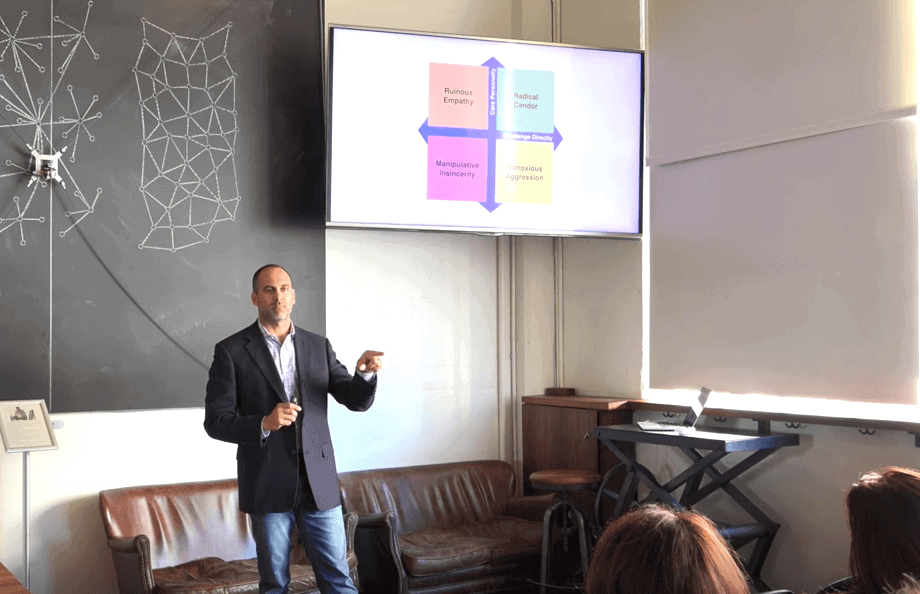
If you’re already familiar with the Radical Candor framework, you know that we’ve labeled the axes “Challenge Directly” and “Care Personally”....
What makes Radical Candor radical is that it’s a deviation from the norm, which tends to fall somewhere between acting like a jerk and avoiding...

Do you think your feedback is often Ruinously Empathetic? If so, you're not alone. In our experience, most feedback mistakes fall in the Ruinous...
Share your perspective
Leave a comment below.