How Practicing Radical Candor Can Help Remove the Stigma Around Mental Health Discussions at Work
*This post about Radical Candor and mental health discussions at work was contributed by Chris Harley, an expert in mental health with a background...
7 min read

By Melissa Andrada, (Mel — she/they), a Candor Coach, DEI & Mental Health strategic consultant, leadership coach, workshop facilitator, and motivational speaker who collaborates with organizations to co-design cultures of inclusion and innovation.
Psychological safety is a key dynamic of a high-performing team. The presence of psychological safety means we can be vulnerable in front of each other, speak our minds, make mistakes, and share honest feedback.
We know feedback is key for high-impact growth. Yet, sharing feedback can be hard when we know our colleagues are enduring difficult mental health conditions.
How can we embody mental health awareness and the principles of Radical Candor — caring personally and challenging directly — to create a culture of psychological safety to make it safer for people at work who are emotionally or mentally suffering to ask for help?

The language and suggestions I offer in this post are invitational and must be adapted to the needs of the individual, situation, and organization.
Be mindful of your boundaries and capacity — and know when to refer someone to an outside clinical mental health specialist.
As a mental health practitioner and the writer of this post, I want to gently remind you to take three deep breaths from your diaphragm and drink a glass of water if you find this content heavy. <3
@narakyaniMental health awareness month ♬ The Night Is Still Young - #marii
In 2019, the World Health Organization reported that it impacted 301 million people worldwide. Depression disorder also is a common mental condition, affecting 280 million people worldwide.
The World Health Organization recently reported that an estimated 12 billion working days will be lost to untreated depression and anxiety by the year 2030, resulting in a global cost of $925 billion.
As a DEI & Mental Health strategic consultant, leadership coach, workshop facilitator, and motivational speaker, I intend to bring more skillfulness and sensitivity to interactions with our colleagues enduring the deepest emotional suffering to evoke a culture of compassionate high performance.
This post was inspired by my own experiences with grief and post-traumatic stress disorder after the tragic passing of my father in 2020.
These learnings are based on my experience coaching and facilitating workshops for more than 50 Radical Candor clients on difficult feedback situations over the past four years, alongside my in-progress Master's in Clinical Psychology and Expressive Arts Therapy at the California Institute of Integral Studies.
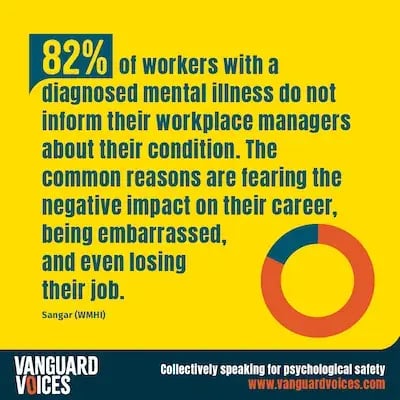
I invite you to bring the dual lens of DEI and mental health to the practice of Radical Candor — and to consider the individuals, identities, and groups most impacted by depression and anxiety, due to inequities within our workplaces and larger society.
To name a few poignant data points, women are twice as likely as men to experience generalized anxiety disorder. In the United States, higher levels of income inequality are correlated with higher rates of depression.
The chronicity of major depression, alongside under-diagnosis and under-treatment, is most prevalent among Black and Hispanic communities in America.
I encourage you to bring the widely used ADDRESSING mental health framework created by Pamela Hays to facilitate an individually attuned understanding of each person on your work team as I walk through two common feedback scenarios.

A peer experienced the sudden loss of a family member seven months ago and openly shared a recent diagnosis of major depression. You noticed they’ve missed four deadlines in the past month.
Throughout the past two years you’ve worked with them, they have rarely missed a deadline. How might you compassionately share your feedback?
Major Depression Symptoms
Understand the psychological impact of depression
Re-enforce your commitment to their growth and healing.
Compassionately offer your observation on their work.
Communicate empathetic expectations and boundaries.
Share your vulnerability and humanity.
Come with collaboration.
Time and expectations.
Accessibility and privacy.
Offer external resources.
A U.S.-based compilation of therapy directories where you may find someone specific to your needs:
@dr.kojosarfo It’s possible to live your best life, I believe in you! #socialanxiety #confidence #makingfriends ♬ meet me at our spot by willow smith and tyler cole - The Favourites.
Social Anxiety Symptoms
Understand the psychological impact of anxiety
If this content feels heavy — or is even making you feel anxious, that’s OK. Sitting with difficult material is how we become more compassionate and skillful as leaders and managers. Take a deep inhalation for three seconds, and exhale for six seconds.
When your exhalations are longer than your inhalations, it activates the parasympathetic nervous system, the system responsible for sleep and rest.

Come with a non-judgmental presence and caring curiosity.
Share your commitment to their integration with the team.
“We’d love to help you feel a part of the team, and to feel resourced and supported to be successful in your role.”
Hold a safe space for them to name their fears.
“I’m grateful you shared your recent diagnosis. I know it might be anxiety-inducing to speak in front of a new team. What comes up for you when you think about speaking?”
Common social anxiety fears:
@idkagoodusernaameloll #socialanxiety #mentalhealth #fyp #awareness ♬ in my head - frank iero wannabe
Help them feel less alone.
Highlight their potential and unique perspective, and come with a trauma-informed invitation.
“I really value your expertise and opinion. [insert key insight they’ve uniquely shared in 1:1, email or another form of communication]. We’d love to hear your voice in our meetings if that’s something you’re comfortable trying. I understand it’s a journey and takes time.”
Support them in connecting to passion and purpose.
Come with collaboration.
Social anxiety team safety.
@reallygoodtalkerTake space leave space # ♬ original sound - Yordi
Accessibility and privacy.
Offer external resources.
Attuning our expectations, feedback, and support to the unique context, needs and strengths of our people will lead to higher retention and impact. At the end of the day, all most people want is to feel safe, seen, and supported. #mentalhealthawareness
What would work for you? What do you need? Let us know on social media:
Instagram
TikTok
LinkedIn
YouTube
Facebook
X
View this post on Instagram
If you or someone you know is struggling or in crisis, help is available. Call or text 988 or chat 988 lifeline.org. You can also visit the National Alliance on Mental Health (NAMI) website, or call 1-800-950-NAMI(6264). In an emergency, contact the National Suicide Prevention Lifeline at 1-800-273-TALK(8255) or call 911.
————————————————————————————————————————————————————————————–
*This post about Radical Candor and mental health discussions at work was contributed by Chris Harley, an expert in mental health with a background...

Creating a culture of feedback at work helps teams thrive, companies retain top talent and individuals grow in their careers. Gone are the days when...
By Nahla Davies, a software developer and tech writer. Before devoting her work full-time to technical writing, she managed—among other intriguing...
Share your perspective
Leave a comment below.