How to Be Remarkable: Growth, Grit, and Grace with Guy Kawasaki 7 / 40
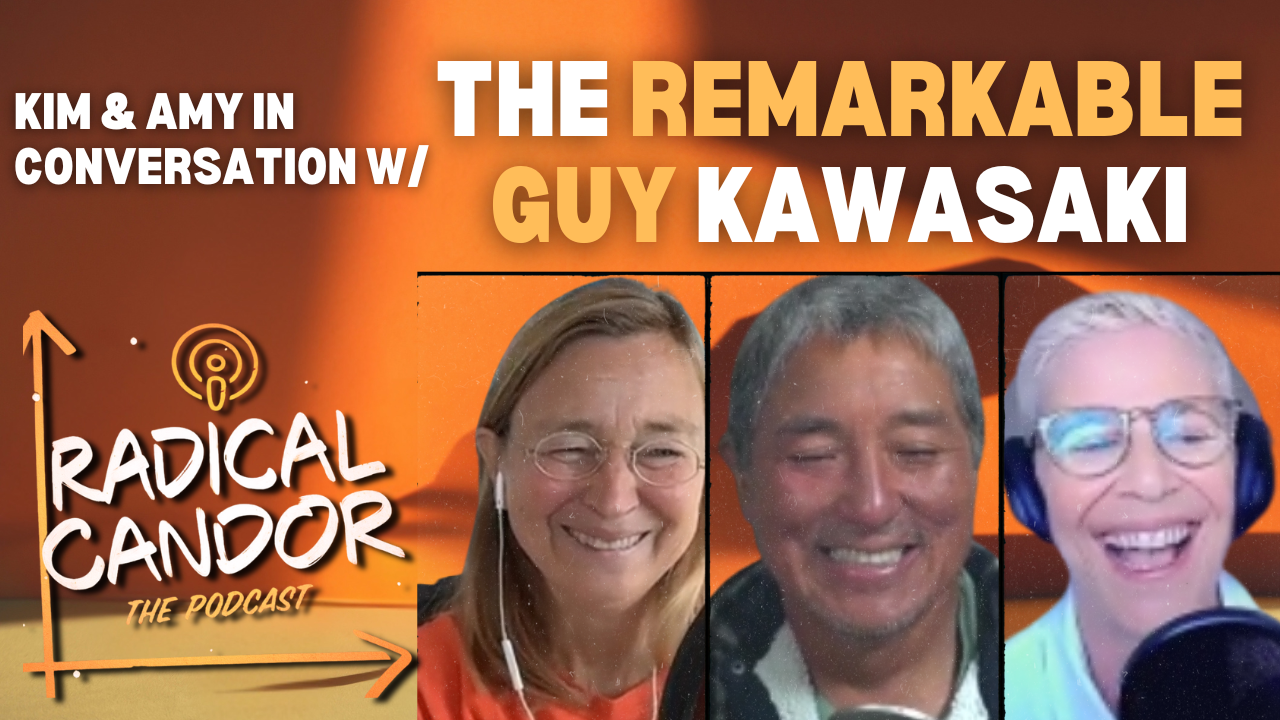
When it comes to making a real difference, being remarkable isn’t about fame or titles—it’s about how you show up for others and yourself. Kim and...
16 min read
 Kim Scott
Mar 25, 2026, 12:00:00 AM
Kim Scott
Mar 25, 2026, 12:00:00 AM
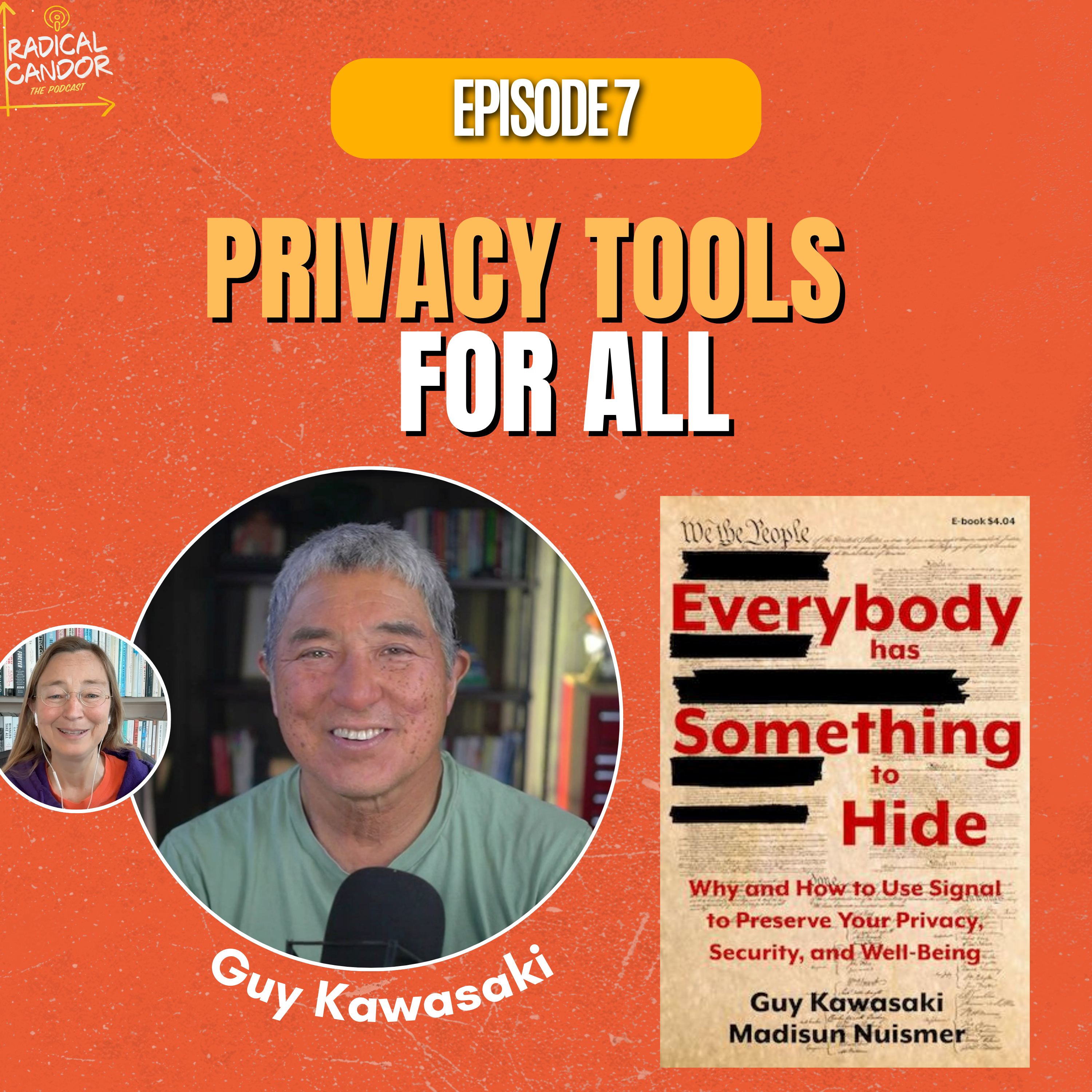
Table of Contents
We all love the convenience of our digital devices and connected services. But what about the ever-expanding pile of digital breadcrumbs we leave behind every day? Those crumbs get swept up by private companies to target us with ads, and by government agencies who might use them for legitimate police work — or, in some cases, political repression. So a lot of people are asking: should I be doing more to protect my personal privacy, and how?
On this episode of the Radical Candor Podcast, Kim talks with tech evangelist and prolific author Guy Kawasaki about the journey that led him to start using Signal — and then to co-author Everybody Has Something to Hide, a hands-on guide for using it well.
Watch the episode:
Kim and Guy discuss the centrality of privacy in a free, democratic society and how tools like Signal can enhance an individual's privacy. Kim shares her experiences with privacy and censorship in her years working in the Soviet Union (and later Russia) in the early 1990s — a reminder that the freedom to communicate without being surveilled isn't guaranteed.
Guy collaborated with Madisun Nuismer to publish a how-to book for using Signal — Everybody Has Something to Hide, released in January 2026. The book grew out of Guy's own realization that even after he installed Signal, it wasn't obvious how to use it to its full potential. He highlights the work of Meredith Whittaker, Brian Acton, Moxie Marlinspike, and the rest of the team at Signal Foundation.
Kim and Guy debate how much we should trust the large tech companies with our personal data. As Guy quotes the old saying, “If you aren't paying for the product, you ARE the product.” Tech's reputation is at a low point right now — but it's worth remembering that there are still many idealistic people inside tech working hard to make the world a better place.
[00:04] Kim Scott: Hello, everybody.
I'm Kim Scott. Welcome to the Radical, Sabbatical, Radical Candor podcast. You got just me and the authors of books I love for the next couple of months. And today I am thrilled to have with us the great guy Kawasaki, who has done many great things. Most recently, he wrote a book called Everybody Has Something to Hide. And he also
[00:09] Guy Kawasaki: You
[00:34] Kim Scott: wrote is the leader of the Remarkable People podcast, the Remarkable podcast. Am I getting it right? Remarkable, try to say that 10 times fast. Remarkable People
[00:41] Guy Kawasaki: Remarkable people podcast.
[00:51] Kim Scott: Well, listen, I'm really excited to talk to you about your new book. This is your 18th book, I believe you've written 18 books, is that correct? Wow, that's amazing. That's amazing. So this is a book about signal and privacy. So what what made you decide to write this book? And I'll tell you why I decided to read it. But first, why did you write it, which is more important?
[00:59] Guy Kawasaki: I honestly have lost track.
It all starts about a year ago and I started reading this article by Wired about how to have completely private and secure messages and then the ⁓ EFF ⁓ has a website that also explains things like this so Wired EFF, I started reading about this and let's just say that there's a different
[01:36] Kim Scott: Mm-hmm.
[01:44] Guy Kawasaki: political climate these days. I thought, know, guy, you should get secure messaging too. And I got interested in, I started using Signal and then I, my best friend from South by Southwest, Hugh Forrest asked me, you know, what do you want to do at South by Southwest this year? I said, I want to interview Meredith Whitaker, who's the president of Signal.
[01:46] Kim Scott: Yes.
Uh-huh.
[02:07] Guy Kawasaki: And he said, OK, I asked Meredith, she said, yes, I did a interview with her at South by Southwest about 11 months ago. And she really blew me away in terms of, you know, sharpness and ethics and taking the high road and all that good stuff. And and, know, I.
The articles by the EFF and Wired, they're kind of like, you know, this is why you should use Signal and this is how to get started. But the more I use Signal, the more I said, my God, people are not going to figure this out. People are not going to use it to its highest potential and, you know, completely safeguard their privacy. So, you know, there should be something like Signal for dummies.
[02:38] Kim Scott: Mm-hmm.
[02:53] Guy Kawasaki: And I actually,
[02:54] Kim Scott: Ha!
[02:55] Guy Kawasaki: I went to Wiley with this pitch. said, you know, I'll write, I'll write you signal for dummies. And they even sent me a contract, Kim. But I'll tell you why I blew that up. So they sent me a contract. All I had to do was sign. But I said to them, you know, since you're a publisher, you're going to print it in paper. I want the price of the paper for paper version of the book to be.
[02:57] Kim Scott: Uh-huh.
Uh-huh.
Wow.
Mm-hmm. Mm-hmm.
Mm-hmm.
[03:22] Guy Kawasaki: 1776. Right? I mean, seriously, right? That is a good idea, right? Yeah. And they told me, all four Dummies books ends in 99. And I said to them, so, you know, did God tell you that? Did Moses tell you that? Did, you know, Mohammed tell you that? Did
[03:25] Kim Scott: You
Yeah, that makes sense. That's a great idea.
Yeah, yeah.
[03:48] Guy Kawasaki: Buddha tell you that like where is it laid down that all yeah that has to end in 99 and he said no that's just the way it is so I walk for that contract for 23 cents and I never looked back and then huh and then I decided it would be Kindle only electronic only so I thought no what price could I put I can't put 1776 on a Kindle book
[03:52] Kim Scott: but it must end at 99.
Wow.
Mm-hmm.
[04:16] Guy Kawasaki: So
because I am so freaking clever, Kim, the price is $4.04 because exactly, yeah. I'm going to write a book called Pricing for Dummies.
[04:19] Kim Scott: It's...
you can't find it. I love it. I love it. I love it.
I love it. And I love that you wrote this book because Signal did seem at first a little bit complicated. I will admit, but after reading your book, want to show you where Signal is on my phone. I put it like right down there on my home screen, like right next to the actual phone. ⁓ Yeah, there you go.
[04:46] Guy Kawasaki: Yeah.
Yo, look,
[05:03] Kim Scott: I think that should be your first chapter because part of the problem I had with Signal was that I could never find it on my phone, you know, whereas my chat was right there.
[05:13] Guy Kawasaki: You know,
I mean, we don't want to go down too many rat holes, but for the life of me, I cannot figure out when you add an app to your phone, where the hell does it go? Does it go to the first empty space? it go to the very, I mean, it's like totally random. I do, and then, and then you try to drag it and then, you know, like everything is.
[05:24] Kim Scott: why it goes where it goes.
It's random, it's random.
[05:39] Guy Kawasaki: is squealing and you try to drag it doesn't go you want to put it in a folder when you drag it to the folder the folder moves so it's like it's like a game you gotta drag your icon and put it's like freaking Tim Cook he should go to fewer movie previews and work on the UI of iPhone more
[05:41] Kim Scott: Yeah.
It is. is. It is. Yes.
Yeah, make it easy to organize your phone. Totally agree.
[05:58] Guy Kawasaki: But,
mean, I mean, seriously, before, I swear, I had an iPhone so long that I swear that before on your computer, it would simulate the iPhone and you could, you know, design, could drag everything, put it in order and you send it to the phone and say, or reorganize like this, because that's the way to do that, where you can point, click and drag. ⁓
[06:20] Kim Scott: ⁓ yes. Yeah, they need to hurry back guy. Set
them straight.
[06:28] Guy Kawasaki: I think the Apple
executive teams, all have personal assistants, so they just tell people, download that, put it on the fourth, whatever.
[06:37] Kim Scott: Yeah, yeah.
⁓ You want to hear why I read the book and why I think everybody needs to read the book and start using Signal?
[06:46] Guy Kawasaki: ⁓ it's probably because you so admire me as a writer, but go ahead, tell me why.
[06:50] Kim Scott: Yes, I so admire you as a writer. That's
number one. No, no, number one is I so admire you as a human being. Secondly, as a writer. And thirdly, the reason why I feel like, ⁓ true confession, I'm sure I do have something to hide. But when I first read that, when I first saw your title, I was like, I might be the exception to that. don't think I, but I think it's still really privacy is very important, even though I have nothing to hide. And here's why.
[06:56] Guy Kawasaki: Ha ha!
Yeah.
[07:19] Kim Scott: Early on in my career, I was living and working in what was then the Soviet Union. ⁓ Never thinking that my experiences there were going to be so relevant to my life back home in the United States. And when I was living and working there, all my phone calls were recorded by the Soviet government. was working with the military industrial complex. So they were doubly, I wasn't just like a student.
running around like cruise missile factories. And that's a other longer story. And so every room I was in had a listening device. Everything I did was recorded. And I could actually trigger the recording by saying cruise missile. And you'd hear this very high pitch beep and it was turning on, know, slick them and click them.
[07:56] Guy Kawasaki: Yeah.
[08:16] Kim Scott: which stands for Sea Launch Cruise Missile and Ground Launch Cruise Missile. So I knew this, but I didn't think it mattered. I was like, I have nothing to hide. I'm not gonna get thrown into the Gulag Archipelago. I have my all powerful American passport. The worst that this government can do is send me back home, which is not the end of the world. So I thought it didn't matter.
that every word that I was uttering was recorded. And then I went to visit a friend in New Jersey and I called my parents from New Jersey instead of from Moscow that particular week. And as I was talking to my parents, I realized that I was having a more open conversation. I realized the fact that I was being recorded and that maybe somebody else was listening to the words I was saying.
was having an impact on what I was willing. And that is the whole point of censorship is that it silences you without doing anything. And that's why I think signal is so important. Like it's really important to candor is something I care a lot about and candor requires privacy.
[09:16] Guy Kawasaki: Exactly.
Huh.
Yeah, yeah, yeah, Well, that that is a very, very good story. I'm going to tell people that.
[09:39] Kim Scott: Because you don't realize it's insidious when when you're when your privacy is eroded. The ways that it impacts you are really insidious.
[09:47] Guy Kawasaki: Yeah.
Well, know,
Kim, I actually would make the opposite case, which is I think that 95 % of the world, they are totally oblivious that this could be happening. So they are overly candor because they have no idea that it could happen, right? And listen, you you have the threat of the Gulag and cruise missiles and all that, but...
[10:04] Kim Scott: Yes, yeah. Yeah, yeah.
[10:16] Guy Kawasaki: People have asked me why you say everybody has something to hide and I would say a very good test is if you saw your text message on a bulletin or on a billboard on the side of a freeway would you say no big deal because I don't know about you Kim but let me confess that my kids say dad you know like I want to use your Netflix account give me your user ID and password so what do do I text it right
[10:29] Kim Scott: Billboard, yeah.
Yes.
[10:45] Guy Kawasaki: And
my other kids are in college and they say, dad, we cannot figure out the housing system. said, just send me your user ID and password or, or I'm, visiting them on campus and I cannot get into the campus wifi. So I don't give me your username and password. So like all of those cases or
[10:54] Kim Scott: Yeah. Yes.
[11:06] Guy Kawasaki: You know, you're going to arrange for surfing lessons in Hawaii and you know, know, the Ohana group doesn't exactly have e-commerce set up. they say, yeah, just call us or text us with your visa number. Yeah. And like, mean, all of that, I'm not saying you have to be a, you know, fentanyl dealer to use Signal. mean,
[11:18] Kim Scott: Credit card number, yeah.
Yes, yeah, that's true. You
don't want anybody to have your credit card data.
[11:31] Guy Kawasaki: Yeah, and then,
okay, now, so that's one level of paranoia, but the next level of paranoia is what happens if your niece is in Texas or Florida and says, Auntie Kim, I missed my period. I don't know what to do. Wow, man, that kind of disgusts. Should I go to Planned Parenthood? ⁓ man, let's take this off WhatsApp.
[11:43] Kim Scott: Yeah. I need a... Yeah. Yeah. Yeah.
Yeah, yeah, yeah,
I feel okay. Maybe this is nutty. I feel like if both of us are on an iPhone, I don't feel so bad about sending usernames and password. I don't send the username on, I'll email the username and I'll text the password. How stupid is that?
[12:15] Guy Kawasaki: That's a good idea.
That's a good idea. I never thought of that. Yeah.
[12:17] Kim Scott: Yeah, yeah.
But still, I like the idea of signal where it's going to disappear, like they're not going to keep that data forever.
[12:26] Guy Kawasaki: Right, right.
And you know, I like you. I trust Apple more than I trust Meta or Google. Right?
[12:36] Kim Scott: Yeah,
I trust Google, but I don't trust Metta at all. But maybe but let's talk about why because a lot of people have told me that I'm just biased because I worked at those two companies.
[12:38] Guy Kawasaki: Yeah, well.
Well, you know, ⁓ Google has clearly expressed the willingness to ⁓ obey subpoenas, right? So, I mean, that's something to think about. And Google's business model is to monetize your data. mean, like they say, you know, if you're not paying for the product, you are the product.
[12:58] Kim Scott: Yeah, yeah.
Yeah. Yeah.
You are the product. Yeah. Yeah. Yeah.
[13:14] Guy Kawasaki: I think a very good test would be that you should never trust a company whose CEO has gone to an inauguration and donated money and seen the previews of movies and you know, ⁓ exactly. I am ⁓ totally conflicted about Apple because if somebody said to Apple, if you give us a back door to iCloud backups, we'll make sure you don't get tariffs.
[13:27] Kim Scott: Well then, Apple's also implicated. Uh, yeah.
[13:44] Guy Kawasaki: Wow.
[13:45] Kim Scott: Yeah,
yeah, yeah, that's a lot of I mean, I do it does make me wonder what kind of pressure these people are under that they're behaving because I'm like, I really, I'm a huge admirer of Tim Cook, you know, and I'm a huge admirer of Sundar Pichai. I think they're both really good human beings and great leaders. And yet
I don't admire what's happening. Like the leadership in tech is not, ⁓ it's not distinguishing itself in this moment in time.
[14:18] Guy Kawasaki: Yeah, listen, I
admire Apple, I admire Google. I can't say I admire them at all, but you know, it's
[14:27] Kim Scott: It
is for me too. mean, in fact, I'm getting together with a group of people in tech, because I think that the people I worked most closely with in tech are problem solvers and they're idealistic problem solvers. They want to make the world a better place. And somehow we have seated the microphone to Peter Thiel and Elon Musk and it's time to grab the mic back, I think. There are a lot of great people in tech.
[14:47] Guy Kawasaki: Yeah.
Yeah, well, so I...
[14:57] Kim Scott: Tech is not full of evil people, but there are some notable exceptions.
[15:01] Guy Kawasaki: Well, you've got to admit that ⁓ Jeff Bezos' wife, number one. Awesome, right? Yeah. Do you know her personally? Yeah, yeah.
[15:07] Kim Scott: Awesome person, not corrupted by her money. I don't, I would love to, do you?
[15:15] Guy Kawasaki: I mean, I know not-for-profits that they told me they're getting a grant from them. And I said, well, did you have a big application? Was there a lot of interviews and whatever? And they said, nope. One day somebody called and said, we like you. We're going to give you money. And there's no strings attached. You don't have to be woke or anti-woke. You just do what you're doing.
[15:29] Kim Scott: Yeah.
Yes, yeah. Yes. Yeah. You just do what you're
think that, you know, I think that that our welfare system needs some work. But I think it's good to give people to give families who are in need money. It's better to have to have an economy that will pay people a living wage. And we don't have that right now.
[15:45] Guy Kawasaki: Yeah.
Listen, I
am all for trying the experiment of universal basic income. I mean, I think that's a worthy experiment. all these angry people, say, well, then all these people who are not, they're not going to lift a finger or we're going to take them off the food stamps unless they prove they're working. It's like, can you take at least just the middle road? Doesn't have to be the high road. Just take the middle road for a while. My God.
[16:05] Kim Scott: Yeah.
Totally.
Yeah, yeah,
yeah, yeah. I mean, people love to work in my experience. Like, if they have work that has some meaning for them, you know? And people want to do a good job. I don't think that people are lazy, by and large. There's not, I mean, there are a few, but there's not, that is not the problem that we're facing.
[16:48] Guy Kawasaki: Yeah, mean,
listen, I know a lot of immigrants. I don't see them sitting around just cashing checks all day. ⁓ yes.
[16:54] Kim Scott: No, no, no, they're working much harder than you or I do. And we're working pretty hard.
I'm glad that you and I can have this conversation publicly. That is really important. And I'm glad that we can also turn to signal and have conversations in private. It privacy is really important. ⁓ Even for people who are pretty open saying what they think in public, which I think you and I both are.
[17:13] Guy Kawasaki: Yeah.
Alright.
Well, I think that, you know,
as privacy goes, so does democracy. I mean, you cannot have a democratic system that doesn't have privacy.
[17:28] Kim Scott: Yes.
Yeah, I'm going to tell you another story. So when I was working in what was then the Soviet Union, I was I was approached by someone from the CIA. They were trying to recruit me. And I looked at him. It was over lunch. And I was like, secrets, the kind of secrets that you keep have no place in a democracy. So both privacy and transparency. Like, how do you balance that? ⁓ Because I think that
Private individuals need privacy, ⁓ but government organizations need transparency. Is that a fair principle or not? What do you think?
[18:13] Guy Kawasaki: I
think it's a very fair principle. ⁓ And, I mean, if you're gonna go into that kind of work, you should just understand that it's a transparent business, right? And then if you wanna have your own protection force and your own fleet of Gulfstreams and all that, then go work for the guy with the business card that says, am the CEO, be-otch, I mean.
[18:16] Kim Scott: Yeah.
Hahaha!
⁓ Yeah, okay, we did diss a couple of people. I'm gonna, you're right, you're right. But it was well deserved. By and large, I'm optimistic. I think there's a lot of great people in tech. They're building great products like Signal and ⁓ people should use them. And the people like you need to get, you you are being very loud and I appreciate that because...
[19:09] Guy Kawasaki: I do not think I'm being very loud.
But know, with this book and with Signal, I think I am helping put the tools in place for the people who are really loud and brave.
[19:22] Kim Scott: Mm-hmm.
[19:23] Guy Kawasaki: I'm just helping people. And I fully understand that, you know, if I have become this kind of unofficial evangelist for Signal, Signal can be used for good things or bad
things, right? I mean, if everybody was using Signal during the Epstein days, there would be a lot less in the Epstein files. Yeah. Yeah.
[19:37] Kim Scott: Yeah, yeah, that's true.
Yeah, that's true. That's very
Well, Guy, it's always a pleasure to talk to you. And I so appreciate you writing this book. And I hope that folks will put signal right on there,
where it belongs.
[19:58] Guy Kawasaki: You
know.
[20:00] Kim Scott: and protect their
[20:02] Guy Kawasaki: Well, ⁓
listen, I hope we, or at least...
[20:05] Kim Scott: Listen, I hope we, or at
least fired you up a little bit looking at signal, but I gotta tell you something. So you're gonna hit the wall with signal. And the wall you're gonna hit with signal is not that it's hard to use, hard to set up, expensive, it's nothing like that. The wall you're gonna hit with signal is when you open up signal, you're gonna say, I don't know anybody else on signal, so why?
[20:07] Guy Kawasaki: I ⁓
[20:29] Kim Scott: am I on signal because my kids aren't, my family isn't, my colleagues isn't, you know, all of that.
And I'm telling you that
you have to help people get on signal with you. It could be just your family, which I haven't succeeded at. But, you know, right now, my most active signal messages is with the people I surf with. So in case, you know, we ever say anything bad about surfing, man, our messages are gone. So that's the challenge. So much of this book is dedicated to
[20:38] Guy Kawasaki: have to help people get on Signal with you. It could be just your family, which I haven't succeeded at. But you know, right now my most active Signal messages is with the people I surf with. Okay? So in case, you know, we ever say anything bad about surfing, man, our messages are gone. so that's the challenge. So much of this book is dedicated to
the evangelism techniques that I learned at Apple and Canva of how to get people to embrace a new product because that is the biggest barrier for signal.
[21:05] Kim Scott: the evangelism techniques that I learned at Apple and Canva of how to get people to embrace a new product because that is the biggest barrier for Signal.
Well, I found you. I found one of my good friends from Russia when I was on Signal. So I'm off to the
You know, two is critical
[21:24] Guy Kawasaki: Two is critical mass.
[21:27] Kim Scott: Yeah, absolutely. And we already had a little chat. So ⁓
So download it and protect your privacy. ⁓ Because there's gonna be, it's good, I think it's important, I think this is an important moment to do it because it seems like we may need it in the future, unfortunately.
[21:47] Guy Kawasaki: Yeah, and
[21:49] Kim Scott: if you're a bad guy listening to this, you probably need signal too. And even if you're a good guy now, I mean, you know.
[21:49] Guy Kawasaki: if you're a bad guy listening to this, you probably need signal too. And even if you're a good guy now, mean, you know,
administrations change, know, lots of things change. So, you know, you may be thinking that everything is hunky dory right now, but you just never know what's going to happen and go either way. Right. So, yeah. Everybody, everybody deserves privacy, Kim.
[21:59] Kim Scott: administrations change, lots of things change. So, you you may be thinking that everything is hunky-dory right now, but you just never know what's going to happen and go either way. So, yeah, yeah, yeah. think the everybody, yes, but it deserves
Yes.
Yes. Yes. I agree. I totally agree. And if you don't have privacy and you become aware that all your messages
you know, could be used against you, you're gonna stop talking, you're gonna stop thinking in the same way. And you don't want a lack of privacy to impact your own communication with your most intimate relationships. All right, thank you so much. Always a pleasure, Guy. And ⁓ let's keep in
[22:45] Guy Kawasaki: Amen.
Alright, thank you.
bye bye.
Privacy lets people speak, read, organize, and dissent without surveillance — which is what makes a free society possible. Kim's experience working in the late-Soviet-era and early-1990s Russia is a real example of what happens when privacy disappears: speech narrows and so does political possibility.
Signal is an end-to-end encrypted messaging app run by the nonprofit Signal Foundation. It encrypts the content of your messages and calls so that no one — not Signal, not your phone carrier, not your government — can read them in transit. It doesn't make you anonymous; it protects the contents of communication between people who are using it.
Guy quotes the old saying, “If you aren't paying for the product, you ARE the product.” Free services often monetize attention and data — and that data can be requested or subpoenaed by governments. The conversation isn't anti-tech; it's about being clear-eyed about which companies have what incentive.
It's a hands-on guide for using Signal well — co-written by Guy Kawasaki and Madisun Nuismer because Guy's own onboarding to Signal made it clear most users weren't getting near its full benefit.
Install Signal and move sensitive conversations there. Read EFF's Surveillance Self-Defense guide. And reconsider which free services you use for the most personal parts of your life — email, search, location — versus paid alternatives that don't monetize you.
Three ways to put this into practice.
When it comes to making a real difference, being remarkable isn’t about fame or titles—it’s about how you show up for others and yourself. Kim and...

While the Radical Candor podcast team is on a Radical Sabbatical, Kim Scott is sitting down with the authors of the books that have most shaped her...
While the podcast team is on a Radical Sabbatical, Kim is spending the season interviewing authors of the books that have shaped her thinking most in...
Share your perspective
Leave a comment below.