The Problem With Passion 3 | 8
On this episode of the Radical Candor podcast, Amy and Jason discuss what Kim refers to in Radical Candor as "the problem with passion." You've...
33 min read
 Kim Scott
Apr 22, 2026, 12:00:00 AM
Kim Scott
Apr 22, 2026, 12:00:00 AM
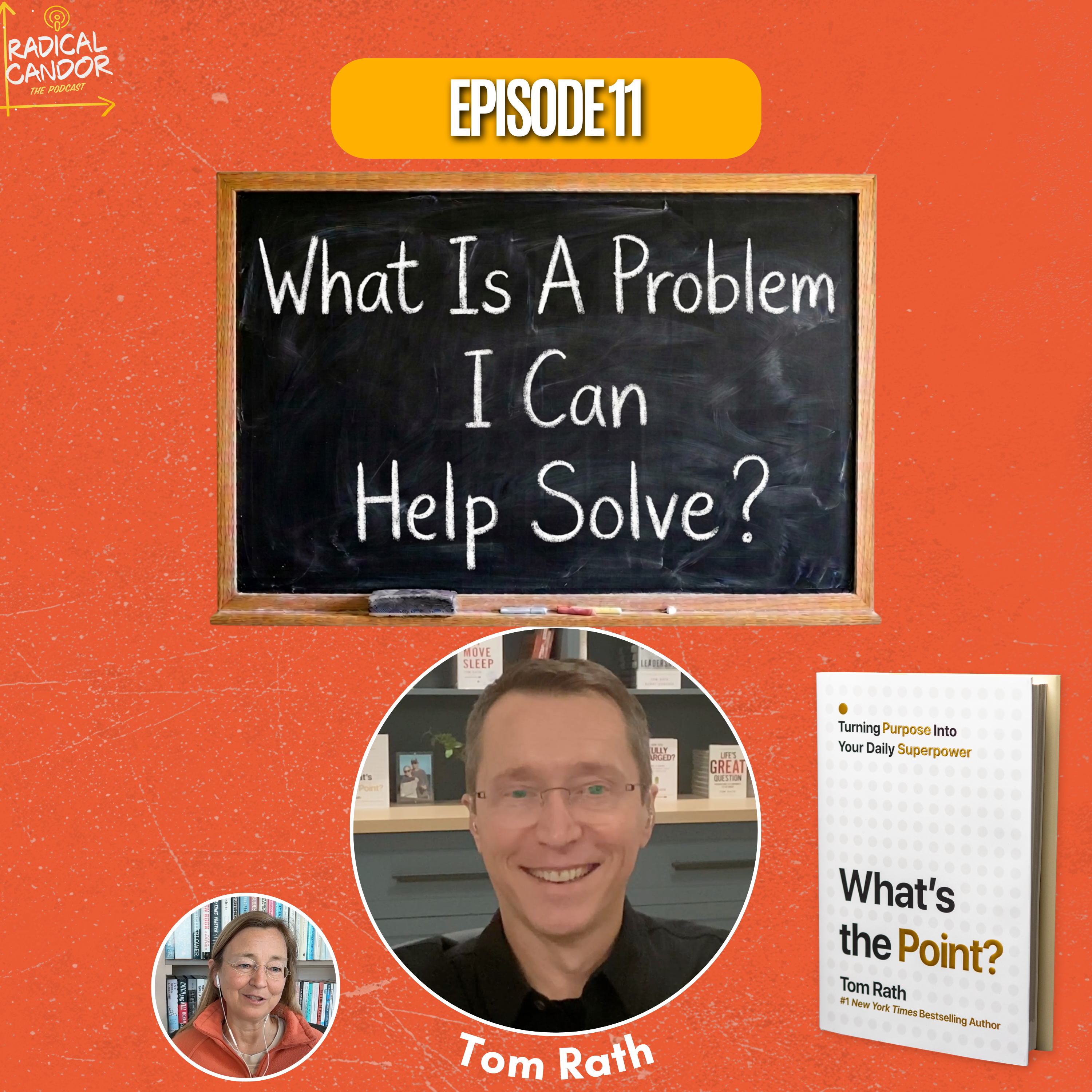
Table of Contents
Graduation speeches love “follow your passion.” Career coaches love it. Parents love it. But is that really the best way to decide what to do for work — especially in a moment of AI anxiety, when the ground under entire careers is shifting?
On this episode of the Radical Candor Podcast, Kim talks with bestselling author and researcher Tom Rath about his new book What's the Point? — and why a better starting question might be: what's a problem I can help solve?
Watch the episode:
Tom argues that passion is a poor compass. It changes, it's hard to articulate, and it puts the focus inward when meaningful work is mostly about contribution outward. The more useful move: survey the landscape, identify the big problems the world is facing, then identify and develop the skills that could help address them.
Tom distinguishes between a job (what you do for money), a career (a sequence of jobs that build on each other), and a calling (work where the question shifts from “what do I do?” to “who do I help?”). The frame matters because different stages of life and different financial realities call for different approaches.
One striking finding: 90% of people in the workforce fall into roughly 50 occupations. But most of us are only exposed to a handful — usually whatever our parents or their friends do. Tom's CareerSight team is trying to widen the aperture before young adults commit to paths they haven't really seen.
[00:05] Kim Scott: Hello everybody, it's Kim Scott and welcome to the Radical Sabbatical. This is a series of podcasts where I am talking to the authors of books that I love. For me, reading books is one of life's great pleasures. And so I'm thrilled today to have with us Tom Rath ⁓ who wrote a book, which is here on my desk called, What's the Point?
And you can pre-order this book now. what's your pub date? April 28th? Is that right? April 28th. So welcome, Tom. I'm thrilled to be talking to you. And I'm really excited to share some of your wisdom from this book with folks.
[00:40] Tom Rath: I think April 28th, yeah. ⁓
Thanks so much for inviting me. It's great to talk to you.
[00:55] Kim Scott: So the first thing that I wanna talk about is the problem with passion, because I agree passionately with you on this topic. But I think it's an interesting point and there's a lot of nuance to it, but I'll share a story with you and then you can respond and tell me if this is what you meant when you were writing. But recently I was with my daughter for vacation in Hawaii, she's 17.
I think we have kids around the same age. And I said, why don't you apply to the University of Hawaii? You love Hawaii. Your passion is the ocean. And she said, mom, the ocean is my happy place. Hawaii is my vacation place. I don't want to make it my work place. And I thought that was really smart, actually. And I remember having kind of a similar
[01:45] Tom Rath: Huh.
[01:52] Kim Scott: thought when I was in high school, I love reading. I love reading novels in particular. And everybody said, oh, you should be a literature professor. And I thought, I don't want to turn what I love to do for fun into my job. So is that part of the problem with passion, or did I misunderstand?
[02:10] Tom Rath: Mm-hmm.
No, I think that's it's pretty insightful about keeping things that are passions in a place where you can do that. It can be a hobby. It can be fun. You don't have to spend all your time working on it from a mastery standpoint. But I think what I've seen over the years and kind of growing up around a lot of psychologists and research and assessments and looking at how we essentially try and route people to jobs and careers right now is that we say, what are your interests? You go through an interest, interest inventory.
[02:37] Kim Scott: Mm-hmm.
[02:42] Tom Rath: What are your passions in some of those conversations? And it's almost ignoring the whole idea of starting with the end in mind. And when you think about what a career is or what a job is, some especially something that turns into a calling in kind of the nomenclature of that, it so often needs to start with what does the world need or at a smaller level, what does your community need? What do the people around you need? And I've learned over the years that when I work back from
[03:05] Kim Scott: Mm-hmm. Mm-hmm. Yeah.
[03:12] Tom Rath: what other people need and then think about how I can kind of connect who I am and my talents with that, that it ends up in a more meaningful place and byproduct than just starting with my passions. I ⁓ know a lot of people, I'm very passionate about playing basketball, but couldn't never make that into a profession at my height and physical ability. And I know a lot of people really passionate about golf, but that doesn't mean it's something that they should pursue as a part of their career and life.
[03:34] Kim Scott: Yeah, yeah.
Yeah.
[03:42] Tom Rath: I think that some of the most hollow, to be really direct, and we called this book, What's the Point? Because we were trying to kind of force ourselves to cut to the chase when I was working on it with my editorial team. And people talking or asking me about passion, every time I've heard that, it really rings hollow to me.
[03:53] Kim Scott: Yeah.
Yeah, does to me as well. not that I don't have any passions, that I'm not a passionate person. But I remember I was interviewing someone at some point for a job doing event planning, which is an important job. And I'm not saying one couldn't have a passion for event planning. So some of this may be my own bias. Like event planning is my personal hell.
[04:30] Tom Rath: You
[04:31] Kim Scott: But
I think that what this person said in the interview was, I have a passion for event planning. And I don't really think she meant it. I think she thought she had to say that to get the job. And I remember thinking, I wish that there weren't so much pressure on her to say she was, I mean, this is a job where she could really be helpful. Like if she could come in and plan these events so I don't have to, like I'm.
[04:52] Tom Rath: Mm-hmm.
[05:00] Kim Scott: She has my eternal gratitude. But I think she felt like that wasn't enough to be useful, do something that needed doing. ⁓
[05:02] Tom Rath: All
Yeah.
Right. I
mean, in almost every, when I'm helping anyone or friends or family with thinking about job interviews and the like, I mean, I think it's just kind of human nature to try and talk it up like you have a passion about it, even when you don't. Right. So there's, yeah, I think if the faster people can kind of move through that to where they can make the most substantive contribution that they feel good about. And it makes a difference for two other people or 20 other people, how many you can reach in a day. I feel like that's
[05:23] Kim Scott: Yeah.
[05:40] Tom Rath: a better way to anchor the conversation. I've always thought about it at a real macro level that we have kind of the supply side of things, which is who we are as people, and you have the demand side over here. And we keep starting with the supply side and trying to inject ourselves into everything instead of starting with what the world needs to the demand side, essentially.
[06:00] Kim Scott: Yeah,
yeah. What do the people around me need? What's the problem that I see that I think I can help solve? Yeah. Yeah. I mean, when Silicon Valley is at its best, which admittedly, maybe it's not right now, but when it's at its best, that's what happens here is people who love to solve hard problems come together, they figure out what's the most important hardest problem we can solve and they solve it and they leave the world a better place. If when everything goes right, which
[06:05] Tom Rath: Yeah, that's a good way to put it.
Heh.
[06:29] Kim Scott: Maybe it's not going exactly right just now. Yeah.
[06:30] Tom Rath: That's very well put. mean, we've
seen that time and time again in big waves and generations where when people come together to do stuff like that, it's not only is it more meaningful, it reaches more people, but it's more fun to be doing stuff and getting stuff done with people you have fun with because, I mean, the relational piece is kind of the core of not only what I would call a great career, but it's the most central element of all the individual wellbeing pieces as well.
[06:35] Kim Scott: Yeah.
Yeah.
Yeah, yeah, there's all this research, which you know better than I do, that if you have at least one person at work who you consider to be a friend, you're going to succeed more at work and do a better job. ⁓ It's often the relationships that we form at work that give work its meaning. And that's what unleashes our capacity to do our best work, I think. At least that's what I say when I talk about the care personally part of radical candor. ⁓
[07:22] Tom Rath: Yeah.
[07:25] Kim Scott: There's another story that I often tell that kind of, I think fits well with your critique of passion, which is there's, ⁓ after the great fire of London, the architect was walking around as the cathedral, which had burnt down, was being rebuilt. And he was asking people what they were doing. And one person said, I am...
laying bricks and another person said, I'm building a wall. And the third person said, I'm building a cathedral to the almighty. And I think too often leaders think that it's their job to sort of tell people that what they're doing is building a cathedral to the almighty. Whereas for one person, what really may have meaning is laying the bricks. There's nothing wrong with laying the bricks. That's what needed doing. And I think that that
Sometimes when we sort of put too much pressure on ourselves to feel passion for what we're doing, we veer into BS territory. What do you think about that?
[08:34] Tom Rath: Right.
I think the biggest thing I learned as I was working on this book, we were going to call, what's the point? ⁓ Just something anchored on the word purpose at first. But then what I learned is I started doing more research and reading is that 90 plus percent of people, when they just hear the word purpose, it gives them anxiety because it sounds so big and so overwhelming and like something that...
[08:43] Kim Scott: Mm-hmm.
Mm-hmm.
Yeah.
Yeah.
[09:00] Tom Rath: has to descend from the heavens in a big ray of light and you find one thing at the end of the rainbow, right? So as I got into it, what I learned for myself and from some of the work is that purpose, the subtitle of the book is ⁓ turning purpose into your daily superpower. And so purpose is actually something and kind of when you're asking what's the point of this, that the more you do it throughout the day and say, okay, I built this section of a wall in the example you're talking about.
[09:03] Kim Scott: Yeah. Yes.
Yeah.
Mm-hmm.
[09:29] Tom Rath: versus looking at the whole cathedral, you need to feel that sense of accomplishment and contribution on a daily basis, not just once every 10 years when something big is finished or a leader's giving a speech about it, right? you really do need to think about purpose as something that you achieve each day, not only in the work that you do and seeing how it makes a connection for a customer or client, but also seeing the purpose in, I mean, if I listen to my daughter talk,
[09:36] Kim Scott: Yeah.
Yeah.
[09:56] Tom Rath: about her day at school and everything that was going on, good or bad. And I genuinely listen without my phone on or any gadget on the table or anything else and ask her good questions. That's a meaningful contribution for me in the span of a single day. And sometimes we just gloss and run right through those things. Right. So kind of making those small connections, I think, has been an underlying theme of a lot of the work that I've done over the years.
[10:05] Kim Scott: Mm-hmm.
Yeah, huge.
Yeah, no, I love it. I love it. I think it's so helpful. I think this book is going to help so many people get their head on straight about their careers, especially right now where everything feels a little bit overwrought, maybe. I remember when I was having some career angst early in my career, a very wise mentor said to me, only about 3 % of us really know what we want to do when we grow up.
and they confuse the hell out of the rest of us. And so, yeah, there are people, and I remember thinking, that's right. I have one friend who knew when she was three that she wanted to be a ballet dancer and she's a ballet dancer now. But the rest of us are kind of trying to figure it out day to day. And that's like that, trying to figure it out is part of the point, isn't it? Yeah, yeah.
[10:57] Tom Rath: Totally.
Mm-hmm.
It is.
[11:21] Kim Scott: The other question about passion, talk about sometimes you have a job, sometimes you have a vocation and what was the third? Yeah, calling.
[11:31] Tom Rath: It's a job, a career, and a calling, which is some
of Amy Rizniewski's work at Yale.
[11:37] Kim Scott: So what's the difference between a calling and a passion?
[11:43] Tom Rath: I think calling inherently is something that is making a major contribution to the world or your community or kind of it's more that connection and outward other orientation. Passion can be almost entirely self-focused and at its worst kind of navel gazing, right? Which that's, mean, one of the things I learned from a lot of the work that I've been a part of on strengths over the years is that when I meet someone and they come up and they just want to
[11:53] Kim Scott: Mm-hmm. Got it.
Yes.
[12:13] Tom Rath: tell me all about their strengths and tell me all about themselves. It's really kind of looking in the wrong direction where what they should be thinking about if I were interviewing someone for a job, it's here's how I can take who I am and apply it to help other people in real direct ways, right?
[12:28] Kim Scott: Yeah, give
strength to the people around me and to our customers. Yeah.
[12:32] Tom Rath: Or to better serve your customers even if you're looking
at a job, not just here's how I can tell you all about myself.
[12:40] Kim Scott: Yeah, yeah, here's
how I can score one point higher on the SAT. Something that is a topic of conversation in my house and I guess yours, unfortunately. I wish it weren't. I vowed that wouldn't happen, it does. There's a really important shift in the book that you recommend that people take to stop asking yourself, what do you do? And to start asking yourself, who do you help? I love that.
[12:44] Tom Rath: Yeah.
I bet it's him here. Yes.
Yeah.
[13:10] Kim Scott: So talk to me a little bit about how you came up with that shift.
[13:15] Tom Rath: Yeah, you know, I've always been inspired by Dr. King's kind of call to action. It's something I have taped up on my desk here about ⁓ life's most persistent and urgent question is what are you doing for others? And that's I feel like that's just such an amazing anchor for how, at least for me, how I want to live my life and thinking about, know, if I sure it's always good to do things recreationally. But when I think about my calling or vocation.
[13:30] Kim Scott: Yes. Yeah.
[13:44] Tom Rath: It's gotta be something that makes, it doesn't matter to me if it makes a really big difference for five people I spend the most time with and care about most, which is just as important as trying to work on a book that reaches tens of thousands of people or more. I've learned to kind of weight those things equally because we all have different levels of connection there, but the constant theme is that it's always, I'm always trying to orient anything I'm doing outward.
Maybe with the one exception of what I've learned about taking care of your own physical health, if you don't do that well, you really can't be your best for other people. So that's my one.
[14:23] Kim Scott: And in some
senses, that's also doing it for others.
[14:26] Tom Rath: It is, right. In some sense it is, but I think it's good to remind ourselves that if we're just kind of going around the clock and burning ourselves out, because some of the most caring and passionate and some of the people I admire most, especially I've spent time with kind of hospice and home care nurses and ⁓ people in healthcare who there's kind of a culture and ethos to do that. But yet it's the last thing that their patients need from a caring and an accuracy and a quality standpoint.
[14:41] Kim Scott: Yeah.
Yeah, yeah. Now I think that's really wise. And I think for me at least, there was a long time in my career where if I went to bed on time, I felt guilty, you know, cause I was like, I should be doing one more thing. Or if I was going to exercise, I felt guilty about it. And I realized at a certain point that the thing I could do for others that was most important was to take care of myself because
[15:12] Tom Rath: Mm-hmm.
[15:22] Kim Scott: If I don't get enough sleep and exercise, I get maybe just a little mean sometimes.
[15:28] Tom Rath: Yeah, mean, it ruins just this sleep thing is kind of like a secret unlock, I think, for me and for a lot of people where if I have a really bad night's sleep, I mean, everybody in my household can tell and they know and I get about 20 % as much done when I'm at my desk and writing and working on projects and then I don't work out and I eat carbs and whatever. But I think kind of starting to understand and acknowledge some of those patterns is an important part of learning how to work better, too.
[15:34] Kim Scott: Yeah.
Yeah. ⁓
Yeah.
Yeah. Yeah. Yeah.
Yeah. Yeah. What about as I think about things, there's some things I've done, which I thought I was doing purely for myself. And it turned out that when I did those things anyway, it was like, part of, you know, eating and sleeping and exercising, eat, sleep, move. But another one of those things, it turned out when I do do those things, I'm better off, you know, I'm serving the people around me by serving, you know,
But there was another, I really, I have become obsessed with planting California poppies in my yard, which is in California. And that sounds so simple, but it involves a tremendous amount of weeding and kind of an irrational amount of time I spend out in my yard pulling weeds and planting poppy seeds and scattering compost.
I sort of felt for a while that, well, I'm doing this because it gives me strength to do the other things. It's like eating and sleeping and exercising. And then a neighbor came and asked if she could put a bench at the top of our yard. And she said, your yard made such a difference to my husband when he was ill.
because the flowers were so pretty, that was what gave him the motivation to keep moving. And that meant so much to, I was like, I wasn't only doing it for myself. And then I felt much better about, and less selfish about weeding. When, why does that, it also happened with radical candor. I thought I was writing it purely for myself because I love to write. And as it turned out,
[17:29] Tom Rath: Mm-hmm.
[17:49] Kim Scott: it did get published and it helped other people. And that is what really gave it meaning. there's something about doing something for yourself that does sometimes yield great benefits in unexpected ways for others. Isn't there, or am I just...
[18:04] Tom Rath: Yeah, and
I think getting outdoors and growing things that make your community more beautiful is kind one of the most natural and clear connections that you could make or something like that. Because I mean, you kind of have the there's something that is almost metaphorical or inherent in planting something that grows. My grandfather kind of got me into this world of books 30 years ago. He was dying of cancer and he asked me to write a book with him that
[18:25] Kim Scott: Yeah.
[18:33] Tom Rath: was our first book called How Full Is Your Bucket that really caught on. And when he was in his last months with stage four gastroesophageal cancer, he could barely get out of his chair and we had to help him with a walker to move around. But his one thing was he had to get out and water the plant on his balcony to get outside there. And we were all worried he was going to fall on the stake and that was going to be the end of him and all this nervous as heck when he went out there. But he knew that if he could still contribute to that and see something grow every day.
[18:35] Kim Scott: Mm-hmm. Yeah.
Huh.
Yeah.
[19:02] Tom Rath: He was still there and he could keep going a little bit. Right. And for a documentary I worked on, we interviewed this guy in Los Angeles. His name is Ron something I'm blanking on it. But he his whole mission and ethos in life was to plant these beautiful flowers in neighborhoods that really needed it and look so desolate. And that was like his whole energy in life that changed these communities and people come and buy on the train and so forth. So I mean, I think it's easy for some of us who have grown up in kind of a corporate world.
[19:04] Kim Scott: Yeah.
[19:32] Tom Rath: to take for granted how those types of actions kind of pump so much energy into the world, even when you don't see it directly all the time, like you did with that one person, right?
[19:40] Kim Scott: Yeah.
Yeah, yeah. think also
there's kind of my first, my very first book I ever wrote was called The Measurement Problem. And it's about, it never got published, ⁓ but I still loved writing it. And maybe one day, but it's about how it's a novel. So it explores this through a funny relationship, but it's about how capitalism is really good at rewarding what we can measure.
and very bad at rewarding what we value. And I think maybe part of the reason that I didn't value or I didn't, you know, I didn't feel as good as I should have about working in the yard is that, you know, it didn't pay me anything. And from a purely financial point of view, was probably an irrational way to spend time. ⁓ But from a what gives life meaning point of view, it's one of the best ways that I spent time.
[20:11] Tom Rath: Mm-hmm.
So true.
Mm-hmm.
Yeah, and more people need to prioritize that time, I think, than we than they do today. Right. That's one thing that I mean, we've got to find ways to force ourselves to just be outdoors in nature more, be more active, be planting things either literally or kind of physical metaphorically. Right. Yeah.
[20:44] Kim Scott: Yeah. Yeah, I agree.
Yeah. Yeah. Or just discovering, just out walking
in an open space preserve and seeing what's there. Just, you know, kind of the color purple. Like one of the things in that book that I think about all the time is that God gets angry if you walk by the color purple and you don't appreciate it. So just get out. You don't have to have planted the purple flower, ⁓ feel a little joy when you see it. Yeah. Yeah. Yeah. No, I love that.
[21:04] Tom Rath: Right?
Yeah, I love it.
Right.
[21:28] Kim Scott: ⁓ So another sort of counterintuitive ⁓ chapter in your book is about having some skepticism about those childhood dreams. yeah, so talk a little bit about that because that was, I really learned a lot from that chapter.
[21:41] Tom Rath: Right.
Yeah, you know, the more I dug into this, ⁓ especially my own kind of life and example of how I ended up in the job that I ended up in after college and what I'm doing today, and really was trying to be as honest in reflection about why I got there. ⁓ It's, I realized that by the time I got to college and kind of started to narrow in on things that
[22:14] Kim Scott: Mm-hmm.
[22:15] Tom Rath: I mean, I grew up around a bunch of researchers and psychologists and teachers. And so the odds of my ending up in one of those jobs was probably about 90 percent. And then the odds of my winding up in the exact same company that my grandpa and parents had started was probably 70 percent at that point. Right. So so much of that is predetermined. And the more I dug into this and looked at some of the kind of longitudinal research out of especially some tracking of European samples over 30, 40 years.
It turns out that the likelihood of ending up in the same industry and the same company as your parents, it's, I mean, in some cases, 50 to 100 times as likely to end up in the same spot. it's, and even if you manage to somehow feel like you went beyond what your parents did, in many cases, it was shaped by the economic incentives or the kind of prestige and social expectations of going to med school or law school or whatever it might be.
[23:12] Kim Scott: Yeah.
[23:13] Tom Rath: And so anyhow, so I went and did the math on how many jobs are there really in the US and looking at a bunch of BLS data. according to Bureau of Labor Statistics, there are roughly 50 jobs that represent 50 % of what's out there in the workforce in the United States, ballpark to kind of summarize it. And when I looked at how many careers out of those 50,
[23:33] Kim Scott: Mm-hmm.
[23:40] Tom Rath: most people get to see by the time they have to make a decision about a major or going to work in something they might end up doing for life. I estimate that they see maybe between two and five. You usually see what mom did. You see what dad did. Maybe you see an aunt or uncle. I've only met one person and she was a podiatrist who she said, actually someone came to my high school and I saw that she was a woman who had two kids and she was really successful and made good money. And that's why I picked it.
[23:51] Kim Scott: Wow.
Mm-hmm.
my gosh. Wow.
[24:09] Tom Rath: But she was the one in 100 exception who
broke out and did something else because she saw someone she admired. But almost all of us just kind of fall into this narrow range. And I kind of joke with some of my colleagues about how we all enter the workforce when we're kind of looking through a pinhole and our apertures may be 10 % of what it should be. I mean, if we could even see 15 or 20 things instead of two or five, even if we're able to see five, that's ⁓ 10 %
[24:26] Kim Scott: Mm-hmm.
Mm-hmm.
[24:38] Tom Rath: of the half of the workforce. So that's about 5 % of what's out there that we see when we make these big life decisions. So I do think we've got to kind of question who we grew up around. What are the limited things that we've seen? Why are we doing that? Why do we think we need to major in this? Is it just because of the money? Is it because of our parents' expectations? Is it because of what a counselor's expectations are for us and the like? And kind of reevaluate that a bit because to really shortcut to the end point here,
[24:41] Kim Scott: Yeah.
Yeah.
[25:08] Tom Rath: My biggest fear in general when I look at the workforce and people's lives right now is that 80 % of us end up, I live across the street from a large cemetery here, but I think we end up with a headstone there and 80 % of us never had a chance to even see what we could have been best at in life. So that feeds me.
[25:21] Kim Scott: huh.
Yeah. Didn't Mark Twain write a book about,
didn't Mark Twain write a book about that? I forgot what it was called.
[25:35] Tom Rath: I've seen some good
quotes that I can never find the right attribution on, but I don't know about a whole book.
[25:38] Kim Scott: I believe
he wrote a book about the world's greatest general. And it turned out he was a cobbler and like he never had a chance.
[25:44] Tom Rath: That's it, yeah.
Yeah, so
he wrote that cobbler in the general story that Susan Kane, who's a friend of mine, had in her book Quiet, and I've tried to go back and find attribution to that, but I can't. I've dug all over. Yeah.
[25:53] Kim Scott: Yeah. Yes.
You can't find it. Okay, I have a
giant book of Mark Twain. I'm looking at it. I'll see if I can dig it up.
[26:07] Tom Rath: I'm
curious because I've heard that story told for a long time and it's really motivated some of my thinking on this, but I can't find a good root source. Please. But that does get to the point of it, right? There are so many people who could have been great generals, great inventors, great thinkers, and their superpowers essentially just lie dormant for their entire lifetime.
[26:16] Kim Scott: You can't find the story. OK, I'm as soon as we stop talking, I'll go pull out that book. Yeah.
because they never got exposed.
[26:34] Tom Rath: They never had that exposure. So I think we've got
to stretch ourselves. And the biggest issue is it's kind of a problem that we don't know we have.
[26:40] Kim Scott: Mm-hmm. Mm-hmm.
Well, and you've created a solution to this problem, right, with your career site. So ⁓ I'm so excited to try it, but where you can get some exposure to other jobs, careers that you might not have thought of for yourself.
[27:02] Tom Rath: Yeah, you know, this is kind of a fun one based on some of the stuff we were talking about where I started creating this tool because my daughter's 17 now my son's 15. But when she was about 13 or 14, I asked her, you know, what do you think you want to do when you grow up? And she said, well, you know, I'd really like to, she seems like she's a good writer for Asia. She's like, I want to be a writer or maybe a teacher. And my wife's a K-12 teacher, right? So, and a reading specialist. So I'm like, wow, that's really thinking outside of the
[27:12] Kim Scott: Mm-hmm.
Yeah.
Yeah, yeah.
[27:32] Tom Rath: And
I've seen so many people, myself included, who ended up in the family business for many years because that was just kind of what was expected, right? So back then I had these conversations with my kids and said, listen, I don't want you to have any more likelihood to follow in my footsteps than randomly flipping a coin and going into something because I want you to explore who you are and think about anything and forget about those expectations. So we talked about it back then, but then at that point I realized that
[27:51] Kim Scott: Yeah.
[28:01] Tom Rath: I don't really have a good way to show my daughter 10 or 20 or 30 different careers. So I brought a group of people together and said, well, how do we fix this? And what we landed on was we went and tried to find the best examples of people who are veterinarians and architects and pilots and engineers and that whole range of the top kind of 50 jobs. And we developed a standard kind of interview script for these videos. And so we asked people,
[28:06] Kim Scott: Yeah.
[28:30] Tom Rath: What are the best points? What are the low points? What are the stressful points? What are the boring points? What are the meaningful points? What does a day look like? And who do you help? Right. And so we tried to put together two or three minute videos. I mean, it takes a whole day to film all this, but two to three minute encapsulations of what does it look like for a day in the life of someone who's ER nurse or whatever the profession is. And so my hope is that if we have these little kind of baseball cards with videos and more information,
[28:35] Kim Scott: Mm-hmm.
Who do you help? Yeah.
Yeah.
Yeah.
[28:59] Tom Rath: that the kids or anyone we can go through and kind of stack here are five things we want to explore more. Here are our top three careers to look into and maybe even ideally do that before you have to pick a major, before you have to start into a line of work. So, yeah.
[29:13] Kim Scott: Yeah, yeah, I love
that. I'm excited. I'm gonna do it. ⁓ I'm really excited. ⁓ And I'm gonna get my kids to do it too, because I think it's, you're exactly right. You have a very, I mean, I remember growing up, I thought, you know, and this may be a privilege upbringing, but I thought there were two jobs. You could be a lawyer or you could be a doctor. And that was it, you know? And I knew I didn't wanna do either one of those things. So I went to...
[29:19] Tom Rath: Yeah.
Exactly. Yeah.
[29:42] Kim Scott: I moved to Moscow after college. ⁓ And I think, you know, I guess thinking back on it, to a certain extent, I did study Russian literature because I loved the books. was a passion, dare I say. ⁓ I don't know if it was a passion, but it did get me out of, I had no idea what kind of career it was going to lead to studying Russian literature.
[29:44] Tom Rath: Huh.
[30:11] Kim Scott: because I also knew I didn't want to be a professor, which was the obvious other choice. And that was very nerve wracking. It created a fair amount of stress for me in late high school, early college. But it was also useful because I did really look around and notice who seemed to have jobs that I
that were making the kind of contribution and where they were doing the kind of things ⁓ that I might like to do.
[30:47] Tom Rath: Right. Yeah, I
mean, it's kind of frightening to me right now with kids who are high school age, where, I mean, they're already getting pressure to think about what do you want to be, what do you want to major in and all these things. And it started to go down that funnel. But yet a lot of the college admissions officers I've been working with on that career site project who have been in that field say that just, I mean, simply between the time when a kid applies to college from the day they enroll, but they haven't even been on campus yet.
60 % change the major they described there, just that little period of time, right? we know almost nothing at that point, but yet we kind of fall into these default channels. then we turn, then we're 30 or 35. And most people at that age don't even realize the degree to which they kind of fell into that default channel. They have made up some story about how it was their own volition or free will. But when you...
[31:18] Kim Scott: Yeah, yes. Why do it? Yeah.
Yeah.
[31:44] Tom Rath: challenge them on it over dinner or drinks and ask them to trace it back, they start to put together and nine out of 10 admit that that's what they ended up in the job because of some other things.
[31:54] Kim Scott: Yeah, yeah. You know, I was looking at a liberal arts college with my daughter and she, I could see her shoulders relax as they said this. They said, we do not allow you to declare a major until you've taken all these courses your first year. And we're gonna force you to try a bunch of different things. And she was like, oh, thank gosh, you know, that that's a choice.
[32:09] Tom Rath: Hmm.
Right.
[32:23] Kim Scott: because she was getting all this pressure to, you know, got to know what you got to declare your major when you apply. And I agree with you, like explore, check some stuff out. Yeah.
[32:32] Tom Rath: Yeah, you know,
especially in this is, mean, this is all kind of emerging rapidly, but in an era where our ability to think bigger and create and kind of elevate what we're capable of doing is reaching proportions that you probably couldn't have imagined two or three years ago. ⁓ It's even I would argue it's even more important to broaden your thinking in those early years instead of going down a
[32:52] Kim Scott: Yeah, yeah.
[33:02] Tom Rath: narrow track of kind of software development or bioengineering, whatever it might be. ⁓ Because the more programmatic tactical things that you would have been encouraged to learn 10 years ago may not give you as much opportunity to do really big things that reach a lot of people.
[33:06] Kim Scott: Yeah.
Yeah, I mean, I think all the jobs are going to change a lot in the next 10 years and in ways that are unpredictable. And hopefully, I mean, there's an optimistic scenario where whatever job that that our kids wind up getting in a few years, they're going to be able to to focus in on the parts of those jobs that they love. And the
[33:28] Tom Rath: Right?
[33:51] Kim Scott: tedious parts, hopefully, they can get AI to do for them. ⁓ From my mouth to God's ear. But ⁓ I think that that's a real possibility. so the things that are involved in a lot of jobs today, they'll be just totally different. So you may as well explore and figure out what the people around you need and what you enjoy doing. ⁓
[33:55] Tom Rath: Right?
You
We might also,
I'm just thinking out loud while we're talking about it, but we might also need more job fluency so that we know all the things that are out there because it's not like when I graduated from college, it kind of seemed like the dream was that you find one career and you stick with it for the next 30 or 40 years. But I don't know that that will be as sustainable or practical. I mean, that's already changed a lot already. yeah.
[34:23] Kim Scott: Yes.
Mm-hmm.
Yeah, yeah, I don't
think I ever had any job more than six years in a row. Yeah. But I was a frequent, frequent changer. You know, one of the questions that a professor of mine from business school used to ask us was, do you want to be a manager or do you want to do the things that managers do? And I think that ⁓ that's important. ⁓
[34:43] Tom Rath: Yeah.
Hmm.
Mm-hmm.
[35:07] Kim Scott: an important distinction and then who do you want to help? Because what are you going to do to help the people around you is what really matters, not sort of the title or anything like that. So what did you want to be when you were a child? As long as we're speaking of our childhood dreams.
[35:19] Tom Rath: Yeah, that was really well put.
You know, I kind of grew up around ⁓ the researchers and psychologists. And so I thought that's what I wanted to be at that time. And I really admired my family members who were doing that, that I got to see. then when I went to college in the mid 90s, it was right when the internet was emerging. So I really got into technology and business and startups and finance stuff and had a real passion there that I, in hindsight, wish I might've made a jump in.
[35:48] Kim Scott: Mm-hmm. Uh-huh.
[35:56] Tom Rath: explored that more thoroughly when I was that age and moved to California or something. But then it took me quite a while to realize that I'd fallen into a default track there. I ⁓ ended up having a great time being pulled into the new challenge of writing and putting books together, thanks to that kind of odd occurrence with my grandfather that I'd mentioned.
[36:18] Kim Scott: Yeah, yeah. And what an honor to get to work with him. I mean, that's a sad, terrible circumstances, but a wonderful outcome, I think, for both of you.
[36:21] Tom Rath: Yeah.
Yeah, I went I went to work back
with him when he was a Gallup just for the sole purpose of being able to work with him for a few years before he got sick. And we had a blast. I was I was the IT project manager on StrengthsFinder, and that was our project to kind of take all these interviews and put them on the Internet. And so those were all person to person interviews. was a big database. Put it all together and make it into an online assessment. So we had a blast with that. And then it was a few years later where he was sick. And he said, do you think you can help me write a book in two months?
[36:39] Kim Scott: Mm-hmm. That's great. Yeah. Yeah. And it worked.
Mm-hmm.
[36:56] Tom Rath: And I knew I was a really horrible writer. I had an English teacher tell me to stick with math because I was good at math. So I was scared to death. But under the circumstances, I wasn't going to say no. So I learned the skill of writing with a lot of work. And now I'm, think 90 % of my time, still editing because my initial drafts are so bad. It is. Yes. Yeah.
[36:56] Kim Scott: Wow. Wow. Yeah. ⁓
Yeah, yeah, and you did it.
Mm-hmm.
Yeah, yeah. Well, look, think that's writing is editing, actually, I think.
I can I can do a pretty fast first draft, but it's terrible.
[37:29] Tom Rath: Yeah, I'm a serviceable
writer and a pretty good editor now.
[37:34] Kim Scott: Yeah, yeah. Well,
it seems to have served you well. I think, you know, I wanted to be an astronaut when I was a kid. Who knows? And actually, I do know why now that now that you mention it, it was because I met an astronaut and and and she said to me, you need to study hard if you want. And even though I didn't become an astronaut that wanting something.
was what gave me the motivation to study hard, because before that, I was very lackluster student ⁓ before, you know, in first, second, and third grade. ⁓ So it's interesting. Wanting something, I think, is very useful for a child. But I think being aware of one of the rabbit holes I've gone down recently is mimetic desire. So Rene Gerard and I don't know if you read Luke Burgess's book, Wanting. ⁓
[38:07] Tom Rath: Yeah.
It is.
[38:32] Kim Scott: So interesting, but it is a big problem to figure out what you want as opposed to what the people around you want. We all want what the people around us want.
[38:39] Tom Rath: Yeah, it's
a big lift psychologically to peel back some of those influences that you have maybe intentionally not acknowledged over the years, right? And I think in an ideal world, there would be plentiful opportunities for young people to meet an astronaut, to do a week-long internship. I mean, there's a kid across the street here who had always wanted to explore veterinary medicine and then...
[38:48] Kim Scott: Yeah.
[39:06] Tom Rath: He spent a few days there and realized, and you got to draw blood. A big portion of the day is putting down the family dog. But to learn that when you're 15, instead of when you're 30 and you've decided on that career, mean, if we could just even, maybe AI will be helpful in this regard to help increase our exposure to examples and people who have tried some of those careers so we can do rapid prototyping faster, that'd be great.
[39:17] Kim Scott: after you've gone through veterinary school and paid a lot of money.
Yeah, yeah, I love that. And also so that we can break free of this mimetic desire of wanting what other people want instead of what we want. I mean, I think you offer an important suggestion in that with your comparison detox. So talk a little bit about the comparison detox.
[39:57] Tom Rath: Yeah, you know, the thing that I've seen is kind of a lot of academic work on how there's that hedonic treadmill that people never get off where you're always chasing something and never appreciating and understanding. you know, and especially with social media and everything that's available, I mean, I think that you're just as likely if you have $100,000 in net worth or a billion dollars in net worth to be envious of the person that has five or 10 times as much.
[40:04] Kim Scott: Yeah, yeah, there's always something more.
[40:27] Tom Rath: Right. And so I think people need to understand that asking what's the point of what they're doing each day is really a way to connect back with what you've done that's meaningful for one of your kids, for your spouse, for one of your friends, for one of your parents, for one of your clients, for one of your customers or someone in your community, because that's where real meaning and real wealth are created. When I interview people
[40:27] Kim Scott: Yeah.
[40:57] Tom Rath: who are the most satisfied with their lives and have the highest levels of wellbeing. It's not just about the kind of monetary ladder treadmill that people can't get off. You know, it's really interesting. Back when we were studying global wellbeing and I was at Gallup, there's a famous question that was developed by a guy named Hadley Cantrell called the ladder of life scale. so it's, imagine a ladder of steps numbered one through 10. What are you on today and what do you think you'll be on in a year?
[41:01] Kim Scott: Mm-hmm.
Mm-hmm.
Mm-hmm.
[41:26] Tom Rath: And I always argued it was a terrible question to measure well-being because when we think in ladders, we think in comparison and we think in wealth. And so the more we can dial back this kind of evaluating life, thinking of ladders and who's doing better than us, I mean,
[41:38] Kim Scott: Yeah.
And you don't want
to get competitive about well-being either.
[41:50] Tom Rath: You don't want to get competitive
about well-being. And ironically, I was in the first class at Penn in positive psychology. And so that's kind of been my background and study. And the more time people spend trying to work on their own happiness and their own well-being, the more likely it is to backfire, in my experience. yeah, and even when I have good friends and guy friends who are kind of going through a tough time or whatever,
[42:00] Kim Scott: Mm-hmm.
Yeah, they feel unhappy and.
[42:18] Tom Rath: the more quickly I can help them to get oriented and focused on what they're doing for their family members or loved ones or social circles. That's actually one of the best hacks to be able to get past what's going on in your own life. Right. So I like the more I study this, I just don't know why it's so difficult for us to spend more time with an outward anchor.
[42:33] Kim Scott: Yeah, yeah, yeah.
Yes, I think you're exactly
right. There's a lot of pressure to a lot of well, social media certainly has us all on the memetic desire treadmill. That's really going so fast. We're getting it's like the Fred Flintstone when he's set the cartoon where he's getting sucked under the treadmill. It's not just almost is absolutely unwinnable. Yeah. So I want to
[42:54] Tom Rath: Mm-hmm.
And it's almost unwinnable, right? Yeah. Yeah. Right.
[43:10] Kim Scott: I want to end with a question that I think you maybe, maybe you just answered it, but I've been thinking about it ever since I read your book. I've been asking myself the question, what's the point? What's the point? And one of the most important things for me, every that I do not every day, but almost every day is have dinner with my kids and my husband. And for me, the point of that, that is the point.
of all of it kind of. But because it was such a fundamental, ⁓ for me, such a fundamentally valuable and important point, I had a hard time answering the question about it. help me with that one. Because I know it's important. I'm going to keep doing it. But I had a hard time answering what's the point, other than it's the most important thing I do every day.
[43:40] Tom Rath: All right.
I think.
And that's why it's important to acknowledge it and have discipline around it, in my opinion, because what I've realized is ⁓ the point of getting a good night's sleep tonight is so that I can wake up and have more energy to be active in the morning, which really gets me going on all the right health things and the right conversations with my kids and with my colleagues in the morning. And then the point of I always walk it, get my heart rate going on the treadmill for at least 20, 30 minutes every day, because if I do that in the morning,
[44:10] Kim Scott: Mm-hmm.
Mm-hmm.
Mm-hmm.
[44:36] Tom Rath: I get a huge mood and productivity boost. just acknowledging that that is the point because it gives me gains for the rest of the day. And then I would argue that sitting down with my wife and kids and having meaningful conversations with my device, totally stowed away and not interrupting a dinner is even more important than any book I work on or any business I work on or anything I'm creating in the middle of the day. Because at the end of life, you look back and those were the points. Right. So, I mean, I will I will.
[44:37] Kim Scott: Yeah.
Yeah.
Yeah.
Yeah. Yeah.
[45:06] Tom Rath: At the end of my life, I will look back and think about how I was hopefully there for my family and my kids, and I listened when they needed it and was there. And it's not about the accomplishments or books sold or any of that kind of stuff. It's those moments in a day to day basis, or like when I hear from someone that read my book, a book and they said it really changed their health or their career or something like that. I mean, it's those little small connections.
[45:30] Kim Scott: Mm-hmm.
[45:35] Tom Rath: that to me exemplify what meaning and purpose is. It's not something that's when once you make a million dollars or sell a hundred thousand books or any of those milestones, those really don't matter as much in the big scheme of things as much as being there for the people who you love that you're with every day, right? That's a great way to kind of close it and bring it together because I think that is the point.
[45:45] Kim Scott: Yeah.
Yeah, yeah, that is the point, I agree.
[46:03] Tom Rath: both for work and a well-being standpoint.
[46:03] Kim Scott: Yes. Yeah, totally agree.
Well, your book is is going to help a lot of people. ⁓ And I love this conversation with you. Thank you so much.
[46:16] Tom Rath: is very fun. Thank you so much.
[46:18] Kim Scott: Take care.
Passion is internal, fluid, and hard to articulate — and it puts the focus on the self when meaningful work is usually about contribution to others. Tom's reframe: don't ask what you're passionate about; ask what problem you can help solve.
Passion is a feeling about yourself; purpose is a relationship with the world. Purpose is more durable because it's anchored to something outside you that doesn't shift with your mood or circumstance.
A job is what you do for income. A career is a sequence of jobs that build on each other. A calling is work where the central question becomes “who am I helping?” — and the answer is meaningful enough to organize the rest of the work around.
90% of workers fall into roughly 50 occupations, but most of us are only exposed to a handful — usually whatever our parents or family friends do. That narrow exposure shapes choices long before any real exploration happens.
Look outward first. List the problems in the world that genuinely concern you, then inventory the skills you have or could develop that match. The intersection is often closer than people realize — and a much better starting point than any passion inventory.
Three ways to put this into practice.

On this episode of the Radical Candor podcast, Amy and Jason discuss what Kim refers to in Radical Candor as "the problem with passion." You've...

We’re celebrating Pride Month, and to kick us off, Amy and Brandi get real about the unfiltered, often uncomfortable truth of being LGBTQ+ in the...

How can you get your employees more engaged at work if they're not invested in the company long term, and is it your obligation to be Radically...
Share your perspective
Leave a comment below.