 Kim Scott
Gary Gerstle on The Rise and Fall of the Neoliberal Order 8 | 16
While the podcast team takes a Radical Sabbatical, Kim Scott is interviewing the authors of the books that have had a big impact on her over the past...
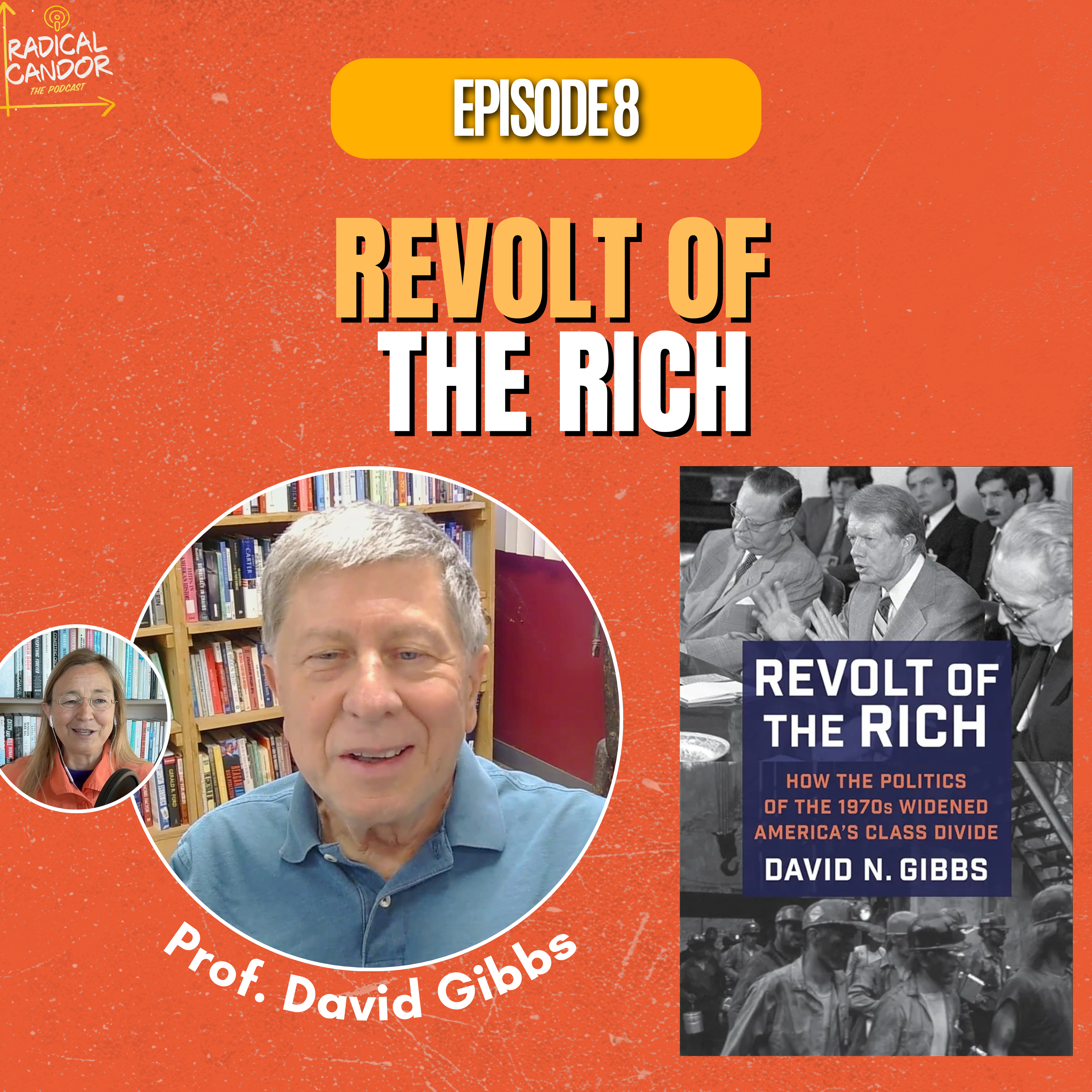
Table of Contents
Wealth concentration in the United States is top of mind these days. While it's tempting to see this as a recent trend, it's instructive to look at what was happening in American politics decades ago — and see how many of these forces were already set in motion in the 1970s.
On this episode of the Radical Candor Podcast, Kim talks with Prof. David Gibbs about his book Revolt of the Rich: How the Politics of the 1970s Widened America's Class Divide — and the Nixon and Carter administration decisions that still reverberate today.
Watch the episode:
During the first oil shock in the early 1970s, President Nixon actively worked to keep oil prices high to support the Shah of Iran and to prop up the dollar. The result was financialization and deindustrialization — a quiet, sustained shift in where economic power lived in the U.S. economy.
Later in the decade, President Carter was central to the trend of deregulation. The net effect of these decisions, Gibbs argues, was an erosion of the foundations of the American middle class — the part of the economy that had powered post-war prosperity.
Kim and David walk through the shift in economic power, the evolution of taxation, the rise of the Christian right and economic conservatism, and what alternatives — political and economic — are available now. The episode is a useful reminder that today's outcomes are downstream of choices, not inevitabilities.
Technical note: there was an issue with one of the microphones during this interview. Apologies for the audio quality.
[00:01] Kim Scott: Hello everybody. Welcome to the Radical Sabbatical podcast. This is Kim Scott. And while the Radical Candor team is thinking about management topics to talk about, I'm going to be talking to the authors of some of the books that I've read in the last year that have really influenced me. And I'm thrilled to have with me today, David Gibbs, who wrote the book, Revolt of the Rich.
How politics of the 1970s widened America's class divide. Welcome David.
[00:32] David N. Gibbs: Thank you for having me on,
[00:33] Kim Scott: Thank you so much for being here. I have been thinking a lot about your book for about a thousand reasons since I read it. ⁓ And in fact, I've come back to it a couple of times, but it's particularly top of mind for me right now, given ⁓ my last trip to the gas station. And given the anxiety that people are having about what the current...
⁓ administration is doing to the price of oil and what that is going to do to our economy. And one of the things that really surprised me that, mean, maybe everybody knew this except me, but when I read your book is during the oil crisis under Nixon, he actually wanted the price of oil to be high. Can you tell folks what he did and why he wanted the price of oil to be high?
[01:23] David N. Gibbs: you very much.
A little bit of background on this, the oil price is the first one. Again, in October 1973 coinciding with the Arab-Israeli war of that year. Israel and Iran keep on coming back and forth on this topic as it is today. That was the origin of the crisis. A series of mostly Arab countries led by Saudi Arabia used oil as a weapon to punish the United States for its support of Israel.
But then after a fairly short period of time, other, not just Arab, but Muslim countries and some non-Muslim ones too, actually saw the advantage. And just in terms of increased revenues, they didn't really care that much about the Arab-Israeli conflict. They didn't feel solidarity with the Palestinians, but they wanted to raise prices and make money. So there was a second phase of oil price increases. It took place fairly quickly. That was led by Iran. Iran did not have a bad relationship with Israel. They had an excellent, very intimate relationship with the United States.
[02:04] Kim Scott: Mm-hmm.
[02:26] David N. Gibbs: And Iran led the second phase of oil price increases. And that led to, communicatively, about a 400 % increase in oil prices in a matter of months, which devastated the economy, the United States, and much of the world economy. It's very striking, first of all, just the extent of the damage it did. It was the deepest recession, the 73 to 75 recession, which was triggered by the oil crisis, was the deepest recession since the 1930s up to that point.
And it led to reduced economic performance for about a decade. And in some respects, you could say it had lingering effects. If you look at world data on GDP growth in the World Bank, it was very high in 50s and 60s until 1973, when it dived. And it never fully recovered. The growth rates since then, ever since then, for 50 years, have never recovered those happy decades of the 50s and 60s. Now, how much the oil price has had to do with that is hard to say, but
[03:09] Kim Scott: Yes.
[03:21] David N. Gibbs: The remarkable detail is that it coincided almost exactly with the oil crisis itself. The oil crisis had something to do with long-term decline in growth. so there was a big deal. And I think we should all be extremely worried about what's going on with the Perkins-Bell fight now on account of the historical record. We can get to that in a moment. But I do want to note here is Richard Nixon we now know from private papers. On the one hand, he expressed great anxiety about the oil crisis. And he was very worried about the oil crisis. It was presented.
[03:27] Kim Scott: Yes.
Yeah, publicly.
[03:51] David N. Gibbs: publicly and it was publicly presented by journalists, academics, enemies of Nixon, everybody as being just bad luck. Nixon had bad luck with design algorithms. We now know is Nixon encouraged the oil price increase and played probably a critical role in making it possible. And I say this because I've been through a lot of the private documents and archives from this period. And that is clearly what the record shows in the sense that the United States
[03:58] Kim Scott: Yeah. Yeah.
Mm-hmm.
[04:19] David N. Gibbs: Communicated and it's communicated directly with the Iranian ambassador. It was our issue and so here to you in 1971 and so you can raise a lot of prices as much as you want. And basically.
[04:25] Kim Scott: Mm-hmm.
Can we
just pause on that? Like, did he not understand that this was going to lead to a recession and to deindustrialization or did he not care? what was his? Yeah. Yeah.
[04:39] David N. Gibbs: I guess.
What was the motive? That's the key. That's the $64,000 question. Let me just
for one second, let me hold off on that question. Like, first of all, I'll give you the facts and then I'll interpret the facts. So a bit more of the facts is that once the crisis occurred, Saudi Arabia seems to have had a political shakeup and a different faction of the royal family came to the fore and they wanted to repair the damaging relationship with United States. And it was imposed quietly by the oil minister, Ahmad Zalqaianani.
[04:48] Kim Scott: Okay.
Okay, the facts, yes.
[05:11] David N. Gibbs: that Saudi Arabia would work with the United States to lower the price of it. And the United States refused. I emphasize that the United States refused. And Yamani was an express astonishment. I saw a letter read all over. That's right. He couldn't believe it. That's right. I should have the Treasury Secretary, William Simon, who reposed this whole policy in the shop as well. But nevertheless, that's what Nixon did. And he stopped by it and kissed him through a tooth, and he was instrumental in that. Now the question is why? And the answer is,
[05:21] Kim Scott: He was shocked. Yeah. Why do you want to pay more for our oil than you need to?
[05:40] David N. Gibbs: The Shah was one of America's most important allies, almost as important as Israel. And he was a close personal friend of many top policy makers, including Henry Kissinger, himself. Iran had been designated as the guardian of the American and Western interests of the Gulf region. Britain had pulled out the military forces after 1968, and before that, after Vietnam, the United States couldn't politically or financially afford to insert military forces into the Gulf. And so to protect the Gulf,
[05:44] Kim Scott: Mm-hmm.
Mm-hmm.
[06:09] David N. Gibbs: we relied upon the Shah. And the Shah had to buy weapons to do this and to buy weapons, have to increase oil prices. And that was okay with Nixon. Plus he bought the weapons from American suppliers, were hurting because of the Vietnam War. Vietnam had tainted. Losing a war damages your credibility. This was losing a war in Vietnam. And weapons sales were down globally. And the Shah was promising to buy huge quantities of US weapons. Nixon appreciated that, did the weapons manufacturers. Furthermore,
[06:27] Kim Scott: Yes. Yes.
[06:39] David N. Gibbs: The Iranian embassy in Washington was very clever. They went around distributing expensive gifts to hundreds of very prominent journalists all over Washington. And like $1,000 tins of caviar and other things as well, people like Barbara Walters and others, people you've heard of. And they produced fawning coverage, not just positive fawning coverage of the Shah. I mean, it's definitely throughout the United States media. If you want to read critical articles about the Shah and let you read
[06:47] Kim Scott: gosh. Like what were they giving caviar and.
Yes.
[07:08] David N. Gibbs: You can't, said, the French press in particular, you have articles that discusses the use of torture and that kind of thing. You really couldn't find that much in the United Press, or in a certain sense of the term, bought off. All right. And it.
[07:12] Kim Scott: Yeah.
Yes. And so what was the
Shaw doing to his own people? I think that's also worth.
[07:24] David N. Gibbs: Well, let's look at more. mean, to that, oil companies, the top seven oil companies, the seven systems that both five were American-owned, they had huge surging profits. So they supported these two. The Rockefeller family had been socially very friendly with the Shah and the Shah, know, so the Rockefellers of course, all of their influence was considerable. So it was this broad coalition of interests, all right, who favored high oil prices. Even that was devastatingly common. And the Shah...
[07:32] Kim Scott: Mm-hmm.
Mm-hmm.
Mm-hmm.
Yeah. So, so
the weapons manufacturers, the oil companies, also Wall Street, the Rockefeller family. Yeah. Yeah.
[07:56] David N. Gibbs: oil companies, the Rockefeller family. That's a big one. So there are
others too. I mean, there's a whole range of interests that investing. I have a letter from US ambassador to Iran business that there's a tremendous amount of investment coming out of the United States and Iran right now is just a wonderful thing. And so this one's for certain segments of business. The oil price increase was a huge advantage.
[08:24] Kim Scott: Yeah.
[08:24] David N. Gibbs: And so
there were pressures on Nixon in favor of high oil prices that represented a tiny segment of the American society and everyone else's footprint. That's right. The American economy overall was devastated by this effect. so that's really is remarkable that this policy was pursued and that Nixon stuck to it even after it was causing the damage, but he did. He did. so The Shah you want some information on the Shah?
[08:32] Kim Scott: Yeah, end of the American economy, frankly.
Mm-hmm.
Yeah, but I
but before we jump into the Shah and what he was doing to his own people, ⁓ what about Wall Street? What was what? Because there was that was also part of what was going on, right?
[09:01] David N. Gibbs: OK, well,
following up on this, what this gets a little bit complicated, the United States at this point was during to bring the Nixon presidency from being a net accredited nation, a net debtor country. had a deficit, structural deficit on our trade balance. Another review, importing, mooring, and exporting. That was new for the United States. We hadn't had that in almost a century. That happened under Nixon.
[09:16] Kim Scott: Mm-hmm.
Mm-hmm.
Right. Right.
[09:27] David N. Gibbs: And it remained prolonged. we still are. We have a structural deficit that just got worse over time. question is, how does the United States remain a superpower, running the world's top currency, in the world's currency, with hundreds of overseas bases? If it seems to be going the way Britain went when it began declining as a superpower, how do you compensate for that? And the answer was petrodollars. You see, countries like Saudi Arabia, with all the major oil explorers,
[09:33] Kim Scott: Right.
Right. Right.
[09:55] David N. Gibbs: This huge surplus of petrodollar, oil was priced in dollars then as today. And obviously they had this huge surplus of dollars that they didn't know what to do with it was sitting in bank accounts or in an interest. And so in 1974, the US Treasury secretary flew to Jeddah, Saudi Arabia and kind of deal with the Saudis. And the deal was the United States would give the political back into Saudi Arabia and bring arms sales. And they would give Saudi Arabia co-equal status for the Iran and the Gulf.
and encourage Saudi Arabia to become kind of a regional power to lean all over the Gulf and in Africa as well for cooperation with the United States. In exchange, the Saudis would use their petrol dollars to buy US Treasury bonds and therefore finance the US debt on a long-term basis. And they would use their influence with the smaller Gulf states like the UAE and Qatar and Bahrain to do the same thing. And this sent a signal all over the world, the dollar, that the Treasury bonds are a safe haven and they're all over the world.
people began buying those treasury bonds. And it's system that prevails to this day. When the US remains the deficit country, it continues to have a growing and growing deficit, which we never have to correct because foreign countries and international private sector address finance the debt by purchasing those treasury bonds. That's how it's been working. And so the advantage was the United States remained ⁓ not only a global military power, but a global economic power. It's enormous.
[11:21] Kim Scott: Not necessarily
economic, but financial power.
[11:24] David N. Gibbs: Well, that's right. Financial power, that basically the dollar would remain the top currency. United States would retain its influence in organizations like the IMF and the little bank. And also we think it was the sanctions weapon, just country with devastating consequences and tremendous impact. And all of that was made possible by this deal, cut with the Saudis. What it meant also though, is that there were large quantities of foreign money, foreign cash flowing into the US economy.
[11:28] Kim Scott: Yes.
[11:52] David N. Gibbs: And that helped to drive financialization. There are other factors at work too, which I won't go into, but financialization began exploding during this period of foreign money being imploring into the US economy. And there was just lots of more money for bankers to play with, shall we say, and of supercharge to financial sector. But that meant is finance as a sector, which had been weak since the Great Depression. It's very interesting to note that the stock market never recovered its 1929 level until 1951.
took that long, because the stock market crash was so devastating. And finance was heavily regulated and viewed somewhat dimly in policy circles because it was associated with depression. That all changed in the 70s, and finance took off in the 70s. And the bottom line is it changed the whole character of the economy as increasingly with low rates of profit in industry and manufacturing and
[12:26] Kim Scott: Right.
[12:47] David N. Gibbs: the opportunity for a quick buck in finance and increasingly more and more money flowing out of industry and into finance. And the beautiful thing about finance, the beauty of it was balance. You see, if you engage in speculative behavior, lot of this was speculative bubbles, one bubble after another. If you engage in speculative behavior and the speculation goes badly, if you're big enough, if you're too big to fail, the government will bail you out with public money. That happened already and that began to happen.
[13:01] Kim Scott: Yeah. Yeah. Yeah.
[13:15] David N. Gibbs: first in 1974 and happened again and again and again and And word got out that you've engaged in financial speculation with some degree of safety because they don't rebound you out. This is ironic because the whole idea here was free markets, but it wasn't really free markets. It wasn't free at all. Exactly. And also what it meant basically is deindustrialization because as finance ascended and industry declined, there was a relationship here. More and more money flowing out of industry into finance.
[13:25] Kim Scott: Yeah.
Yeah, it wasn't free. was was basically workers paying for bankers.
[13:47] David N. Gibbs: because profitability opportunities were greater with finance, partly due to the rise of petrodollars. There are other things that could have been done. mean, the United States basically could have favored industry, have devalued the dollar and encouraged exports, but that wasn't done. Instead, finance was favored. And the people making the policy mostly attached to the financial industry. William Seidman, the Treasury secretary, is the one who engineered this deal, and he was former president of Salomon.
[13:53] Kim Scott: Mm-hmm. Mm-hmm.
Mm-hmm.
[14:14] David N. Gibbs: He was a lifelong investment banker. And his whole perspective as banker, he was quite natural in terms of finance. ⁓
[14:20] Kim Scott: Right. Cause that was where he had made his career. Those were the people he knew.
So let's kind of take a step back and take a look at what this whole process did to the ordinary people in Iran and to the ordinary people in the United States. You had the bankers, you had a few oil executives, and you had a few executives from, the military industrial complex.
[14:26] David N. Gibbs: Thank you.
[14:50] Kim Scott: exerting pressure on Nixon to allow the price of oil to go up. What was the net result for the people of Iran and for the people of the United States?
[15:01] David N. Gibbs: Well, I'm an American citizen. assume you are too. Give me a guide and then we'll get through. Well, America first is my motto. And yes, the as far as the United States goes, and well, first of all, the mid decade recession is devastating work, lowered living standards, spiked unemployment, not only but under unemployment. People who's, you know, that's never taken from counting the data is typically in one session, not only do you get people lose their jobs, people don't lose their jobs and get lowered hours.
[15:04] Kim Scott: Yes. Okay.
Ha!
Yeah.
Yes.
[15:31] David N. Gibbs: or lower
wages, that happens all the time, the larger scale. That happens massively in the seventies. And that was totally connected to the oil crisis that I've just described. Furthermore, was another thing too, which is that basically, because inflation was associated with all of this, basically, there were a lot of pressures to engage in anti-inflation and the anti-inflation policies, which really took a while, they didn't fully activate until the end of the decade. But to preserve,
[15:34] Kim Scott: Yeah. Yes.
[16:00] David N. Gibbs: To lower inflation and also to preserve the value of the dollars at the level of currency, the standard remedy is to increase unemployment. It's called austerity, that's the term. It's done mostly through the Federal Reserve. The Federal Reserve raises interest rates, which they did to address colony levels by the end of the decade. Interest rates will raise so much by the end of the decade that German Chancellor Helmut Schmidt said, global interest rates are higher than they've been since the birth of Christ, that's what said.
[16:10] Kim Scott: Yes.
my
gosh. Yeah.
[16:28] David N. Gibbs: long time in the long memory.
I personally can't remember back to the birth of Christ, but I guess he did. In any case, and as a result of very high interest rates, it had the predictable effect and intended effect of driving down living standards. The whole idea is if prices are too high, whether it's because of oil or whatever reason, the standard remedy is you drive down living standards, force people to consume less by making them poor.
[16:32] Kim Scott: Ha!
[16:57] David N. Gibbs: You know, that's that basically will cure inflation. I should add, by the way, the cure was much worse than the disease. Inflation didn't go down by the 80s, but wages never were real. Yeah, prices were lower, but your wages were too much lower and they never recovered. know, average male wage was lower in 2017 than it been in 1970. And so there was a permanent resetting of wages at a lower level as a result of this. And one of this flow from the oil prices.
[17:06] Kim Scott: Yeah, yeah.
Yes, yeah, yeah.
[17:26] David N. Gibbs: Because inflation, wasn't all fuel, but it was mostly oil. Oil prices surged, and the cause of oil prices surged. There were pressures for austerity. There were demands to have the standard remedy, which was austerity, higher unemployment. It was done. And so there was an enormous price pay by the average American for the oil crisis. That's not all of what was going on here, but that was a very big part of what was going on.
[17:30] Kim Scott: Yeah.
Yeah, I mean, and it's also interesting. One of the points you made in your book, think, is that inflation tends to hurt people who have money more than people who don't have money, it, you know, so inflation hurts the rich. And so basically the rich didn't, this is the title of your book, which is so good, The Revolt of the Rich. The rich didn't like having their money be devalued. And so they told everybody else, you've got to,
[18:01] David N. Gibbs: Good.
[18:20] Kim Scott: you know, tighten your belt and eat less and ⁓ have less.
[18:24] David N. Gibbs: Although the detail on that
is that the inflation in the 70s was different from inflation now in the sense that we still had unions back there, reasonably strong ones, 25 % humanized rate of force in 1970. And they did have some influence on a wage level, overall wage levels. And so what that meant basically is what was called the wage price spiral is as prices went up, typically wages went up, not in middle of the recession, but after the recession, before the recession,
[18:32] Kim Scott: Yes.
Mm-hmm.
[18:53] David N. Gibbs: wages tended to go up mostly in tandem with prices and you do not really
[18:59] Kim Scott: As long as you add unions, pushing that to happen.
[19:01] David N. Gibbs: That's right. Wages did not.
Well, that's right. And we don't have that now. So inflation has a very different impact. But then basically, wages did go up to some degree. Also, Social Security was indexed to inflation. The people who are most hurt by inflation were actually the very rich, believe it or not. It's hard to believe that it's true. And the reason is it's very hard to preserve the value of accumulated wealth, real value, in times of inflation. The stock market, for example, did not do very well.
[19:14] Kim Scott: Mm-hmm.
Yeah.
Excuse
me.
[19:32] David N. Gibbs: standard investments did play during the 1970s. And that combined with low rates of profit rate of profit in the seventies with the lowest I believe in the 20th century. And then the combination of inflation and low rates of profit caused the very wealthy to organize in a way they'd never organized before in a massive scale and to pour money into politics. And the brains behind this were people like Milton Friedman and Friedrich Schwarz-Hajek.
[19:33] Kim Scott: Mm-hmm.
Yeah.
Mm-hmm.
Yes.
[20:01] David N. Gibbs: who were not only talented economists, but they were also political operators and they had enormous corporate power. For example, Milton Friedman's book, Capitalism and Freedom, which I read at age 17, that was, it was actually a very well written book. And I remember at 17, I was impressed by it, but I did not know, was that the fund of relations for Martin Luther was paid to generate sales in this book, became a best seller. I thought, I'll let my book of I Hill and Milton behind me, I'd be a best seller too.
[20:14] Kim Scott: Yeah.
Yeah, yeah,
if somebody buys a hundred thousand copies of your book, it's a best seller. Surprise, surprise.
[20:32] David N. Gibbs: That's right. right. And so,
so it wasn't just talent. Talent is never enough. You also have the financial backing and Friedman had that. Friedman had that big time. ⁓ And so I think basically what you had here was also a general push by the very rich to redistribute wealth upwards. The bottom line is this. The economy, the US economy was ⁓ sick during the 1970s. It was running a temperature. Inflation was the main indicator of that temperature.
[20:39] Kim Scott: Yeah. Yeah.
[21:02] David N. Gibbs: And if look at rates of productivity, the best education. Of economic health, they basically flattened. Right? And so the question is, somebody has to pay. And so the rich basically said to each other, if anybody has to pay it better not be us. Okay. And so shift the burden onto someone else that someone else was the working classes. All right. And that's exactly how it was done. That's exactly how it was done by the end of the decade. You want a full.
[21:09] Kim Scott: Mm-hmm.
Yeah.
[21:30] David N. Gibbs: Well, certainly our financialization, as I've described it, which immediately wiped out industry, also wiped out unions because as industry goes, unions grow.
[21:32] Kim Scott: Yeah.
Yeah, financialization
was deindustrialization, deunionization. mean, that was the net. Yeah.
[21:40] David N. Gibbs: That's exactly what was. That's
why there was very close correlation there. And in addition to that, you had austerity and privatization taking place. And ⁓ deregulation in particular, I mean, I have to say deregulation, in theory deregulation can work well in that there weren't any deregulations that did impede productivity, ⁓ that basically reduced competition and impede productivity. And if we're done correctly,
[21:48] Kim Scott: Mm-hmm.
[22:09] David N. Gibbs: But it could have produced positive results. were two problems here. Well, under Carter deregulation, there's Carter who did deregulation.
[22:17] Kim Scott: Yeah, this is, let's pause here on this, cause this is really interesting. ⁓ this is another thing I didn't know. Like Carter actually kind of outdozed Doge. was some correct. Yeah. Yes. but he, there was, I'm going to get the facts wrong so you can correct me. But, but one of his campaign and one of his campaign promises was that the, the U S government had.
know, 2000 federal bodies and I'm going to reduce it to three or something. That was really shocking. What was that about?
[22:49] David N. Gibbs: Excellent.
Well, you I promised that he would consolidate government departments in a way that would save overhead and reduce your efficiency and to have done that in Georgia. You don't really do that, but what he did do was deregulation. He wasn't free. Carl was a conservative. We've always was an economic assembly. He came from a right.
[23:04] Kim Scott: Yeah.
Yeah. And not really
supportive of unions either.
[23:11] David N. Gibbs: He came from a white work state and the South was basically human free. He had no conception of meaning, it's the importance of meaning. And he was a small businessman, essentially, a relatively wealthy one. came from a small town, but he was not poor. And I think he saw himself as an economic technocrat, which it's not even illogical, but his ideology, as it turned out, was to redistribute wealth upwards. I'm not sure he saw it that way, but that certainly was the effect. And one of the ways it was deregulation, now, as I said, deregulation in theory.
[23:13] Kim Scott: Yeah.
Yeah.
Yeah, yeah.
[23:41] David N. Gibbs: could have been useful and that there weren't NGO regulations that did impede productivity and it could have been done in a way that would have been useful. But I think the regulation was largely a Plutarch, it's a lower wage, that was the name. In other words, that's what happened and I think that's what was intended by the people who supported it.
[23:55] Kim Scott: Yes.
Well, there were the trucker, there were a lot of truckers who refused to deliver goods, right? There were these trucker. ⁓
[24:09] David N. Gibbs: Well, there were splits in the trucking industry. So the problem is
the team steered really was very corrupt. a lot of the writing file were rightly elevated from the corruption of the team steered people. And they also were alienated from the fact that wages weren't going up in this, weren't going down in but they were mostly flat. They weren't going up either. And workers have been used to the idea of wages going up. had been the American scandal, an American birthright almost. And that wasn't happening in the 70s. And so I think they turned to...
[24:14] Kim Scott: Yeah.
Yeah, no, yeah. Right.
[24:37] David N. Gibbs: Bottom line is that nobody was offering any good alternatives. The economics profession was totally becoming very much free market oriented. There wasn't really that interest in the workers anymore. And the political left at that point, if you can go into this more, was becoming very interested in identity politics, gender, race, sexuality issues. I know in some young people, well, there was that, think, in terms of the mass movements of this era, they were non-economic and phobias. In other words,
[24:39] Kim Scott: Yeah.
And they're also like the Watergate babies, you know.
[25:03] David N. Gibbs: People who focused on women's rights have focused on women's rights narrowly, not in terms of women have to pay the credit card, they have to pay the rent, but in terms of abortion, in terms of the women's rights for abortion, I'm not saying that's not important to do, but women also have to pay the Well, I'm sure it is. And all women feel that way in writing, so men too. But the point is, women also have to pay the rent. And there was no framework conception of that. It's kind of amazing.
[25:16] Kim Scott: Very important to me.
Yeah.
Yeah, yeah,
yeah. I think that that's the other thing that I really sorry to interrupt, that really struck me as I was reading your book is that we from an economic point of view, from a you know, what happens to the average American, we really have one party. And for a while, we had we had, you know, both the Democrats and Republicans were pretty progressive. ⁓ FDR, Ike, Ike was arguably like, what was the tax rate?
[25:53] David N. Gibbs: That's right.
[25:57] Kim Scott: What was the?
[25:58] David N. Gibbs: I was a diehard communist clearly. nominal tax rate for the top rapidly was 91 % in Eisenhower. Eisenhower's most important contribution to domestic history, fun policy aside, is that he ratified the New Deal. He basically got the Republican Party on board with the New Deal. And part of that, mostly until Nixon,
[26:01] Kim Scott: You
Yeah. Yeah.
for a while until Nixon came along.
[26:27] David N. Gibbs: Until Nixon quietly and then gradually much more publicly. The public party jettisoned the new deal. the Eisenhower. You know, remember Alexandria of cause of Cortez proposed a 70 % bracket. And she was accused of being a radical socialist. I just thought they must be a communist by the standard. That's why I should have these were nominal rates. The real rates give the good policies always lower.
[26:35] Kim Scott: Yeah.
Yeah, yeah. Yeah, he was he was 91 not 70. Yeah.
[26:57] David N. Gibbs: Taxation was very progressive in the 50s. It did tax the rich more than the poor. And you can see if you look at the data on the distribution of income and wealth narrowed considerably during this period. And so it had a real impact. so anyway, it sounds like we want to ask a question.
[26:59] Kim Scott: Yes.
Mm Yeah.
Yeah, yeah.
I do. so basically, I mean, and again, tend to overstate things for clarity. So correct me if there's more nuance to this, but basically once, once Nixon and Carter came along, not only did the Republican party sort of give up on the new deal, the Democratic party gave up on the new deal too. mean, and that's what is, ⁓ I don't know how I got to.
[27:36] David N. Gibbs: Yes, that is right.
[27:44] Kim Scott: be 60 years old and not know that, not understand that. But it was really revelatory for me. Like what happened to the, I mean, it's not surprising that the Republican party did, but what happened to the, why did the, why did Carter give up on unions on, you know, why did he tell the workers of the U S we need to tighten our belt instead of fight these high oil prices and fight financialization? Like what happened to us?
[28:12] David N. Gibbs: It was the ideology of Milton Friedman and that took hold across the whole economics profession to increase and agree and across the policy level and he said it was funded very heavily, very powerfully by big money, really big money. That's one of my central points here is why it was acting very strategically and I at the private papers of a lot of what I did for research, I went to private papers of wealthy individuals and looked at what they were saying privately to each other.
[28:17] Kim Scott: Mm-hmm.
Mm-hmm.
So there was a strategy there, a big money strategy.
Yes.
Mm-hmm.
[28:42] David N. Gibbs: And there
was a certain sense, and it's being figuratively here, but I'm sure it happened a little bit, that they would go into a room, act almost like a Marxist caricature or something. They would go into a room, close the door, they'd hand out the cigars, hand out some of the brandy, maybe tell a few dirty jokes to break the eyes of little men in those days. And then they started plotting strategy. And there was a certain sense, the top figures, the people who were orchestrating this were like generals planning a military offensive. It was that carefully done.
[29:10] Kim Scott: Yeah.
[29:11] David N. Gibbs: It was done with great care and skill.
[29:13] Kim Scott: And who were
the main characters? Who were these cigar smoking, brandy swilling?
[29:16] David N. Gibbs: Well, a number of people, there's somebody called
Paul Wehrich who helped. He was a political activist, heavily funded by the Scaife family, Richard Mellon Scaife of the Mellon Fortunes, heavily funded by Scaife. And he was the, I'd say the most brilliant mind into his political strategy during this period. And what he said is that he was in the war and he thought of the idea of forging a line between economic conservatives
[29:24] Kim Scott: Mm-hmm.
Mm-hmm.
[29:45] David N. Gibbs: and social conservatives and evangelicals. The United States is a very religious country, but it's always been a religious country. have periodic upsurges of the evangelicals and Christianity, and 70s is one of those upsurges. Fourth Great Awakening was quantum setup. Reactions of the 1960s and all the shocking things of the 1960s. It is remarkable the cultural changes that in the 60s have fastly occurred. A lot of people were shocked, and the evangelical Christianity was the response. And it was a huge number of people there. We're talking big.
[29:50] Kim Scott: Mm-hmm.
Yes.
Mm-hmm.
Yes.
[30:13] David N. Gibbs: Also, Christian Zionism became very popular.
[30:16] Kim Scott: You know, yes, I grew
up as a Christian scientist, actually. Are you mean, yes, Christian Zionism, yes. I was gonna say Christian science is a pretty small religion.
[30:21] David N. Gibbs: Well, Zionists, Zionists, Christian Zionists, yeah, I'm talking about, yeah,
well, Christian support for Israel, guess, and it also came up in this group. And so, Weyrich had this idea of coalitions, called the fusionism, and the idea is basically of economic conservatives, that's big business basically in the welfare, and want basically deregulation and redistribution of wealth upwards, and on
[30:32] Kim Scott: Yes. Yes.
Yeah, yeah.
[30:47] David N. Gibbs: Then you have social concern as you want to anti-abortion and against immorality as they define it and all those things against the most of the speaking sex and drugs and lacking of all show, say. finally, you had militarists who wanted greatly increased military spending because military spending is low after Vietnam. forget that. But Nixon actually reduced the military budget and there was a big movement to increase it. And so you bring in militarists and also the pro-Israel faction.
[30:51] Kim Scott: Mm-hmm.
Yeah.
Mm-hmm.
Right. Again, yeah.
[31:17] David N. Gibbs: You know, basically Israel Robin's brought into this as well. And so that was the image that was projected by Weirich and he was very instrumental about it. listen to him discuss it, he's been interviewed. He's very clever and he said that, you know, we tried going into middle class or working class neighborhoods and talk about cutting business taxes and people hated it. Didn't work at all. And so we pivoted it. We corrected our mistakes. That's very impressive, by the way, the right correctness mistakes. The right correctness mistakes.
[31:23] Kim Scott: Mm-hmm.
Yes.
[31:46] David N. Gibbs: And he said, so we didn't do that. We realized what really sells in those communities was morality. OK, that's that's the ticket. And so that's when they got the idea of the Christian right. And they began pouring money into evangelical preachers and a forging relationship with evangelical preachers, producing an unbeatable carnation. didn't happen until then. I think maybe the mid 70s. Most of the evangelicals were relatively political, not completely. There's a small Christian right, but it wasn't anything on the scale.
[31:52] Kim Scott: Mm-hmm.
Yeah.
[32:15] David N. Gibbs: What occurred and Wayne Rich set up the idea of this big, very good tent. The idea was get a majority and then take power and implement our program. That's exactly what he did. And it wasn't just in the Republican Party. Well, evangelicals, the social issues, mostly that was the Republicans, but the economic conservatism that affected both parties. And I think what the Democrats did is for the most part, they moved left on social issues, things like abortion rights, gay rights.
[32:25] Kim Scott: Yeah, yeah. was, was a...
[32:43] David N. Gibbs: But they completely moved right on economic issues because most of their left activists didn't care about economics. increasingly what I would call there's a French economist Thomas Piketty, who referred to the left. You might call it less politely a snob left or a posh left. All right. I have to say that. mean, that my background is on the political left. They don't say that lightly. It is true. If you look at who goes to these meetings, and that's been true since the 70s, it's people with advanced degrees in high incomes. OK.
[32:46] Kim Scott: Yeah.
Yeah.
Yes.
Yes.
[33:12] David N. Gibbs: And that's not what it used to be. That's what it became in the 70s. And people in that kind of category don't have to worry about paying the electric bills and so. and so there's no conception of economics and so they lost visions of economics.
[33:22] Kim Scott: Yeah, it doesn't matter how much the grocery bill is really. Yeah.
And they also were raising,
sorry to interrupt, but they were raising a lot of money from Wall Street too. They got very close to Wall Street.
[33:38] David N. Gibbs: Well, foundations private foundations, we find that increasingly we are moving into these social issues. And I think one of the reasons they did is the very rich don't really care that much about these things. All right. They have no problem with gay rights, except for this go probably have the billionaires. It's not a problem at all. And so.
[33:42] Kim Scott: Yes.
Mm-hmm.
Yeah.
And people on the right don't care, even though half of them may be gay too, they're not gonna get in trouble, right? Their money can ⁓ insulate them from the lack of rights that the rest of the people have.
[34:09] David N. Gibbs: you
Well, see rich farms and expansion of rights of the rich. mean, we had, was very impressed by the fact that there was a certain sense of victimization by the very wealthy in the early seventies. And they're literally talking privately about themselves like the persecuted minorities that were often the most persecuted minorities. I'm just a set. So, know, I'm not sure which figure it's, it's a little bit entertaining to read these things, obviously. And the extraordinary lack of self
[34:25] Kim Scott: Yes.
Yeah.
[34:41] David N. Gibbs: irony perhaps, with these people lack of a sense of humor maybe, but that is how they felt about it. And so they wanted to redistribute wealth in a way that would benefit them. They had the means to do that because they had ready reserves of money they could invest in politics, they did invest in politics. They're very clever.
[34:42] Kim Scott: Yeah.
Also in PR, sorry I keep interrupting you, but also in PR. They were very smart on figuring out what their messaging was. ⁓ Orwell wrote a book called All Art is Propaganda. They were better on the propaganda side than...
[35:01] David N. Gibbs: Yeah, sure.
They were excellent. They had
very clever people in front of them. And I must say, I came up with a certain sense of begrudging respect on the skill of the people on the right. They're so much better at this than anybody on the left. It's very disciplined. That's right. Also, there is a certain sense, again, of strategic thinking. When I was a child, I played chess a lot. have the conception of chess as a strategic game. And these people played politics like a chess player.
[35:27] Kim Scott: Yes, discipline.
Mm-hmm.
[35:42] David N. Gibbs: and thought about their wounds and veras.
[35:45] Kim Scott: Yeah, yeah, yeah, they sure did. So let's, let's pivot a little bit now and talk about most of the radical canner podcast listeners are managing teams throughout the economy. And one of the things folks are stressed about is how do you manage it? Like how do you deal with this sense of uncertainty ⁓ in the economy as you're trying to manage a team through?
turbulent times. So one of the questions I have for you is, what should people be thinking about when they go to the gas station? And what should they be thinking about when they're doing some planning for the business? What are the implications for the situation that people find themselves in today?
[36:36] David N. Gibbs: Well, I'm assuming that this based on the historical record, going to see, first of all, we already see right before our very eyes, a very big surge in gas-solding prices. And that's only the beginning. And every reason is not going to anytime soon. Even if war ends tomorrow, it'll take months at least for things to turn out. Next phase will be food prices. Because food agriculture is one of the most energy-dependent sectors. Fertilizers are mostly petroleum-based. And a lot of them come directly from the British Gulf. So there'll be a big surge of food prices.
[36:47] Kim Scott: Mm-hmm.
Yeah.
Yeah.
Mm-hmm. Mm-hmm.
[37:06] David N. Gibbs: And after that, probably a major economic downturn, there's a possibly an AI bubble. There's deregulation of finance, which means possible financial crashes with very high levels of household debt, much higher than in the 70s. Not as high as they were at the time of the 2008 crash, but way higher than the 70s. And all of that bodes poorly for the way the economy is going. So basically, ⁓ any kind of it
[37:27] Kim Scott: Yeah.
[37:35] David N. Gibbs: I was talking to my son today that we should plan financially with certain prudence and hold reserves because people are going to need reserves. Those who can have them, I know most of the people with paycheck to paycheck and they're going to really suffer. But those of us who are beneficial or have benefited reserves, we should build those reserves as much as possible and be very prudent financially.
in coming months and perhaps in coming years because it's going to be a ride. It's guaranteed to be a wild ride. The only question is how wild will it be? And nobody knows the answer to that question.
[38:06] Kim Scott: Yeah.
Yeah, yeah. What's your guess? What's your bet? How wild on a scale of one to 10? How wild is it going to be?
[38:17] David N. Gibbs: I would, I would, I would expect something probably like the mid decade recession of 1970s, which was very, very, very severe. And there's always the danger and I do emphasize this is always the historic danger. ⁓ Of something like the 30s, we should never rule that out completely. I think that's it's there are all sorts of barriers that prevent that, but none of these barriers.
[38:25] Kim Scott: Yeah.
Yeah.
[38:42] David N. Gibbs: complete, shell aside, and then all sorts of Bear in mind, this is not the first global shock we've seen. The first global shock was the war in Ukrainian mushroom, which had major economic impact, including on energy, especially for Europe and the United States as well. There's been all sorts of uncertainty, and business hates uncertainty. Investors hate uncertainty. It's bad for the economy, private sector economy, investment in the mostly private sector, and people don't like to invest in times of uncertainty.
[38:44] Kim Scott: Yeah.
Yes. Yeah.
[39:09] David N. Gibbs: Multiple rewards are not good for the climate, for the business investment climate. In addition, there's a sense of uncertainty about American politics. Nobody knows American politics is going on. We don't have mass violence in this country. What's Trump going to do? Are the Democrats going to do anything respond to Trump? Nobody knows. And I think that sense of nobody knows. that basically we're in a new world here where the old rules don't apply so much.
[39:23] Kim Scott: Mm-hmm.
[39:36] David N. Gibbs: Is something I think investors are going to be very skimpy about that's going to be bad for the rate of investment and therefore bad for rate of economic growth. And all of that basically suggests again a very wild ride and all the question is how bad will we get and. We'll see.
[39:53] Kim Scott: Yeah. think one of the things that I find helpful at this moment in time is really thinking about building a team of people and making sure that the gap between the highest paid person and the lowest paid person is not too great. That we are, and also trying to the maximum extent possible not to depend on the financial markets, but to depend on real things that are really happening in the real world. ⁓ Because
because the
the class divide is very troubling. And as a probably left of left progressive, it really is, I think an economy does well when everyone can participate and thrive. Like that's what creates an innovative environment. ⁓ And so one of the things that I've been thinking about in terms of AI, for example, is
[40:49] David N. Gibbs: I agree.
[40:57] Kim Scott: Don't use AI to cut costs. Use AI to do new things that you could never have done before AI. And encourage the best ideas out of all different kinds of people in your organization. ⁓ And sort of create a micro counterbalance to this. But also, think, let's figure out how to plan for an economy that includes everyone. ⁓ Because we have done a bad job of that.
[41:25] David N. Gibbs: Well, that's true. mean, one of the things I do want to note is basically we paid a very high price for the enormous inequalities we've got essentially. Distribution of income and wealth is back to what it was pre New Deal All right, we have in a certain sense, argument worse. That's right. That's right. Yes.
[41:35] Kim Scott: It's worse maybe even. I think Musk
is the richest man that the United States ever had in terms of the percentage.
[41:43] David N. Gibbs: To my yes,
right. I think globally, if I'm not mistaken. so the concentration of all this really quite extraordinary that has a number of consequences. One of them is effective demand is going to be reduced to both the performance of people because people don't have enough money in their pockets to buy what's being produced. So there's that. Another one is it produces poverty and social problems associated with poverty that produces up. No, one of the most unhealthy things you can have in your life is stress associated with money.
[41:46] Kim Scott: Yeah.
Yeah.
[42:12] David N. Gibbs: is well established. And people are enormously stressed by not having enough money. We're not talking about a minority here, we're talking about a majority of the public are in that position. And the worst social problems, you get mental illness, you get crime, you get social breakdown. Enormous homeless in capitalism, including right in front of my house in Tucson, that has enormous costs, forget about morality, financial costs. You have children, basically, who are being damaged by having their parents at home.
[42:12] Kim Scott: Yeah.
Yeah.
Yes.
Yeah.
[42:41] David N. Gibbs: by being left alone for long periods of time, this produces intergenerational costs, financial costs to the economy. It's not good for the economy. I could say it's not very good in the moral sense either, but let's leave that out for the moment. And just know it's expensive. You don't really save anything by kind of social background.
[42:46] Kim Scott: Yes, yes, trauma. Yeah.
Yeah.
No, in fact, you
incur enormous expenses.
[43:04] David N. Gibbs: It
was a study, know, New York City was where the idea of austerity was first used almost as a laboratory experiment in 1975 and as a to the fiscal crisis of New York in 1975. And I focus on that in the book. One of the striking things, the ideas that they were encouraged to greatly reduce spending on social programs in New York. And irony is that there was a study by the Journal of Public Health on long term costs of cutting social programs vastly exceeded what was saved.
[43:14] Kim Scott: Mm-hmm.
Yeah.
Yeah.
[43:32] David N. Gibbs: They didn't
save a dime. They didn't save anything by cutting those programs. It cost them money. All right. And that's really the long term effects of allowing inequality to fester, allowing poverty to fester. There's no real long term benefit anyone from that. I suppose maybe for Elon Musk, and you can always fly out to your island, or Jeffrey Epstein, you can go out to your hideous island of the Caribbean or something. You always have that. I suppose maybe the top tier can be insulated. But you don't believe that, we need the very top tier.
[43:54] Kim Scott: Yeah.
Yeah,
[44:01] David N. Gibbs: Okay, everyone that's going to get priced.
[44:01] Kim Scott: but even yeah, even the top tier, mean, the Rockefellers were the people were constantly trying to kill them. Like you make yourself a target. ⁓ And who wants to live that way?
[44:10] David N. Gibbs: Well, that's true. Obviously, that's
true. Who wants to live that way legitimately ask that question and say, maybe the very wealthy Joseph Kennedy, who is not a very pleasant person, by the way, but he did say something very interesting is that he once said in terms of justified support for Franklin and Eleanor Roosevelt, he said, he basically said.
[44:16] Kim Scott: ⁓
[44:32] David N. Gibbs: That inequality was getting so bad that it was destabilizing, threatening political stability. He said something like, this isn't a direct quote, it's a paraphrase. If I could give up half of my fortune, which is very large, by the way, so I could live with the other half safely and securely, I would happily do that. And you can say that's a rational attitude. It's not an altruistic attitude. It's in his interest to do that. And Joseph Kennedy was smart enough to figure that out. ⁓
[44:45] Kim Scott: Yes.
Yeah.
Yeah. Yeah.
And I think for a long time, was the, like, I certainly have paid 51%, 52 % tax, right? My, like, and I've actually paid it, you know, I haven't had any loopholes. And what the problem is, like, I'm not a, I'm, you know, I'm not a billionaire. I'm doing fine. I'm not pleading poverty, but I'm certainly, you know, I own my house. That's it. That's, and I can, yeah, it's great. It's awesome.
[45:01] David N. Gibbs: Obviously they're going.
That's good, that's good.
Better than the outside is.
[45:30] Kim Scott: Yeah, yeah. But I'm happy to pay 52 % tax rate when I'm, you know, unfairly lucky. Like, I don't understand why the, as far as I'm concerned, there's an excellent ROI on that money.
[45:46] David N. Gibbs: Generally speaking, it's true. mean, obviously you can always there's no doubt there's always a certain amount of waste of fraud and mismanagement. It's always true. That's true of everything. And there's no question. private sector, we have some private sector, there's that massive mix of that. I suppose one area basically that is disturbing is the United States has become addicted to permanent war. It really is true. I think it is like a drug addiction almost. And we're seeing it play out right now in the Persian Gulf
[45:53] Kim Scott: Yeah. Well, it's also true of billionaire spending, by the way, there's a certain amount of waste like
Yeah.
[46:15] David N. Gibbs: It does not promote security. What's going on in the Gulf has nothing to do with security. It has insecurity and it's extremely expensive. And we're seeing how expensive it really is. And so I think basically ⁓ cutting back on the expenses, basically of what some have called the overseas market empire, the empire of business in some of the world. It's something that really needs to be looked at very carefully because again, that's a major source of inequality. The beneficiaries of this are weapons manufacturers.
[46:17] Kim Scott: No.
Yes. Yeah.
[46:44] David N. Gibbs: I know for the most part, and everyone else pays for it in a very negative way.
[46:47] Kim Scott: Yeah. Yeah. Yeah.
Well, David, I always learn so much from talking to you and I know our listeners will as well. Thank you so much for writing your book, Revolt of the Rich. I'll put this in the show notes. I encourage folks to buy it, read it, learn from it. Any final words of wisdom for people before we say goodbye?
[46:56] David N. Gibbs: Thank you.
Thank you.
Well, one thing they be on the guard for is new calls for austerity because with inflation surging, we'll now see another call to fight inflation through austerity, lowering living standards and increasing unemployment. Okay, that's exactly what happened at end of 1970s. I can almost guarantee from the calls for that now, people need to fight that. People need to fight that. All right. That is not a good solution. That lowers wages.
[47:35] Kim Scott: Yes.
[47:40] David N. Gibbs: Lower his wage is probably for good, okay? That's what happened in the 70s. so I think that basically we should be politically trying to oppose that.
[47:50] Kim Scott: Yes, and not only politically, a lot of our people make decisions about how much people get paid. Take a little bit about away from the people on your team who are getting paid the very most and give it to some of the people who are getting paid the very least. ⁓ This is in your power to do. And it's a good thing for those individuals. And if we all do it collectively, it's a good thing for the economy. All right. Thank you so much.
[47:53] David N. Gibbs: Thank
Thanks again, Dr. Bajay.
Prof. David Gibbs's book argues that key decisions of the 1970s — under both Nixon and Carter — set in motion the financialization, deindustrialization, and deregulation that widened America's class divide and shaped today's economy.
Nixon worked to keep oil prices high to prop up the dollar and the Shah of Iran. That decision accelerated financialization (more economic activity flowing through finance) and deindustrialization (manufacturing moving offshore), reshaping where opportunity lived.
Carter-era deregulation across transportation, energy, and finance unwound rules that had supported the middle class. Combined with later tax shifts, the effect was to move risk down the income distribution and reward up.
Because the structures put in place then — financialized markets, weakened labor, and a tax code increasingly favorable to capital — compound. The wealth gap of today is largely a 50-year-old story still unspooling.
Gibbs is skeptical of nostalgia for any single past era, but the book outlines policy choices — taxation, antitrust, labor protection — that historically have built more inclusive economies and could again.
Three ways to put this into practice.
While the podcast team takes a Radical Sabbatical, Kim Scott is interviewing the authors of the books that have had a big impact on her over the past...
Wealth inequality and the concentration of political power can feel like the unique problems of our era. But there are lessons to be learned from the...
While the podcast team is taking a Radical Sabbatical, Kim is interviewing authors of the books that have had a big impact on her over the past two...
Share your perspective
Leave a comment below.