 Kim Scott
Funny (Not Funny) — Giving Feedback About Nervous Laughter 5 | 19
On this episode of the Radical Candor podcast, Amy and Jason answer a listener's question about how to give feedback about nervous laughter. As you...
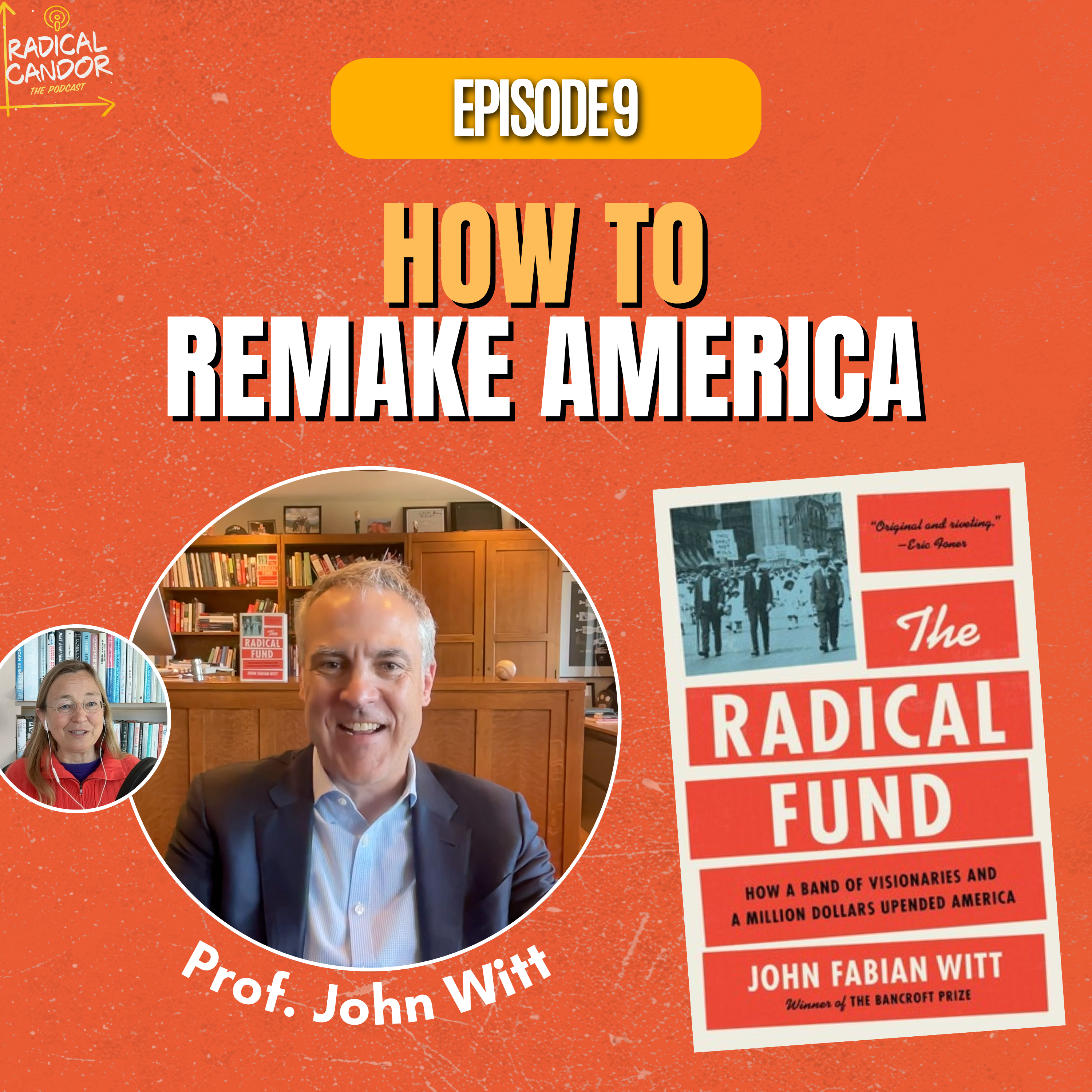
Table of Contents
Wealth inequality and the concentration of political power can feel like the unique problems of our era. But there are lessons to be learned from the past — sometimes from the most unlikely places.
On this episode of the Radical Candor Podcast, Kim talks with Yale Law School professor John Witt about his book The Radical Fund — the story of the Garland Fund, established by Charles Garland in the early 1920s, and how that one philanthropic experiment helped lay the foundation for some of the 20th century's most consequential civil rights, labor, and free speech wins.
Watch the episode:
The Garland Fund was a small, deliberate pool of capital that backed the legal and organizing work that eventually delivered safer working conditions, free speech protections, and equal rights. Kim and John walk through how those movements drove the economic successes of the mid-20th century — and why a million dollars, well placed, outperformed many funds many times its size.
The conversation explores Sidney Hillman's vision for industrial democracy, the evolution of worker participation in capitalism, and the collaboration between Black leaders like W.E.B. Du Bois and James Weldon Johnson and the white labor unions of the era. The throughline: solidarity across demographics didn't happen automatically — it was built.
Kim and John discuss what these lessons mean now — including the “Dead Hand” debate over how much control donors should have after they're gone, and the role of money and foundations in social justice work. The history is hopeful, but not comforting: the people who made these wins didn't think small.
[00:05] Kim Scott: Hello everybody and welcome to the Radical Sabbatical podcast where I Kim Scott am talking to the authors of the books I love. And one of the books that I love so, much is the Radical Fund written by John Witt and with me today is John Witt. Thank you so much for writing this book, John.
[00:30] John Witt: You're welcome, Kim. I didn't do it for you in particular, but I'm so glad to hear that you appreciated it.
[00:34] Kim Scott: ⁓ The thing, there are many
things I love about this book, but one of the things that left me with a sense of optimism is how similar and in fact, much worse things were in the twenties and thirties. And somehow people found a way to muddle through and, and to create a better world. So ⁓ that's what I love. What, what, prompted you to write this book? What, what, what love prompted you to write it?
[01:04] John Witt: It always is love that prompts you to write a book. I this thing took me more than a decade. ⁓ sure. And ⁓ so for me, ⁓ I feel like my lifetime, I was born in 1972. I feel like I watched the aspirations of an era of a civil rights movement and a labor movement that when I was born had accomplished things that just a generation before were unthinkable.
[01:06] Kim Scott: It does. there's no other, it's not money, that's for sure. ⁓
Mm-hmm.
Mm-hmm. Mm-hmm.
Yeah.
[01:32] John Witt: And my lifetime has been watching those things on the ropes in playing defense and stumbling. And this book is about a foundation that started a long time ago, the 1920s, a century ago. And what they did was they set in motion the kinds of things that formed the ideals of my childhood that have been in retreat ever since. And so this foundation launched Brown Against Board of Education.
[01:37] Kim Scott: Yes.
[02:00] John Witt: the most important and famous 20th century Supreme Court case, and also one, a case that many of my students, I teach here at Yale Law School, many of my students are disillusioned about. It did not desegregate America. It did in some dimensions, but we have tons of segregated, you see the point. And so I wanted to get at the...
[02:16] Kim Scott: Yeah.
[02:25] John Witt: at the origins of this project that meant so much to me growing up and that I, like so many other Americans, am watching in various forms of collapse and decay.
[02:36] Kim Scott: Yeah, it's horrifying, really. ⁓ And I think that's part of the reason that I wanted you to talk to the radical candor listeners is that so many people are coming to me and they're saying, in this world where everything I believed in seems to be up for grabs, all the things that I thought we all agreed on, we don't agree on anymore. ⁓
I'm worried that if I succeed, I may be part of the problem and not part of the solution. And the folks in your book offer such ⁓ an incredible example of how you can change the world with not a ton of resources and what a positive impact that these folks had. yeah, Brown v. Board of Education. mean, the list goes on. Scopes Monkey Trial.
[03:26] John Witt: No, no.
[03:32] Kim Scott: they funded a ⁓ lot of work ⁓ that we just can't imagine that one fund. So what were some of the other big accomplishments?
[03:46] John Witt: So,
yeah, that's a great way to just to get a sense of what this foundation was funding. It exists from 1922 to 1941. And some of the things that come into their purview are the earliest First Amendment free speech cases at the U.S. Supreme Court. I don't think Americans understand that free speech at the U.S. Supreme Court is an incredibly new thing.
[04:00] Kim Scott: Yeah.
Yeah, yeah, it's like after World War I.
[04:10] John Witt: Yeah,
arguably 1931 is the first time the US Supreme Court uses the First Amendment to protect a dissenting speaker. mean, 1931, the Bill of Rights is 1791. We get 140 years of no free speech in the courts. these people, because this foundation exists right alongside the early ACLU, American Civil Liberties Union. So they're working on free speech cases.
[04:22] Kim Scott: Yeah. ⁓
[04:34] John Witt: They are working on the Scopes Monkey case, which is a First Amendment free speech case for teachers. Civil rights cases like the Scottsboro Nine, a terrible, essentially lynching by a judge ⁓ in Scottsboro, Alabama.
[04:40] Kim Scott: Yes.
Yeah.
[04:49] John Witt: in the early 1930s and the decades-long defense that gets initiated in the 30s is launched by this found paid for by this foundation. The defense of two anarchists named Sacco and Vanzetti that transforms liberalism in the 1920s, the secret money behind it is this foundation. And then the creation of a whole network of labor colleges, which is now forgotten thing. But in the 1920s, labor is on the retreat on the defense
[05:04] Kim Scott: Mm-hmm.
Yeah.
[05:19] John Witt: sounds a little familiar. And the move of the 1920s is to invest in a series of essentially ⁓ higher education institutions that take labor organizers and union members, spend a year with them at a, my favorite is a place called Brookwood Labor College in Katona, New York, fancy neighborhood, big mansion. And it was a left labor college for 20 years.
[05:21] Kim Scott: Yes.
and
talk about some of the people who are educated there.
[05:46] John Witt: amazing.
So the NAACP would send students there and get scholarships paid for by this foundation. ⁓ The brain trust of this college, Brookwood Labor College, was a man named A.J. Musty, who's a really important nonviolent ⁓ protester. He inspires Dr. King ⁓ in the 1950s and 60s. ⁓ And the guy behind the scenes is a man named Sidney Hillman, ⁓ Russian Jewish immigrant.
[06:12] Kim Scott: Mm-hmm.
[06:16] John Witt: chased by the Cossacks essentially, chased by the Zombo to Chicago where he's running the Amalgamated Clothing Workers of America. And in the 1920s, he's the great theorist of how to remake American capitalism. All this is happening outside the state, that is outside the government. The federal government is not interested in the ideas of Sidney Hillman or the NAACP or the Brooklyn Labor College. So these are people in political exile.
[06:18] Kim Scott: Wow.
[06:43] John Witt: who are dreaming up new forms to do politics, to make the world a better place. And the Industrial Labor Union, the kind of thing that exists, people now know it today through the United Auto Workers. The United Auto Workers comes out of the Brookwood Labor College experiment ⁓ as a new idea about how to organize people in modern capitalism. So many things we've already talked about, it's like a scatter shot, but this foundation was quietly seeding experiments in all these areas.
[06:55] Kim Scott: Yes.
And wasn't Rosa Parks educated at one of these schools? mean, like,
[07:17] John Witt: So yeah,
she's part of the lineage because the Highlander Folk School, famous place for Southern civil rights ⁓ activists, the Highlander Folk School comes out of the Brookwood tradition. The founder of Highlander, a guy named Myles Horton, spends a day at Brookwood on his way to creating Highlander. So it's ⁓ lots of connections.
[07:29] Kim Scott: Mm-hmm.
Let's talk about Sydney's ideas for fixing democracy slash capitalism in a way that works. Cause it does feel to me, I mean, I went to Harvard Business School. It's not like I'm a communist, but it feels to me like capitalism is, is the rich get richer algorithm is, has run away with us. The wealthiest, if I'm right about this, the wealthiest 20 families in the country will have 103%. If you just do the math of all the wealth in the country.
by 2035, which obviously that's not going to happen, but something's wrong in the state of capitalism right now.
[08:14] John Witt: Right, right. It does
feel right. The state of Denmark rotten then. ⁓ Well, so Hillman, there is a tradition and this foundation has communists on it. ⁓ Part of what big fight laid in the story is a fight in which the communists try to take it over and fail. ⁓
[08:18] Kim Scott: Yeah, yeah.
Thank goodness. I mean, they were part of the
problem, not part of the solution.
[08:34] John Witt: They had the, there
was, well, Hillman's part of the opposition to their effort. And Hillman comes in and says that the American tradition of, represented by the industrial workers of the world, which is kind of an indigenous American radicalism ⁓ in capitalism, ⁓ he says that approach to class warfare was wrong.
[08:39] Kim Scott: Mm-hmm.
Right.
Mm-hmm.
[08:56] John Witt: And
what the labor movement should do is to capitalize on the astonishing prosperity that mass production capitalism can generate and capture some of that prosperity for the working class. ⁓
[09:09] Kim Scott: Yeah, share a little, know,
we're all getting, the pie's getting bigger. Let's not, let's make sure three people don't get all the slices.
[09:17] John Witt: But he wasn't under any illusion that just appealing to the bosses and their better judgment would produce that. He knew that he had to be able to deliver power in order to extract for labor.
and for tens of millions of working class Americans. ⁓ They're just desserts from the amazing machine of American prosperity that was mass production capitalism. And so the Industrial Labor Union is Sidney Hillman's brainchild.
And the idea is to bring together workers across occupations, not just the bricklayers and the carpenters in their own separate occupational trades unions, but instead to organize them all by industry such that they could organize at a scale adequate to meeting with the General Motors, General Electric, Ford Motor Companies of the age. And what he helps to set in motion was what his generation called industrial democracy. It was a democracy in which ⁓
[10:05] Kim Scott: Yeah.
[10:17] John Witt: union leaders with the project of advancing the prosperity of America could meet and bargain with management that had the same project and then figure out some way to split up the. ⁓
the proceeds and that kind of project ⁓ lit up the world of Brookwood Labor College and lit up this foundation. And I think helped produce, well, we know from the economic historians that it produced a capitalism in the middle of the 20th century that managed to get rid of the wild inequalities in the 1920s and avoid the wild inequalities of our time. mean, the famous...
[10:51] Kim Scott: Yeah.
grew
and it grew faster. It was more success. It was both, uh, actually. And that I think that's, I mean, you, it doesn't get lost in your book, but it had that fact. was growing. We were growing. Cause I think his ideas had a bit, Sydney's ideas had a big impact on FDR and sort of the, the new deal. I assume I'm right about that.
[10:58] John Witt: Yeah.
Right.
no,
for sure. It's Brookwood. Brookwood Labor College students and staff end up as New Deal administrators. Right, right. ⁓ And then the Wagner Act, the National Labor Relations Act that produces the bargaining regime, that's designed by the technical experts out of this Brookwood Labor College, Sydney Hillman world.
[11:22] Kim Scott: Yeah. FDR always said ask Sydney,
Yeah.
Yeah. Yeah.
And it turns out, and they were reacting against Taylorism, right? It turns out that if you get the best ideas out of people and pay them reasonably, if you have a participatory ⁓ democracy and a participatory company and a participatory economy, it's going to grow faster. It's going to get, because we'd never had the kind of growth that we had in those years.
[12:04] John Witt: Right, well, their project was to figure out how to do those things at scale. mean, the mass production economy was a huge challenge to the old, long-standing artisanal ways of inducing worker participation. ⁓
[12:08] Kim Scott: Yeah.
Yeah.
Yeah.
[12:19] John Witt: And once the artisanal skilled roles had fallen aside because of the astonishing efficiencies made possible by mass production, Hillman is the first generation of, ⁓ in a sense, from the Harvard Business School perspective, Hillman's part of this first generation of ⁓ worker participation in the making of firms, making firms better.
[12:42] Kim Scott: Yeah, yeah. And I feel like we've lost so much of that. And we started losing it kind of in the 70s, I guess, or you tell me when. You're the historian. I'm just, yeah.
[12:52] John Witt: Yeah, well, it goes through cycles, doesn't it? mean, you know,
and those cycles are partly based on changing fads and fashions in managerial culture and in union culture and partly based on changes in technology. I mean, you know, I don't know, the AI moment doesn't seem like a moment that's designed to reproduce the kinds of worker participation. ⁓
[13:07] Kim Scott: Yeah.
Except,
I think it is. Here's my optimistic view for how it could be anyway, because I sort of feel like one of the huge mistakes that we made, I guess starting around the 70s is starting to hammer away, not pay workers well, not allow them to participate in the group. And when...
[13:18] John Witt: Good.
[13:44] Kim Scott: When growth slowed, management paid itself more and workers less. Go figure that. And then started outsourcing and started treating people like cogs in a machine. contrast that with ⁓ TPM at Toyota, which was like, ⁓ we're going to treat people well because we know that they're going to know when to. ⁓
[14:11] John Witt: .
[14:12] Kim Scott: you know, pull
the Kanban cord and, and, and that worked better. And I sort of feel like when I was at Google, I was leading ⁓ a sort of a, ⁓ basically a call center, essentially was customer support. And so there was a lot of routine boring work. And I said to folks, we're going to try to automate all the grunt work.
but we're not going to shrink the size of the team. I'm not going to fire you all for figuring out how to automate your jobs. I want you all to figure out how to grow the business, like with your extra time and do projects that have real meaning for you. And I think if we can use AI to help people automate the parts of their jobs that they don't love so that they can do work that has meaning and that will help grow, then AI ⁓ could take us back to where we were.
at the end of your book.
[15:11] John Witt: Well, that makes sense. If I were one of your listeners right now, Kim, I might be thinking, what on earth does this foundation that's working on democratizing management in the 1920s and 30s, what did they have to do with Brown against Board of Education and the First Amendment? So, but I think there's a really important lesson here too, which is Sidney Hillman's view about industrial democracy required figuring out how to work across different demographic groups.
[15:24] Kim Scott: Yes.
Yes.
[15:38] John Witt: I mean, you and I right now are talking after 50 years of astonishing immigration to the United States. The 1965 Immigration Act transforms America, I say for the better. ⁓ The Great Migration transformed the America of early and mid 20th century, ⁓ transformed early and mid 20th century United States. I the shutting down of immigration in 1920.
[15:49] Kim Scott: Yes.
[16:05] John Witt: is accompanied by this astonishing great migration of black Americans from South to North. And so one of the things this foundation does and its commitment to try to figure out how to remake American democracy is take on ⁓ front and center the project of ⁓ accommodating, integrating, engaging.
[16:09] Kim Scott: Mm-hmm.
[16:26] John Witt: this new black population is now a part of American democracy. Before the Voting Rights Act of 1965, black Americans in the South weren't a part of American democracy, or at least after the fall of Reconstruction. But the Great Migration means that black America is part of our politics for the first time since 1876. And that is such a big project for the United States.
[16:36] Kim Scott: Yeah. Yeah. They were for like 10 years and then.
Yeah.
Yeah.
[16:54] John Witt: And it turned out it was connected to the industrial democracy in all sorts of ways.
[16:56] Kim Scott: Yes.
Yeah, essential because if you allow, if workers allow themselves to be divided, they will be conquered by, and this goes back to Bacon's Rebellion. mean, this is an old, old American story, unfortunately. ⁓ You probably know, I mean, you definitely know more about Bacon's Rebellion. Why don't you explain to people what Bacon's Rebellion is? Because I'll get the facts wrong.
[17:22] John Witt: Well, right,
this 17th century moment in which white indentured servants and black labor, it's not quite clear what its status is. It's so early in the colonial experiment that black and white workers are working across this enslaved indentured servant category, and there's an uprising of white and black labor. And the response by Virginia elites is to harden the difference.
[17:34] Kim Scott: Yeah. Yeah.
Yeah.
[17:52] John Witt: between
black enslaved people and white workers. And to start the project of divide and conquer, provide psychic wages to white workers. They get status in return for abandoning the class solidarity across race. And this one.
[18:10] Kim Scott: Yeah. And also in return
for abandoning living wages. Like, yeah.
[18:16] John Witt: Well, that's the effect. Yeah. I mean,
this book really starts in 1919. The foundation doesn't start until 1922, but the book is about the crisis of post-war democracy. And that's a moment in which strikes all across America as workers try to retain the gains of the World War I moment are crushed. And they're crushed because black strikebreakers come, the steel is the best example around Pittsburgh. Black strikebreakers.
[18:21] Kim Scott: Yes.
Yeah. Yeah.
[18:41] John Witt: Black workers aren't allowed in the white unions. So of course they're strikebreakers. They don't have any investment in protecting the white workers. In fact, at places like East St. Louis in 1917, and then again in race riots all through 1919, white workers have ganged up and essentially engaged in pogroms, destroying entire black communities to try to protect their privileges in the industrial economy.
[18:45] Kim Scott: Yeah.
Yeah.
And your descriptions of these events are so hard to read and so important to read. I mean, it was terrible what people did. ⁓
[19:15] John Witt: Yeah.
Right. imagine a world of surging ⁓ racial conflict, wild economic inequality, and the repression of free speech, and the shutdown of immigration. And it all comes right after a pandemic. mean, it's like our world. It's like all of
[19:28] Kim Scott: Yeah. Yeah. Yes. Yeah, it is.
No, it was very interesting. I was, I was at an event the other day and somebody said, ⁓ you know, ⁓ I had this friend and he had this flooring business in Pennsylvania and he hired a group of people and he took out loans and then all his competitors hired, ⁓ you know, ⁓ workers who, who would accept.
you know, below minimum wage payment because they, ⁓ they didn't have their documentation and it put them out of business and his, he was angry at these poor worker. How about, like, how about being angry at those people that mistreated those workers and that a government that doesn't protect them? Like if, if we really pay everybody well, then we don't have this problem. And I think, and I, I suggested he read your book, because it was,
It's so clearly laid out. is not something new. Why are these white workers blaming these Black workers when they should be blaming the leaders who are, yeah. yeah. And building that solidarity was something that was a big project of the Radical Fund.
[20:46] John Witt: They're really a both in the same boat. They're both in the same boat.
Yeah, this is a group of people who set out under these conditions of authoritarianism and Jim Crow and economic inequality to figure out how to rebuild a democracy that can be decent. It's not gonna be perfect. In fact, there are big debates. are idealists and perfectionists in this group who wanna push for perfection.
[21:05] Kim Scott: Yeah.
Yeah.
Yeah.
[21:21] John Witt: And the heart and soul of this group, people like James Weldon Johnson, the head of the NAACP, or Roger Baldwin, the head of the ACLU, ⁓ Frieda Kirchweg, this amazing editor of The Nation through the 1930s, Nation Magazine. ⁓ These are people who are deeply pragmatic. They're idealists in their way, and they wanted to actually accomplish a working, decent democracy, not just dream of one. ⁓ And...
[21:32] Kim Scott: Yeah.
Yeah. Yes.
[21:49] John Witt: the foundation, came by surprise, this money for this foundation. And it was this occasion where they got to experiment in different forms of democratic, ⁓ different forms of democratic life making.
[22:04] Kim Scott: Yes. And I want to talk about the surprise because it was, that is a good story in itself. But first I want to talk about James Weldon Johnson, who was one of the most remarkable. mean, there's a book is full of remarkable people, but talk, talk a little bit about the role that he played in helping. Cause that a lot of the people didn't understand and the fund didn't understand the importance of building solidarity in order to create a participatory economy.
⁓ in a truly participatory democracy. Talk about his role a little bit.
[22:37] John Witt: Well, Johnson
is one of the great, mostly forgotten characters of 20th century America.
[22:41] Kim Scott: Yeah, I was shocked. I'm like, why
don't I know all of that? Like, why didn't I study Johnson? I mean, I think we know the answer, but, but I didn't know about Johnson until I read your book.
[22:48] John Witt: Yeah, great. So, you know,
he's a polymath and he's a Renaissance person. ⁓ is the drafter of the lyrics to what's known as the Black National Anthem, Lift Every Voice and Sing. Those are his lyrics. He's a poet. He's a novelist. ⁓ He is an editorial writer all through the 1910s. He was in the Foreign Service under Theodore Roosevelt and... ⁓
[23:13] Kim Scott: believable.
[23:15] John Witt: until fired by Woodrow Wilson because the Democrats coming into the White House in 1913 means the end of the Black Civil Service. ⁓ He's born in Jacksonville, Florida. He's an early participant in the Great Migration. He's nearly lynched right around the turn of the 20th century in a terrible moment of a terrible fire in Jacksonville where he grows up. And his response as is the response of his brother is to leave and go to New York. His brother becomes a really important figure in Broadway musicals in the early part of the 20th
Johnson
dabbles in that. But in 1920, becomes the first Black director of the NAACP. This is W. E. B. Du Bois's great institution, the National Association for the Advancement of Colored Persons, still around today, famously, importantly. And it's run for 11 years by white directors.
The idea is that Du Bois is behind the scenes, along with some variety of faceted characters, some Black, some White, but White directors needed to have power is the thought. But Johnson is such an influential figure, and the NAACP is feeling its maturity in 1920, and he becomes the first Black director. And in that position, he helped sponsor much of the Harlem Renaissance while pushing for anti-lynching legislation in the Congress.
[24:08] Kim Scott: Mm-hmm.
Thank
[24:32] John Witt: and serving all the while on the foundation, on this board of this foundation where he works together with ⁓ white labor union people like Sidney Hillman. And that's really, that conversation is the thing I think maybe that most lit me up in learning about this story.
It's story in which white labor union leaders come together with the leaders of the Black Great Migration to have a conversation around a table about how to split up a pot of money that's big for them, but not big in the scheme of things. And they've got to work together. And they have some fights because they disagree. And they also learn from one another in all sorts of ways. I think the...
[25:03] Kim Scott: Yeah. Yeah.
Yeah.
[25:12] John Witt: the democratic projects that came out of the 1920s that helped to transform the New Deal and the Civil Rights Movement came out of these kinds of conversations where unlikely people talked to one another.
[25:22] Kim Scott: Yeah, yeah. And I think there was also another thing that really struck me about the book was the understanding that power was important, money was important, but also the narrative was important, and the role of propaganda in this. And one of the really interesting things that you wrote about was during the ⁓ effort
during Johnson's effort to get the anti-lynching legislation passed, the decision to take out the ads. Can you talk about that? Because that was really eye-opening.
[26:02] John Witt: This is one of the first things the foundation does. And again, it's really about 1919. World War I and this aftermath brings the power of propaganda to the attention of the entire Atlantic world in a way that ⁓ nothing had before.
[26:06] Kim Scott: Mm-hmm.
Mm-hmm.
[26:16] John Witt: because World War I showed how governments and powerful interests like large firms and US Steel and others could shape the opinions of the people. mean, think of the ad campaigns that probably your listeners, viewers, readers are familiar with from World War I. The Uncle Sam ad, I want you, the US Army. That is part of this propaganda campaign of the United States government and people thinking about democracy in the wake of the war, people like the great columnist Walter Lippmann in particular.
[26:26] Kim Scott: Yeah.
Yes. Yeah.
Mm-hmm.
[26:45] John Witt: are thinking how can democracy work if the government can shape the way people think? The government's supposed to be accountable to the people who are supposed to be independent of the government, but it turns out that propaganda, so propaganda is this threat to democracy. And what the foundation does is decide to invest in a series of counter propaganda efforts. And the very first one, the very first one is an ad campaign.
[26:51] Kim Scott: Yes.
[27:11] John Witt: ⁓ In the middle of the fight to get an anti-lynching bill through the Congress, a fight that fails because the Democrats filibustered in the Senate, ⁓ James Weldon Johnson, along with W.E.B. Du Bois, goes to the fund and asks for funding for an ad campaign. They actually designed the ad campaign by the early leader of Madison Avenue, guy named Edward Bernays, the first great publicity man, ad man in American history. He's Floyd's nephew twice over.
[27:35] Kim Scott: Freud's great-grandson or something. Nephew,
okay. ⁓
[27:39] John Witt: He's nestled twice through marriage.
⁓ And Bernays puts together a full page ad called The Shame of America that runs in newspapers all around the country, newspaper ads, full page ads paid for by the Garland Fund. And the ads bring to the attention of Americans all over the place, white Americans in particular. Black Americans already knew about this. It was the NAACP's campaign for for decade and more. ⁓
[28:02] Kim Scott: They knew, yeah.
[28:08] John Witt: And the shame of America brings the basic statistics about this lynching crisis. Three to 4,000 people since the fall of Reconstruction into the early part of the 20th century lynch, sometimes in horrific public executions. I just a nightmare of human prorogation control.
[28:23] Kim Scott: It is really, yeah,
when you read about them, you just, I mean, especially I grew up in the South. I'm like, who were these people doing this? And, know, yeah.
[28:34] John Witt: And did Du
Bois and Johnson come to think that even though they lost in the Congress, in the Senate, that their ad made a difference? And the number of lynchings...
[28:42] Kim Scott: Well, yeah, the
number of lynchings dropped dramatically after this campaign.
[28:47] John Witt: So it's, ⁓ which is not to say that Jim Crow collapsed, but whether it had to alter in response to this ⁓ assertive engagement. They even put it out in the Atlanta newspapers. So they, which is an aggressive Georgia was not the place for Auntie Lynch. Yeah, right.
[28:51] Kim Scott: No.
Yeah.
Yeah, yeah, but they took their money. Their
money was green. And that is also an interesting theme that I kept thinking about throughout the book because I think of propaganda as a bad thing. It has a negative connotation. But Orwell wrote a book, All Art is Propaganda. W.E.B. Du Bois said, you know, I don't want, you know.
How did he put it? He, don't want to engage in anything that's not propaganda. Like, yeah.
[29:32] John Witt: Yeah, he wants to change people's minds. And he
goes back and forth on this, but in the middle of the 20s, he's committed the idea that ⁓ black art isn't worthwhile unless it has a propagandistic dimension to advance the project of the American black community that's so horrifically repressed and subordinated and subject to violence in the 20s. But he's in a big debate because on the other side, some followers of James Weldon Johnson are saying, wait, if we...
[29:42] Kim Scott: Yes.
Yes.
Yeah.
[30:02] John Witt: subordinate our art to these political projects, then Jim Crow is reaching into our lives and altering the aesthetic standards, the aesthetic visions. so that's really, that debate comes into the book in ways that James Weldon Johnson allows me to see. And it was, I learned a lot.
[30:09] Kim Scott: Yeah. Yeah.
And I think a lot about those ad campaigns, especially given the way that advertising drives social media. It seems like it's amped. This was true then, but it's exponentially more true now. And I wonder.
[30:42] John Witt: Right. Well,
yeah, the debates, mean, Lipman's ideas along with Du Bois and James Walden Johnson, they sound like our debates about democracy in the era of social media and the internet, ⁓ disinformation campaigns, misinformation, echo chambers, and they were essentially developing strategies ⁓ for clicks. How do they capture the attention of American citizens since democracy turns on the attention of American citizens?
[30:52] Kim Scott: Yes.
Yeah.
Yeah, yeah.
And they were just using the tools. These were tools, they could be used for good. They were being used for bad, so they used them for good. And that's the genius of it. It's tempting to say, advertising should be illegal. Or you can fight fire, fight fire with fire. And that's also the question of money ⁓ and the fund itself.
So maybe this is a good time to talk about how the fund came to be and the debate about the existence of the fund at all, which is an incredible story.
[31:43] John Witt: Yeah, it all
starts with an unplanned inheritance. A Harvard undergraduate named Charles Garland, who's in the process of dropping out, never finishes, inherits when he turns 21 what the residue of his grandfather's Wall Street fortune. His grandfather had been in and around the beginnings of what's now the Citigroup Empire, the first national bank of New York in the late 19th century. He's partner of Jay Cooke in the Civil War.
[31:48] Kim Scott: Yeah.
Right.
[32:13] John Witt: railroad finance
in the 1870s. And when young Charles inherits this money in 1920, his 21st birthday, he looks around at the world we just described, Kim, the world of Jim Crow, racial subordination, economic inequality. And he says, I want no part of this. I didn't earn this money. I don't want to be implicated in the evils of the world of authoritarianism around me. I refuse it. And it causes a huge scandal because a lot of
[32:24] Kim Scott: Yes, yeah.
Yeah.
There's a lot of people who are like,
I'll take it.
[32:44] John Witt: Well,
exactly. And he is alternately lionized and mocked in the press. Society pages from all over the country send their reporters scurrying to Massachusetts to report on this young man. It helps that he's a looker. He's a handsome young man. The pictures are in the book. I'll leave it to the viewers to decide. ⁓ He's also got a beautiful young debutante ball wife, also 21 years old. And so pictures of the two of them fill the society pages around the country.
[32:49] Kim Scott: Yeah.
Yeah.
Yeah.
huh.
[33:13] John Witt: until he is persuaded by the amazing American eccentric idiosyncratic character writer Upton Sinclair, who's written The Jungle, which is the great expose of the stockyards of Chicago. And Sinclair says to Garland, Charles, don't refuse this, accept the money and give it to me and I'll give it away to causes you believe in. And eventually Garland is persuaded to do this.
[33:24] Kim Scott: Right.
Well, I mean,
think Upton Clare did something slightly different, if I remember right. He didn't say, it to me. He said, I'll give it to somebody else. it was very clear, you know, and there were checks and balances. Like one of the other themes through the book is power and the problem of power. And so he wasn't saying, you know, give it to me. He was like, let's create a group of people who will figure out how to deploy it. Yeah.
[33:43] John Witt: Mmm.
Yes.
Right, right, that's right. Let's create a foundation. And honestly,
Sinclair is not an organized enough person to ever have able to give away a million, there's a million dollars. He could not have handled it. He did apply for grants a whole lot. There's a lot of inside conflicts of interest in this story, actually. My nonprofit lawyer friends are horrified by it. But the man who takes over and sets up the foundation's board is Roger Baldwin, who two years before,
[34:09] Kim Scott: Ha ha ha!
Yeah. Yeah.
Yes.
Yes.
[34:29] John Witt: has created the ACLU. ACLU created 1920, same year as the inheritance, and Baldwin incorporates the American Fund for Public Service in 1922. It's a Delaware corporation. ⁓ It, after some lobbying and litigation, has the tax status of what we would call a 501C4. ⁓ And ⁓ that's how the thing comes about. And Baldwin puts together a board of directors of people who aren't so sure that big sums of money should be changing American politics.
[34:46] Kim Scott: Mm-hmm.
Yes. Yeah.
[34:59] John Witt: None of them are sure about it. And
that debate runs through. Garland's initial reaction is shared by these people.
[35:06] Kim Scott: Yeah, they're
talking about the dead hand. that's the, I love that. talk about the dead. What was the problem with the dead hand?
[35:15] John Witt: Well, the dead hand is a kind of classic problem in the law of trusts going back into medieval England. It's also a problem in constitutional democracies. I Thomas Jefferson says that we should have a revolution every 18 years because otherwise we're being governed by the dead hand of the past. This has a trust, if it's all bound up in a set of rules that allow it to exist into perpetuity, allows people in the past to control us in the present and off into the future. And so this is a real problem in
[35:30] Kim Scott: Yes.
Yeah.
[35:45] John Witt: democratic theory and how to organize a world that's had wealth in the past. And this group of people is made up of people who are among the fiercest critics of the new Rockefeller era foundations of the American 1920s. This is the beginning, Kim, of the great philanthropo-industrial complex of America.
[36:04] Kim Scott: Yes.
[36:06] John Witt: the Carnegie's, the Rockefellers, the Russell Sages and all of the big names. The Yale University, the buildings that I'm in, the building that is built in 19, finished in 1931, it's built with Rockefeller oil money through the Harkness family, silent partners of the Rockefellers. And so all of these big institutions in the United States are being built up with the wild economic profits, riches of 1920s robber baron capitalism. And this group is made up of critics of that.
[36:08] Kim Scott: Yes.
Mm-hmm.
Yes. And they, changed some things, right? They changed that one of their goals, for example, is to give the money away as fast as possible, as opposed to, yeah, yeah. Yes.
[36:35] John Witt: but they'll correct themselves.
down. They want to spend down structure. The philanthropists among your list will
observe that it's not to exist in perpetuity. It's not a 5 % payments a year to preserve the principle. They want to spend it down as fast as they can. And they're amused because the Wall Street returns in the 1920s make it impossible to it. They can't spend it fast enough. So ⁓ yeah.
[36:57] Kim Scott: Yeah.
are so big. ⁓
⁓ Mackenzie Scott is having that same problem I just read recently. She's given away more money than almost anyone ever. And she still has more than she started with because of this algorithm we're talking about.
[37:13] John Witt: Right.
Well, let's
hope that the fall of 1929 isn't looming in our own.
[37:27] Kim Scott: Well, yes.
mean, this, and this is one of the questions I had for you, because it seems like, you know, the last time we were in a similar situation, it took three combined things to change it. took a crash, stock market crash. took a nearly a revolution. I mean, there was, there was a lot of violence and unrest in the country, which you describe, and it took a war. Like, and so the question is,
We're facing a similar set of problems in terms of people being disenfranchised, terms of people, in terms of economic inequality. And I think when you wrote the book, the economic inequality was not as big now as then, but I think now it's worse. I think I read recently that Elon Musk is worth more than Rockefeller was by some measures. So we're facing a similar set of problems.
And the question is, what can we do so that we can solve the problems without an economic collapse, a revolution, and ⁓ a war? Those were pretty painful ways to come to grips with what happened.
[38:42] John Witt: Right, well, there's a historian economist at Stanford named Walter Scheidel has a great book. You should bring him on. ⁓ It's called The Great Leveler. And the Scheidel claim is that you don't get radical transformations without catastrophes. ⁓ You know, it's thousand years. Well, here's the thing is that catastrophes and big transformative events don't determine their own future.
[38:52] Kim Scott: Uh-huh.
Well, I hope he's probably right, but I hope he's wrong.
Yeah.
[39:11] John Witt: That is, many things, many futures can come out of a stock market crash or a Great Depression. And we know this in the interwar period because Germany's economic crisis in the interwar period produces fascism. ⁓ The United States' economic crisis in the interwar period produces the New Deal and then fast on its heels the civil rights era. ⁓ That was not a necessary path.
[39:27] Kim Scott: Yeah. Yeah.
[39:41] John Witt: there were many paths that could have been taken, ⁓ many of them quite horrific. And I think that what the groups in the 1920s and early 30s that were seeding these forms of industrial democracy we've talked about, these forms of interracial solidarity, these forms of free speech, what those things did was they made it just that much more likely that the United States would take better democratic paths out of economic catastrophe rather than worse. And I think that's huge.
[40:06] Kim Scott: Yes.
Huge.
[40:09] John Witt: There are big forces in the world and we can't, there are gonna be big forces and they are gonna push our countries in directions with huge amounts of power, but they're not gonna determine the particular path that those histories take. that I think is what these folks were up to was ⁓ preparing for better paths rather than worse.
[40:25] Kim Scott: The outcome, yeah.
Yeah, yeah, yeah. And I think the thing you end on such an inspirational note about a reminder of what all these people did with what they had and what, mean, you know, the initial fund, was a big deal to inherit a million dollars in 1920, but it was even, it's $36 million or something today. it's...
it was not an infinitely huge. It was nothing like what the Rockefeller ⁓ Foundation had. So with not infinite resources, you can have a huge impact on the future, a hugely positive impact on the future. ⁓ And especially if you don't try to control it. I mean, that was the thing. All of these people were looking for checks and balances. They weren't insisting on control.
[41:29] John Witt: For sure.
didn't, for example, use the kind of metrics that a lot of philanthropists use today of measurable results. We've talked today about the success stories. I the number of things they invested in that collapsed almost immediately, they were engaged self-consciously in experiments. They were investing in people, in long-term projects. Brown against Board of Education, the grant is 1930. The Brown against Board of Education is 1954.
[41:38] Kim Scott: Yes.
Yeah.
Yeah.
[41:59] John Witt: So they have a long time horizon. They're ⁓ investing in talent and finding amazing people and sometimes failing. And if we'd asked them in 1929, they would have said it was a failure. ⁓ You know, the summer before the crash, they would have said, is not taking. ⁓ But it turned out the things they'd seeded bloomed later ⁓ in all sorts of really astonishing ways.
[42:12] Kim Scott: Yeah.
Yeah.
They were like the venture capitalists of idealism.
[42:30] John Witt: I
think, I love it, I love it. For the radical candor, ⁓ that's the way to think about it. But it did have a kind of venture ⁓ dimension. They spread their money in a whole bunch of different ways and they saw which kinds of investments would have huge payouts. And then that dwarfed the ones that had failed ⁓ in all sorts of...
in all sorts of ways. the question now is, what are the kinds of investments that we might be able to make today? ⁓ One baseline point here is, we've been here before. I think it's really easy for us after almost 80 years of a New Deal order with a civil rights add-on. Of course, those two things were always in some tension with one another. It's easy for us to forget that there have been forms of authoritarianism in American history in the modern era.
[43:03] Kim Scott: Yes.
Mm-hmm.
Yes.
[43:22] John Witt: forms of wild inequality with racial violence that dwarfs things that we see today, as horrible as many of the things we see today are. So we've been in similar kinds of situations and we have resources to draw on, sense of how to...
[43:38] Kim Scott: Mm-hmm.
[43:40] John Witt: build a democracy for our own moment of economic flux. There are the moment of economic flux, the rise of mass production capitalism, and our moment of technological transformation. The project now is to find the kinds of social formations, the equivalence of industrial democracy for the age of our 21st century capitalism.
[43:57] Kim Scott: Yes.
And the good news is there's a lot of people out there doing incredibly great work on this. And I think that's the thing to hold onto is not that you have to expect it to fix everything tomorrow, but we're planting seeds and it may take some years for those seeds to bloom. Well, I recommend that everyone read or listen to the radical fund. I listened to it on Audible. This is a book that I
listened to, and as soon as it was over, I just started again at the beginning. And I almost never do that, but the book really meant so much. So John, thank you so much for writing it and for talking to us about it. Really appreciate it.
[44:48] John Witt: Thank you.
[44:50] Kim Scott: Thanks so much.
A roughly $1M philanthropic fund established by Charles Garland in the early 1920s. It backed legal and organizing work that helped deliver some of the 20th century's biggest civil rights, labor, and free speech wins.
The fund made early bets on the NAACP's legal strategy, on industrial unions, and on free speech defenses — work that took decades to land but produced landmark outcomes well beyond the dollars committed.
Hillman was a leader in the labor movement whose vision of industrial democracy — workers participating meaningfully in the economic system, not just resisting it — shaped a generation of organizing.
It's the question of how much a donor should be able to direct how their money is spent after they're gone. The Garland Fund's history is a case study in the tension between donor intent and emergent need.
That patient, well-placed capital — paired with movements willing to do the slow work — can produce outsized wins. And that solidarity across very different communities has to be intentionally built, never assumed.
Three ways to put this into practice.

On this episode of the Radical Candor podcast, Amy and Jason answer a listener's question about how to give feedback about nervous laughter. As you...

In honor of Employee Appreciation Day, this Friday, March 3, Russ and Kim talk about cultivating a sense of appreciation within your team. They...
On this episode of the Radical Candor Podcast, we're taking a break from our GSD Wheel series and welcoming back to the podcast Russ Laraway, author...
Share your perspective
Leave a comment below.