Retain Your Team During the Great Resignation 3 | 11
You’ve likely heard about the Great Resignation — perhaps you’re even one of the millions of people who’ve bid their jobs farewell over the past few...
50 min read
 Kim Scott
Apr 29, 2026, 12:00:00 AM
Kim Scott
Apr 29, 2026, 12:00:00 AM
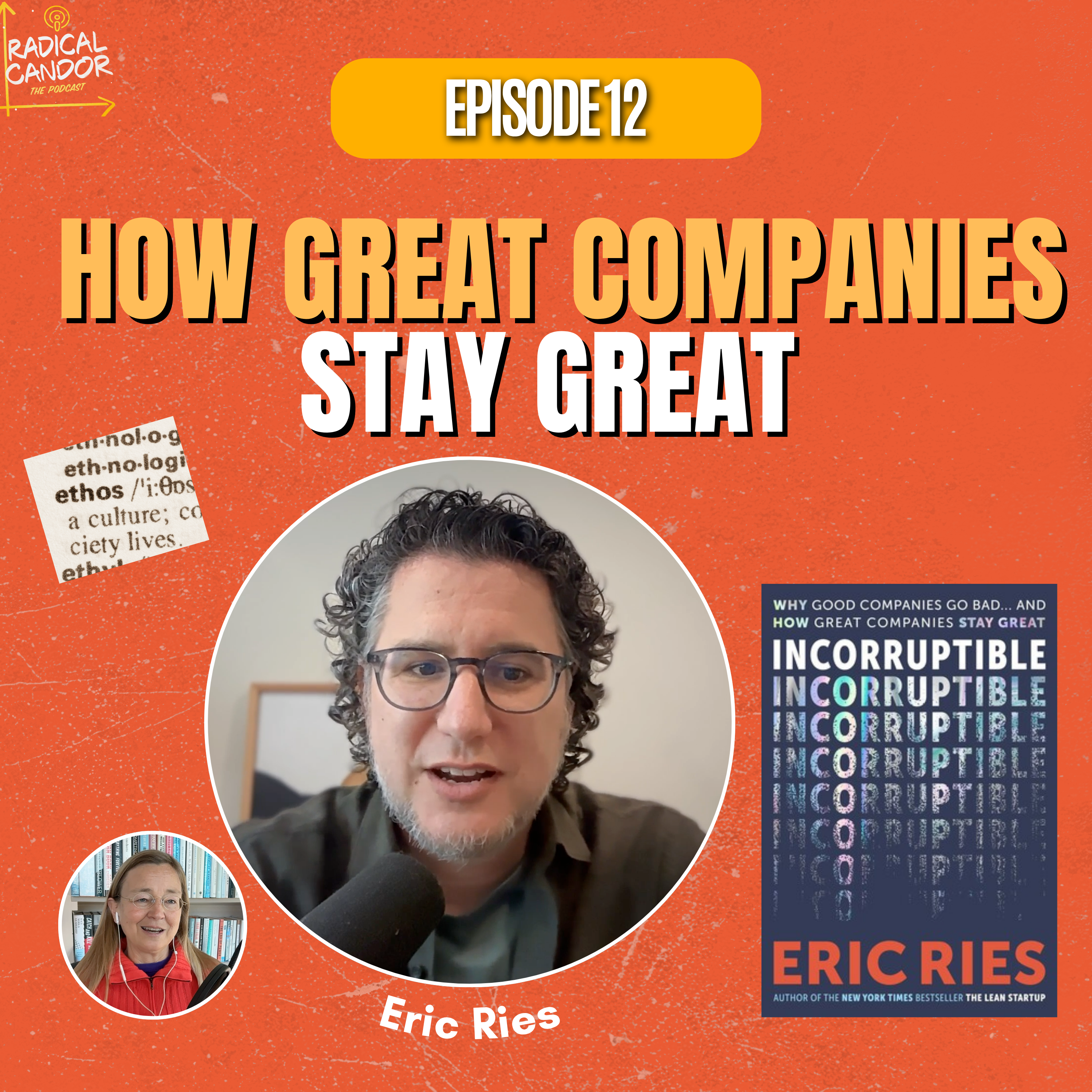
Table of Contents
All too often, founders start a company and hire an incredible team dedicated to solving an important problem and leaving the world better off. Then they get a taste of success — and the bankers and lawyers swoop in. Demands to “maximize shareholder value” set in. The company succumbs to the gravitational pull of mediocrity, or worse. Compromises are made, rationalizations abound, and after a while people start to wonder: how did this happen?
On this episode of the Radical Candor Podcast, Kim talks with Lean Startup author Eric Ries about his new book Incorruptible: Why Good Companies Go Bad… and How Great Companies Stay Great — and what it actually takes to build a company that stays true to its purpose.
Watch the episode:
Eric has spent years researching companies that drifted — and a smaller set that didn't. The drift is rarely a single dramatic decision; it's a long series of small rationalizations under sustained pressure. The haunting story he opens with: Vectura and Philip Morris.
Eric introduces the concept of financial gravity — the unconscious forces inside corporations that pull every decision toward short-term shareholder value. It's not evil; it's structural. Recognizing it is the first step in resisting it.
If financial gravity is the problem, governance is the lever. Eric walks through examples of companies that built institutional protections — Costco's governance fortress is a favorite — and explains why governance ratings, founder control, and the challenges of public-company life all matter for keeping a great company great.
[00:05] Kim Scott: Hello, everybody. I'm Kim Scott. Welcome to the Radical Sabbatical podcast, ⁓ where we are talking to some of the authors of the books that have made a huge impact on me, rather than our usually scheduled programming. Today, I am thrilled to have Eric Ries Am I pronouncing your name, Eric? I just had a moment. Okay, okay, okay. Eric Ries with us. Eric is the author of the New York Times bestseller, The Lean Startup.
[00:27] Eric Ries: Yes, yes, Ries likes the candy, I always tell people, yeah.
[00:35] Kim Scott: the Leader's Guide. And he has a book coming out that I think is one of the most important books I've read in the last decade. It's called, Incorruptible, Why Good Companies Go Bad and How Great Companies Stay Great. And I'm sure everyone listening wants to build a great company or a great team that stays great. And I think, Eric, what you write about in this book is very relevant right now because so many of our listeners
have asked us to take a step back and think about what it means to lead, to manage in this moment in time. The world right now feels broken. Something is rotten in the state of Denmark. And the market seems to reward companies that are doing things that seem to do more harm than good, to put it ⁓ gently, I guess. And it begs a question. What does it mean to be a leader in this kind of environment? People are asking, am I contributing
[01:08] Eric Ries: Yeah.
[01:31] Kim Scott: to this more harm than good problem by being successful. And obviously, I don't want to go into my career trying not to be successful. So I think your book really addresses this anxiety and so much more. So thank you for writing it.
[01:45] Eric Ries: gosh, thanks for the kind words. I'm so glad you so glad you enjoyed it.
[01:49] Kim Scott: Yeah, it's really important. So what prompted you to write it? When was the moment that you said, I've got to sit down and spend some time on this topic?
[01:57] Eric Ries: Gosh, well, I've been working on it for years. feels like forever. You know how the writing process can be. Sometimes it does not come easy. And for this one, I really, I had a hard time figuring out both like, what is the thesis exactly? And how do I narrow its focus enough to make it a book and not like a 12 volume, you know, monstrosity because I had been, you I've had a lot of success with Lean Startup and the kind of the movement that that's spawned. And I'm very proud of it. feel.
[02:00] Kim Scott: Yeah, yes.
Yeah.
Yeah. Yeah, yeah.
Mm-hmm.
[02:25] Eric Ries: really blessed I get to do what I get to do. And I've helped so many company, mean, right? Like hundreds of companies, thousands, I don't know how many companies I've touched to this point, ⁓ creating incredible wealth and impact in the world. So I'm happy, that's all good. But I've been at this long enough that I've also gotten to see the dark underbelly of this business. And so many of the people that I admire the most, who I've helped the most, like something wrong happened. Like they took a wrong turn and their company is not what it could have been. And we all kind of vaguely,
[02:26] Kim Scott: Yeah, you should be proud.
Yeah.
Mm-hmm.
Yeah. Yeah, their company betrayed
them or got taken away from them.
[02:54] Eric Ries: Yeah, it's incredibly common. It's so common that we hardly even know what to call it because we just see it. We see it all the time. You know, I was just in a restaurant and I took one bite of the food and hadn't been there in a couple of years. And I was like, did private equity buy this restaurant? I could taste it. I could taste it. And we've all had, I tell that story all the time. And so many people come up to me and they're like, I know what restaurant you're talking about. And then they.
[02:59] Kim Scott: Yeah.
Mm-hmm.
My
son was just talking, we went to this great restaurant that we loved and we ordered the flourless chocolate cake and he was like, I know who makes this cake. Every restaurant buys this cake from the same giant company and it's not good.
[03:31] Eric Ries: It's not good. It's just, it's not what it was. And I think what I eventually realized is that we're, we're teaching people a value destroying set of best practices that I myself was teaching. They're worth their, their abysmal. And I just thought for a long time, I was like, I don't really understand these practices, but I think that somebody surely does. And they must be that way for a reason. And over time, you know, I've come to see, first of all, I've seen the destruction that they wreak firsthand. And later I came to understand the research we have that they're actually like.
[03:40] Kim Scott: Yes, their worst practices.
Yeah.
[04:01] Eric Ries: quite poor. When I say value destroying, I don't mean like in a minor way or as a metaphor, like literally setting incredible amounts of value on fire. And at the same time, they're making the people that operate them miserable. So I've seen all these people have all this worldly success, one compromise at a time. And then they end up, yeah, out of control of their own company, their company becomes malignant or bureaucratic. They, they wound up becoming the villain of their own story and they're left with a lot of riches and a lot of regrets.
[04:12] Kim Scott: Yes.
Yes.
Yeah.
[04:28] Eric Ries: I started
to ask the question, like, who is it for? If the winners are miserable, yeah, why, like why is it? And the answer is right there in the subtitle. Cause I think of this book as like, there's the why readers who are like, why is this happening? And the how readers, like, how do I prevent it from happening to me? So those really were the two theses of the book, which like, how do we get into this situation and what are we going to do about it?
[04:32] Kim Scott: Yeah, why is this happening? Yeah.
Yeah.
Yeah.
So one of the stories that you told in the book is is haunting is of an entrepreneur who created a company that would allow you to inhale a drug and then who bought it and what happened. Tell that story, because I think it...
[05:08] Eric Ries: sure. I'll tell the story. Yeah, it's a,
it's a really haunting story. And it's so sum ups our, our moment, our moment in the financial system that we're in right now. And I'll tell you how I discovered the story too, because I didn't know about it in real time. What happened was for years, I've been doing this hypothetical exercise with entrepreneurs when I would meet them. Cause, cause a lot of founders especially, but I see this in other middle managers and senior leaders and board members. A lot of people have never read their own corporate chart.
[05:21] Kim Scott: Okay.
Mm-hmm.
Mm-hmm.
Yes.
[05:38] Eric Ries: And I have no idea
what their corporate governance is. Like, it's actually like shocking to me how
[05:42] Kim Scott: I,
I, I will confess, even after reading your book, I haven't yet done, I'm going to do it. My, my co-founder and I are like, we got to do this. Yeah.
[05:48] Eric Ries: Yeah, you got to do it. It's like eating your vegetables. And listen,
I don't blame you because these documents are so boring. And actually as one crew will get to that's part of the problem. They're also written in this very esoteric language that where like up is down and black is white. So even though it says one thing on the page, it actually means kind of the opposite in, in practice. we'll, we'll get to that.
[05:55] Kim Scott: They're deadly. And that's part of the, that's by design.
Yeah.
Yeah.
It's like a ballot
measure.
[06:11] Eric Ries: It's
really, it's absurd. is not designed for builders to comprehend because it is designed for builders to delegate to the governance class. That's a, it's an ooster patient of power away from those who build things to those who govern things. Anyway, so for a long time to help founders, especially board members understand this problem, I would ask them to do this hypothetical. I'd say, who do you think is the most evil company in the world?
[06:16] Kim Scott: Yeah.
Yes. Yes.
Mm-hmm.
Yeah.
[06:35] Eric Ries: And people would be like, what do you mean evil? Define evil for me. it's okay. I don't mean in some kind of like absolute moral sense. What I mean is the one company on this earth that no matter how much money they offered you, you would never go work there. That's it. Like there's just nothing they could do. There's no promise they could make you. You don't trust them. You don't believe. And nobody has trouble answering this question. They might not want to say it out loud. And, know, and over the years I've been using the exercise, people name different companies, you know, like it used to be like munitions and weapons merchants were high on the list.
[06:46] Kim Scott: Yeah.
Yeah.
Yeah.
[07:02] Eric Ries: You
know, it used to be like bioengineering companies were high on the list. Increasingly tech companies are unfortunately high on this list. Yeah, I get that a lot, especially from younger people who feel betrayed, personally betrayed by this product. Anyway, I tell them, look, your values may be different than mine, but my father was a pulmonologist growing up and we were always taught that Philip Morris was the most evil company in the world. Whatever they offer you, you just don't believe them because they're up to no good because they were willing to sell cigarettes to children. Okay, fair enough. If you're listening to this and you want to do the exercise at home,
[07:05] Kim Scott: Yeah, now it's met up probably.
Yeah. Yeah.
Uh-huh.
Yes. ⁓
Yeah.
Yes.
[07:31] Eric Ries: You don't have to pick Philip Morris. You could pick whoever you want. So I asked people, okay, imagine that that company, whoever you picked, in my case, Philip Morris comes to you and offers to buy your company from you for $1 more per share than it's worth. Are you selling? Like, entrepreneurs are always like, no, of course not, outrageous. One person did ask me one time, well, what are they going to use my product for? I'm like, to sell cigarettes to children. Does that change your answer? Hell no. mean, hell no is the most mild version of the answer I get here. People are like, of course I'm not doing that. I'm like, great. Well, did you know?
[07:33] Kim Scott: Yeah.
Mm-hmm. Everybody says no, of course not. Yeah.
Yeah. Yeah. Yeah. Yes. Yeah.
[08:00] Eric Ries: that according to your own ⁓ corporate charter that you yourself signed, most governance experts in the world believe that you have a fiduciary duty to say, yes, you have to do it. It's not up to you. Should this happen? And the first time I exercise, I remember someone accused me of lying. They're like, that can't possibly be right. And I'm like, listen, call your guy. Cause they always be like, well, my guy would never do that for me. I'm like, call your lawyer. It's always your guy. don't know why call your guy. just ask him straight up.
[08:05] Kim Scott: Mm-hmm.
You have to.
Mm.
Yeah.
Yeah. Yeah. Yeah. Yeah. Some. ⁓
[08:30] Eric Ries: if what I'm saying is true or not.
And they call me back and they're like, he said it's true. He doesn't understand why I'm upset. He thinks he did me a favor by giving me the best practice corporate governance. And like, okay, now you see the problem. Anyway, after I'd done this exercise for a lot, I actually had, I got in a situation where people would sometimes accuse me of exaggerating. Like, come on, that's an unfair hypothetical, a dollar per share, you're exaggerating. And so I went hunting for like,
[08:39] Kim Scott: Ugh.
Mm-hmm.
It's not gonna happen. That'll never happen.
[08:55] Eric Ries: stories, I mean, I was accumulating for the book research on stories where this had happened and occurred to me one day, I was like, has this ever happened involving the actual Philip Morris? You know, it's like, I actually never bothered to look, it was hypothetical to me. So I'm looking around it, I got a list of all the companies Philip Morris had ever acquired. And I discovered this company in the UK called Vectura. Now, Vectura was a spin out of the University of Bath formed by a bunch of founder scientists who believed in inhaler therapeutics. So
[09:04] Kim Scott: Yeah.
Mm-hmm.
Mm-hmm. Yeah. Yeah.
[09:23] Eric Ries: inhaled medicine for asthma, COPD, illnesses like that. They
had a successful spin out. had university based IP. They took the company public. They were a publicly listed company on the London Stock Exchange. And one day the actual Philip Morris, I think what happened is a consultant came to them and told them that they should diversify their ill gotten gains out of just tobacco into other adjacent businesses. some, you could just see how like some consultant made a spreadsheet and I just did.
[09:42] Kim Scott: Mm-hmm.
Yes, yeah, it's best
practice.
[09:51] Eric Ries: best
brand whatever. And they were like, we have a lot of ⁓ experience in inhaled technologies. We should go acquire this inhaled therapeutics company. So the actual Philip Morris shows up on the doorstep of Vectra and says, we'd like to buy the company for 155 pence per share. ⁓ At the same time, the company is like, uh-oh, this doesn't sound good. So they started soliciting other bids and they got a big U S private equity firm to bid 145 pence per share. And they were getting this bidding war going, but,
[10:08] Kim Scott: Mm-hmm.
Mm-hmm.
[10:20] Eric Ries: Philip Morris made a public statement. like, listen, we have unlimited money. You understand? Cause of our, our ill gotten gains. understand? So we will. Yeah. It was like, because of all the bad stuff we do, we have, we have plenty of money. So we will outbid any rival. So anyone bids anything, we're going to outbid them. So don't bother. So the private equity firms like whatever, we're not going to bid against Philip Morris. It's not possible, but we will, we will still will buy, we'll leave our bid where it is. So the board of Vectora had this very simple decision to make three doors. Door number one, stay independent. They're a public company. No, so problem to be solved. Just stay a minute.
[10:24] Kim Scott: Yeah, because we've addicted so many children.
Yeah.
huh. Right. Right.
Yeah.
[10:50] Eric Ries: Door number
two, sell to the private equity firm. Door number three, sell to Philip Morris. Now this was a massive controversy in the UK. Every normal person who hears this story is like, big tobacco should not own a healthcare company. This is absurd. There were inquiries. The British Thoracic Society begged them not to do it. But the board of directors had a meeting and they just said, look, this is ironclad, black and white. It's our fiduciary duty. We must sell the company to Philip Morris. So they did. They just did it. Now within three years,
[10:54] Kim Scott: Mm-hmm.
Yeah.
We have to.
my god.
[11:20] Eric Ries: Um, Philomars had taken, uh, like, 90 % of the purchase price. had to take it as a write down because they utterly destroyed this company and they sold it for parts. was like a massive active value destruction, even on top of how absurd concept from the beginning. Yet the board of directors felt like their hands were tied. So when I tell the story now, I'm always like, see, I was exaggerating. It wasn't, it wasn't a dollar per share. was much worse. 10 pence is about, it's about 15 cents us.
[11:25] Kim Scott: Mm-hmm. Yeah.
Ugh.
It's worse than you think. ⁓ It was 10 pence per share.
[11:47] Eric Ries: was enough to get them to trigger this so-called fiduciary duty. So yeah, I think that story is really chilling and everyone who tells me it's not gonna happen to them, I'm always like, then what, tell me specifically what is different about your situation than Victoria's. And they're always like, ⁓ I have good intentions. Well guess what? That doesn't count for anything.
[11:47] Kim Scott: Ugh.
Yeah.
The CEO of that,
I mean, the founder of that company must have just been devastated.
[12:10] Eric Ries: You know,
I don't know whether it's a, it's a happy part of the story or a sad part of the story, but he actually had passed away before this happened. So at least he didn't live to see it done, I guess. But yeah, it's, it's grim, but it's extremely common. And in fact, it's so common that, ⁓ you know, this was an, as far as we can tell an act of unintentional value destruction, but a lot of acquisitions these days are specifically designed.
[12:17] Kim Scott: ⁓ no. Ugh. Yeah. Yeah.
Yeah, yes.
Mm-hmm. Are intentional. It's
catch and kill.
[12:35] Eric Ries: to destroy the
thing. They're basically kind of see catch and kill behind you on the thing. They're literally catching kill. In fact, there's an academic study in the pharmaceutical industry on what are called killer acquisitions. There's actually enough. happens often enough that we have a data set to know that at least 5 % of pharma acquisitions are designed to shut down the opposing companies R and D. So these are not value creating activities. These are value destroying activities that
[12:44] Kim Scott: Ugh.
[12:58] Eric Ries: shouldn't be like our ideology, our modern ideology about finance driven capitalism were true that it's really about value creation and competition. We wouldn't see these symptoms. So that's how you know that this theory is clearly false.
[13:06] Kim Scott: Yeah. Yeah.
Yeah. Yeah. So in some ways, mean, this is part of the problem, I guess, is these large companies, a lot of antitrust regulations have been weakened or even just killed. part of the problem is basically just ⁓ the financialization and therefore deindustrialization, but not just deindustrialization.
[13:34] Eric Ries: De-buildification,
[13:35] Kim Scott: Yes, that's what I was going to say.
[13:36] Eric Ries: the inability to make money by making things at all, yeah.
[13:40] Kim Scott: Yeah, yeah. So that's part of it. In some ways, it feels a little bit, your book feels like the answer to what Cory Doctorow calls in shitification. ⁓ Is that fair? Would you agree?
[13:50] Eric Ries: yeah.
very much so. In fact, I consciously thought about that a lot when writing the book, because of course I find his writing very compelling, but also very infuriating. And I understand from the outsider's perspective, if you're a policymaker or a customer or even an investor, if you're from the outside these organizations, it's very natural to see them as rapacious by nature. But being on the inside, I feel like I know the human beings who start these things, who operate them.
[14:02] Kim Scott: Yeah, yeah, yeah.
Yeah. Yeah.
Yes.
[14:23] Eric Ries: who live them every day, are, I know they're investors and they're board members and they're executives, like I really, and a lot of them are very good people who really mean well. And in fact, what I've seen is so many of them basically lose control of the thing that they made. So they're inadvertently creating like a Frankenstein's monster, not intending to do so. And I just felt like, okay, leaving the policy aside, this is not a book, not a political book, and it's not a book about public policy. Although I think the public policy implications are obvious, but.
[14:26] Kim Scott: Yeah, they're all good people. They're all reasonable.
Yeah, yeah.
Yeah.
[14:50] Eric Ries: But I don't, I don't go there in the book because I just wanted to answer this question, not what should companies be allowed to do, but instead the more important question to me is what should we as company builders, what should we want to do? What should we see? What ought we to do? It's kind of an old fashioned book answering the asking a kind of a virtue question about what is the right way to go about making money. And my conclusion, you know, spoiler alert is that there is really no need to give up on making money.
[15:03] Kim Scott: Yes.
Yes.
Yeah.
Yeah, yeah.
[15:20] Eric Ries: I think it's perfectly possible to make money in an ethical way, and that our grandparents and great grandparents were not as confused on this point as we are. We've actually lost something very essential, and it's why I chose the title of the book, Incorruptible, because I felt like in our modern language, we don't even have a word for this value-destroying behavior. We don't know what to call it. Mission Drift sounds like a navigation error.
[15:20] Kim Scott: No.
Yeah, we are very confused on this point.
Mm-hmm.
Mm-hmm.
Yeah,
short term is like maybe.
[15:47] Eric Ries: Short-termism, that's like
one person's short-termism is another person's agility. So what are you gonna do with that, right? We literally can't call it anything. And eventually I realized, I was like, well, what would it have been called in previous eras? Oh, it would have been called corruption. Because our modern definition of corruption has become catastrophically narrow. Now it only means like the most egregious crimes. And even that is like going by the wayside. No, it's just very slow. Once you start to reward and celebrate,
[15:51] Kim Scott: Yeah.
Yeah.
Yes.
Well, and even that now seems to be acceptable. Yeah. Yeah.
[16:17] Eric Ries: and get your grant social approval for that matter, let alone celebrate, to value destroying ways of making money. It's very dangerous. It's why the ancients warned us about demagoguery and all this stuff. Like they weren't concerned because it doesn't work. It's dangerous because it does work. know, as you start selling an addictive product, it seems to work. make money, right? So what's happened is we've created an economy where many of the ways that we make money today are great grandparents and great grandparents. Not just would have looked at that as like morally dubious.
[16:20] Kim Scott: Uh-huh.
Yes.
Yes, it works. Yeah.
[16:47] Eric Ries: They would have been crimes, right? Including in the 19th century. This blew my mind when I learned it. I'm like, how does not, how is this not widely known? I don't know. In the 19th century and before for almost the entire history of the joint stock corporation, but certainly in the 19th century in America, if you tried to create a corporation, you were required by law to state what its purpose was. And its purpose had to be to make a thing. And you had to make an application that showed that it was in the public interest that this thing be made.
[16:49] Kim Scott: Yes. Yeah.
Yes.
[17:14] Eric Ries: So in those days, if I had tried to enact modern best practices and I had tried to acquire a company that made a railroad or I tell the story of the Erie Wars where there was someone, a banker tried to take over the Erie Canal construction operating company. If you wanted to convert a company from making a thing to simply making money for its shareholders, as I want to say the legal purpose of this company is now to make money for shareholders, that would have been illegal. The courts would have voided your charter.
[17:22] Kim Scott: Yeah.
Yeah, it's just to make money. Yeah.
Yeah.
[17:40] Eric Ries: as ultra versa, meaning beyond the scope of what had been granted as the corporate authority. So this is not like some ancient thing from the medieval period or whatever. Delaware didn't switch over to what's called general incorporation until 1899. And then even after it.
[17:45] Kim Scott: Wow. Wow.
Mm And in
1899, you could incorporate and your purpose was to make money.
[18:01] Eric Ries: No, here's what's so interesting. If you read the statute in 1899, the key breakthrough, this is called general incorporation. And the idea was simply that people should be allowed to form a company for any reason without having to go to their state legislature and get permission. But if you read the statute, it's super clear that you still have to say what the reason was. You had to say this is the purpose of the corporation. And it was only in the late 70s, early 80s that we adopted the now modern idea of shareholder primacy, where it was seen as acceptable to say that you're not trying to
[18:07] Kim Scott: Mm-hmm.
I see. Uh-huh.
Yeah.
of shareholder promise. Yeah.
[18:30] Eric Ries: do anything at all but just trying to make money.
[18:33] Kim Scott: And not even
make money for a very narrow set of people, the shareholders, like not your employees.
[18:37] Eric Ries: Yeah, just for the shareholders. And increasingly we're
even talking about just for the short-term shareholder, not even for any kind of long-term. It's gotten, it's an idea that is like, you know, it's consuming itself. It's self-destructive. And so, yeah, that's where this modern idea of fiduciary duties comes from. And in the book, I trace the history of how we went from a, what I call a three-legged stool, like a very sensible and coherent idea of corporate purpose, which was basically three legs. First leg.
[18:43] Kim Scott: Yeah.
Yeah, yeah, there's a great.
Mm-hmm.
[19:03] Eric Ries: corporations are incorporated in order to do a specific thing that has a public benefit. Two ⁓ boards of directors are trustees of that corporation. So they have a duty, a fiduciary duty, a positive duty from trust law to preserve and protect that corporate purpose. And their tertiary third duty, the third leg was the agency duty. They are also agents of the shareholders, but they had a negative duty to prevent the shareholders from being defrauded.
[19:08] Kim Scott: Mm-hmm.
Mm-hmm.
that purpose, not just the making money.
[19:30] Eric Ries: because the shareholders have given money for some purpose, have used it for something else. That's a form of fraud. So that three-legged stool made perfect sense. And it was because of that three-legged stool that we had the biggest breakthrough in corporate governance, which is the creation of limited liability for investors, right? Because investors are not the controlling entity. They don't bear liability, which makes perfect sense. But what has happened over the course of the 20th century, as financialization increased, we have knocked the legs off this tool.
[19:30] Kim Scott: Mm-hmm.
Right. Right. That's a wow.
Mm-hmm.
Mm-hmm.
Yeah. Yeah.
[19:56] Eric Ries: We've gotten rid completely of the purpose leg. Now everything is, is financial only. We got rid of the trustee leg. It's become like the list of ways that boards now are supposed to police self-dealing is like very minor compared to what it's considered their major duty. only the agency duty remains. They are basically agents of the shareholders to maximize their return. The reason why this is so stupid on top of all the other social and economic and environmental catastrophes that it is enabled. It is also really bad for investors. First of all, it locked.
[20:08] Kim Scott: Yeah.
to make sure they make money, yeah.
Yeah, doesn't work
in the long term.
[20:25] Eric Ries: It doesn't work in
the long run. It doesn't work. So it puts investors into a prisoner's dilemma where each feels they have to extract as much value as possible. That's someone beat them to it. But also it is logically incompatible with limited liability. So going back to Roman times, this is an ancient idea. If I am your agent, then I also, I incur liability on your behalf for my actions, right? You send me to the marketplace to get, say, get me the lower lowest price by whatever means necessary. And I stab a merchant.
[20:33] Kim Scott: Mm-hmm.
Mm-hmm.
⁓ wow. Yeah.
huh. Wow.
[20:54] Eric Ries: It's as if you stabbed the merchant because you gave me the knife and these
instructions. So if we're going to really live in a world where corporations are agents of shareholders, then we can't have limited liability. And if you've wondered why is the public all of a sudden super outraged about all this behavior, why are there been increasing calls for the corporate death penalty? It's because I think people are intuitively understanding there has to be some account of somebody has to be accountable for this behavior. And if you're going to the board is not accountable because ultimately they only answer to shareholders, then it, then it just.
[21:05] Kim Scott: Wow.
Yeah.
Who is?
Yeah.
[21:22] Eric Ries: Who
else can be accountable? It has to be the shareholders. So I think shareholders would be wise to stop having their agents go around saying that they are in fact owed only this fiduciary duty and go back to a more reasonable understanding of what the fiduciary duties are.
[21:27] Kim Scott: Ha!
Yeah, yes.
thought you were going to go down a different path, which is that the companies that really try to resist what you call gravity, I want to talk about gravity in a minute, but the companies that try to instill a purpose and put that purpose to the forefront tend to do much better than those who don't. The short-termism, in addition to incurring this major liability,
Like on the fear side, there's also a greed problem. It doesn't work as well. Yes.
[22:10] Eric Ries: It doesn't work on top of everything else. It's not very
effective. Boy, that was one of the biggest things I wanted to get right with this book and why it probably took so long. There's like almost as much citations in this book as the main body of the text because I was like, we have to get this right. Yeah. I really spent a lot of time on this because at first I kind of couldn't believe it. Like when I first got into this, I was like, I hated the word corporate purpose. I was like, feels like some kind of like.
[22:22] Kim Scott: Yeah, yeah, it's well researched.
Yeah.
[22:37] Eric Ries: I was skeptical too, but like over time I've just seen the evidence. Like if you just meet companies that are mission driven, they're purpose driven, they just, they have such a level of flow that conventional companies can't touch. And I was like, I've made all the money I've made in my life has come from these companies. I actually way outperform. So I started to be like, okay, that seems pretty obvious. I wonder if there's any research about this. And what's funny is you talk to the academics who study these questions and they're like, there's no, I'm like, I need you to answer this controversial question for me. They're like, there's nothing, there's no controversy.
[22:43] Kim Scott: Yeah.
Yes.
It's not,
it's true. It's just true. Yeah.
[23:06] Eric Ries: The data is unequivocally clear and there's
so many variations of it. Companies that obviously work there that are purpose-driven outperform companies where people, investors or employees can trust what they say outperform.
[23:18] Kim Scott: Mm-hmm.
[23:19] Eric Ries: Companies with alternative governance structures that are not designed around shareholder primacy also outperform and not just outperform in the moral dimension but simply in the economic dimension because they're able to pursue long-term economic goals. It's very the mechanism is not some mystery either. The whole thing is well understood. So at a certain point you start to be like if all these worst practices we know what their alternatives are and we've studied the alternatives and we know the alternatives work better. Why are we wedded to these practices for what to what end?
[23:35] Kim Scott: Yeah.
Yeah, it
yes. Well, because there are some people who really benefit from the short term and and they have a lot of power right now. It's it's it's so interesting. Like, I really learned this when I first got to Google. I'm going to tell a small anecdote. And Google's not perfect. And maybe it got maybe it succumbed to gravity and the fullness of time. But when I first got there, this was in 2004.
[23:51] Eric Ries: There sure are. They have a lot of power.
Mm-hmm.
[24:12] Kim Scott: There was a little link at the top of Google to a definition of if you just put in a word, you would get some results, but there was also like a link out to a dictionary. And it went to, forgot what dictionary, but some, some formal dictionary, but, but dictionary.com, which was not a formal dictionary, was an AdSense publisher. I'm like, we should, we should link to them because then we'll make money on every, and I got in so much trouble.
for saying that. and I'm like a newly minted MBA. And I was like, this seems obvious, but they're like, you don't understand what our purpose is. Our purpose is to organize the world's information and make it universally accessible and useful. And we think this does that better than that. And we don't care about the money. ⁓ That's the old Google. Yeah, that's what it was like.
[24:43] Eric Ries: that's so great.
Oh, love that story. Yeah, that's the old Google. now, like, there was an incredible
article, I don't know, gosh, I can't remember now who wrote it, tracing the history of that issue inside the controversies that related to that Google and kind of charting that was basically like, that was part of why Google beat Yahoo. And then after Yahoo had been driven into submission, Google started to succumb to those same forces and they hired a bunch of Yahoo people.
[25:16] Kim Scott: Yes.
[25:24] Eric Ries: who ultimately had the last laugh because they changed it to match the Yahoo policy in the end.
[25:24] Kim Scott: Yeah. Yeah. Well, and, and,
you know, there was also gravity. went public. Like, and if you read the S1, there was a lot of hand wringing, like, and conviction that the company could go public and not succumb to gravity and gravity. So talk, talk about gravity. This is basically the gravitational pull of, of the stock market, basically is, is my understanding of it, but.
[25:33] Eric Ries: Post-grabbing.
Yeah, yeah, financial. Yeah,
yeah. So this is, think one of the things that I feel like we got wrong in a lot of business writing and a lot of management thinking is we're focused so much on the surface level characteristics of organizations, the things that we can see and measure, which are important strategy, business model, culture, people. I'm not going to say this stuff's not important. I would say super important, but because we're focused on the surface, we're missing certain things that are below the surface. And I call them the.
[26:05] Kim Scott: Mm hmm. Yeah.
Yeah.
[26:17] Eric Ries: the fundamental forces that act upon organizations, borrowing metaphors from physics in order to understand this, one of which is what I call financial gravity. So if you want to understand the gravity, it's important to understand it's macro effect, but also it's micro mechanism. So in macro effect, what we see is companies over time, they slowly start to conform to the values of our financial system, even if they started out in different places. And the fact that
[26:22] Kim Scott: Yeah.
Mm-hmm.
Mm-hmm. That's maybe
the story of Google right there in a nutshell.
[26:44] Eric Ries: Yeah, I mean, it really,
and I actually made a study of the blog posts that long time I'm talking about people who've been there more than 10 years, long time Googlers, right? When they leave Google, it's like a genre. They're incredible. You should read them. read four or five of them back to back to back. will feel this sense of loss that they can't quite name. And that
[26:51] Kim Scott: Mm-hmm. Mm-hmm. Yeah. Yeah.
Yeah. Yeah, no,
when I left, like I burst into tears and not like full snot running down the face kind of, yeah, yeah.
[27:09] Eric Ries: Yeah, yeah, yeah, yeah, because
it was such a special thing. And listen, Google's a great company, even today, great company. I don't mean to say it's still a great company, but like it has had this, this loss of something, something special, something precious. So, so that's the macro effect is, and the fact that you know, that it's a force and not random is that companies all wind up in the same place. Even if they start in different decades, different industries, different founders, different ideals, they all wind up in this same mediocre.
[27:14] Kim Scott: It still is a great, yeah.
Mm-hmm. Yeah.
Mm-hmm.
Yeah.
[27:35] Eric Ries: So much so that if I tell you that a company has lost its soul or if I tell you a company has succumbed to big code disease, you already know what I mean. You don't have to be like, which company? What industry? It doesn't matter. You know exactly what happened. So we have to understand what causes this macroscopic effect. And I delved a lot into the psychology research here. If you've ever watched someone meet a celebrity or a billionaire for the first time, you've probably had this experience. It's kind of gross.
[27:44] Kim Scott: Yes. Yeah.
Mm-hmm.
Yeah. What happened to you? Yeah.
[28:05] Eric Ries: You know, it's like they just be, yeah,
they're you're like, when did you become incredibly obsequious and agreeable? Like, and if you talk to people who've had that experience, say, why did you do that? They don't know why they didn't plan that. It's just like, is, they weren't even aware that they were doing it. It is an unconscious force and it's an instinct, it's a survival instinct that has been bred into us that you can't turn off anymore that you can change your eyes from dilating in the dark. It's just, it kicks in.
[28:12] Kim Scott: Yeah.
or they weren't even aware that they were doing it. Yeah.
The fawn instinct. Yeah. Yeah.
[28:33] Eric Ries: So what, and when does it kick in? It kicks in whenever you have resource disparities between people. This is why inequality is so toxic. When you have power, status, or economic disparity between people, you start to like, you just unconsciously think, gosh, this person could make my career with a snap of their fingers.
[28:40] Kim Scott: Yes.
Yeah. Yeah.
And I'm going to overlook all kinds of annoying things that they're doing. Yeah. Yeah.
[28:55] Eric Ries: I just, you know, and we have so much research about this. I mean, even
like, I'm one of my favorite studies. They measured people who had resource disparities and gave them each a cookie while they're sitting and talking to each other.
[29:05] Kim Scott: Yeah, and
the person with more money gobbles up the cookie.
[29:09] Eric Ries: Yeah, yeah, they literally could measure the radius of crumbs that they left on the table is proportionate to their net worth. Their relative status disparity. It's incredibly, it's just because it's a hundred percent unconscious. So what happens is, so you see a company go public, for example, and I ask CEOs all the time, you know, I built a stock exchange. So I spent a lot of time studying the IPO process and companies and I asked people who've taken a company public, what's the biggest difference you notice before and after the IPO? They always give the exact same answer. Everyone's watching the stock ticker.
[29:15] Kim Scott: It's so awful.
Yeah.
Yeah.
Yeah. Yeah.
[29:40] Eric Ries: They can't help it.
Their net worth is now gyrating with the stock market. And so what happens is in every meeting, there's like an extra ghost in the meeting with you, which is called the market. And you start to hear people say stuff like this, like, we want to do that, but the market might not like it. And if you quiz them about it, you're like, what does that mean? Who's the market? Who might not like it? They're not actually super clear. You see this in startups. They're like, VCs might not like it. Like which, which VC?
[29:43] Kim Scott: Yeah.
Yeah.
Yeah.
Yeah.
Yeah, which VCs
[30:06] Eric Ries: Yeah, do you have someone in
[30:06] Kim Scott: hoops. Yeah.
[30:07] Eric Ries: mind? like, how do you, and more importantly, if you say, how do you know that that's true? They'll be like, well, everyone knows that. Like, but did someone tell you? Like, how is it that you have knowledge that everyone knows that no one ever said out loud, right? It's an unconscious transmitter. So the first stage of it is gravity warps behavior. You start to change your behavior in ways that you think will please the dominant force.
[30:13] Kim Scott: you
Ugh.
Yeah.
And you also, that's if you're in a position of less power, even if you're in a position of more power, like when Twitter went public, Dick Koslow, who I think was a great leader, said, we are not gonna be assholes in a box. Like, that is what every company, and they weren't assholes in a box. And yet, you know, it happened to Twitter. Like, yeah.
[30:55] Eric Ries: It happens anyway. Yeah. Because
what happens is first of all, we financialized everything in the world, the financial system just immeasurably vast. So, so yeah, you're the CEO of a big company, but you are actually very small relative to this massive system. And we see like, it's, it's actually like a spectacle of watching like these incredibly wealthy people desperately trying to make the stock price go up. And you're like, what for what, what is it for?
[31:02] Kim Scott: and measure and measure everything. Like, yeah.
Yeah.
Yeah, yeah. And then feeling insecure,
insecure when it doesn't, yeah.
[31:22] Eric Ries: And they feel incredibly insecure and they're
actually very easy to bully and move from the outside because they have this deep need to conform. So eventually, the other thing that psychology research teaches us is that consistently ⁓ enacted behaviors eventually become internalized as values. So you might start out saying, we're going to be the good guys, don't be evil. We're going to always put the customer first. You even have companies that still says that on the wall.
[31:31] Kim Scott: Yeah.
Yeah.
Yeah.
[31:49] Eric Ries: And
everyone involved says that's what we do. People don't even realize that the value changed, but their actual internalized belief is something like, well, we try to put the company, the customer first. I tell the story. Yeah. Rita. Yeah. That's an incredibly insidious story. And, and in fact, was this very famous story about,
[31:54] Kim Scott: Yeah.
Yeah, or it's like J and J's credo. Did you read that book that that is the most insidious example?
[32:14] Eric Ries: After the original person who created the credo, Rodger Johnson II, after he passed away, the company was drifting. And a second generation leader was at a corporate retreat. just been named company president. And one of the other executives gets up at the retreat and is explaining that the credo with its five commitments is kind of like juggling a series of balls. And there's only one red ball, the one you better not drop, the one for profit. And ⁓
[32:20] Kim Scott: Yeah.
Yes.
Yeah, and one you better not drop.
[32:41] Eric Ries: the new president stands up and says, excuse me, my friend, but I'm afraid you're mistaken. Starting today, all the balls are red. Like he was the who was like, no, it doesn't work that way. We make profit because we take care of patients, because we do all this other stuff. And in fact, was eventually named CEO. He did revitalize the company and he was responsible for the very famous Thailand. I'll recall if you know that story. And yet, yeah.
[33:03] Kim Scott: Yes, and yet if you read No More Tears, that book, like
he was was was flawed, profoundly flawed, Burke.
[33:10] Eric Ries: No, profoundly flawed
because despite his best efforts, despite like, my favorite thing is that Robert Wood Johnson, when he invented the credo, he had it carved into gigantic limestone blocks in stone at every person who walked into the office. So that he was like, for all time, people will have to see the credo. But the blocks are still there. The people who put asbestos in the baby powder, walk by those blocks every day on their way to work. It's not enough. It doesn't matter what you put on the wall. It doesn't matter what you intend.
[33:19] Kim Scott: Gantic stone, yes.
Yeah.
Yeah, every day, yes.
[33:38] Eric Ries: Gravity operates automatically. It is an unconscious process. So unless you specifically design an organization to resist it, what you will get eventually is this very exploitative behavior that our current financial system transmits as its value.
[33:41] Kim Scott: Yeah.
You know, it's so interesting. I've been thinking about, I've been thinking about Metta and because there are a lot of good people. mean, I know people who I really like, you know, who, who work there. It's like not, you know, ⁓ and I, I'm totally, there's part of me, and this may be an excess of empathy, but there's part of me that is really, that does feel some.
[34:01] Eric Ries: Sure, me too.
[34:16] Kim Scott: compassion for these folks because they have these dashboards. They're looking at the numbers. The number is going up and they're like, hooray. The very first book I ever wrote was called The Measurement Problem. And it's about how capitalism is really good at rewarding what we can measure and really bad at rewarding what we value. And it seems like figuring out how to have the dashboard for what we value is part of how we resist this gravity.
[34:43] Eric Ries: Yes. Gosh,
you were prescient in writing that for sure, because we know that that's, I think, a very succinct way of saying the problem. And in fact, in the book, I argue for what I call holistic metrics, which are like intentionally designed systems of metrics that are designed to help us ⁓ bring the intangible, the most important forms of value into the realm of the tangible. So for example, ⁓ in our modern system of OKRs, there's a tremendous flaw, like a deep, deep, deep flaw. And that is
[34:55] Kim Scott: Mm-hmm.
Mm-hmm.
[35:12] Eric Ries: When we take an objective like revenue growth or whatever our objective, market share, any objective, and we break it down.
[35:17] Kim Scott: Yeah, for folks who don't know what
an OKR is, it's objective and key result.
[35:21] Eric Ries: Yeah, objective
and key result. There's just another word for the modern sense, the modern idea that you should break down a large goal into a series of sub goals and assign each individual manager a specific metric that they personally will be responsible for hitting. If we do that, every single person who receives one of those metrics has a choice to make. If they want to, they can choose to personally boost their individual metric, their little dashboard at the expense of the trustworthiness of the company.
[35:24] Kim Scott: Goals.
Yeah, I'm not sure. Yeah.
Yes. Yeah.
or at the expense of their peers or at the or at the expense of the like I got a good number and it hurt the it could hurt the yeah yeah
[35:57] Eric Ries: Sure. Yeah. I'm not, I'm not responsible.
think it was, I think it was the marketing guru Rory Sutherland who has a whole rant about how when people are brought in to do cost reduction, they're not held accountable for the cost to the brand, you know, the erosion of quality. They're like, they're not not really held accountable for the long-term consequences of their choices. That's, that's all we're talking about here. And most companies, not only do they assign metrics and hold people accountable to hit your metric, we do it in a competitive way where we stack rank people against each other. This is an old Jack Welch is I'm going back all those years.
[36:06] Kim Scott: Mm-hmm.
Yeah. Yeah. Yeah.
Yeah. Yes.
[36:26] Eric Ries: So when we stack rank people according to how well they hit their metric, then we create a prisoner's dilemma again, where it's like, look, you might not want to violate the trustworthiness of the company to boost your numbers, but if you don't, you'll be at a disadvantage against those managers who do. therefore wind up promoting the most sociopathic amongst us. And then we wonder why companies lose their trust. what are, like it's a nuts, it's a nuts idea. When the trustworthiness of the company is its most valuable asset. So a huge part of the book is about the operating discipline necessary.
[36:32] Kim Scott: Yes.
Yeah. Yeah.
It is.
Yeah, yeah.
[36:55] Eric Ries: to bring these intangible values into the realm of the tangible so that we can manage for them. Because it's not enough to just say, well, let's be trustworthy in general. Well, from that logic, you could justify anything. Rather, we have to be able to say, and I ask people to visualize this scenario, because I think most people who've been a middle manager at any time in their career will be able to relate to this. If you're what I call a torchbearer, I feel like every company there is like a silent reserve of people who just, they always want to do the right thing no matter what. If you've ever had that job and you have that disposition,
[37:03] Kim Scott: Yeah.
Yeah, yeah, this culture, yeah.
Mm-hmm.
[37:25] Eric Ries: It's exhausting because every single day of your life, somebody comes into your office wielding a spreadsheet like a weapon. That's like, listen, I've calculated the ROI. We could save three cents per widget if we like put toxic chemicals in the thing and make people ill and then we'll make a little bit more money. And if you say like, I don't think that's the right thing. Like, what are you some kind of idealistic soft hearted, whatever we're here to make money. And so like, because they seem serious and you feel weak.
[37:28] Kim Scott: Yeah.
Yeah.
Yeah, yeah. Yeah, and then they make you feel stupid for wanting to do the right thing.
Yeah.
[37:52] Eric Ries: you wind up compromising. And oftentimes what you do is instead of saying yes or no, you just say, how about if we only, know, instead of saying three cents, let's save one cent and let's do it a little bit, like be evil a little bit. And instead what we need to be able to do is train all of our people that if that ever happens to you, you gotta be like, ⁓ you are proposing the liquidation of a critical and precious resource. So get out of my office. Absolutely not. Of course we're not doing that. why are we even talking about this? I don't need a spreadsheet to know it's wrong.
[38:07] Kim Scott: Mm-hmm.
Yes. Yeah. Yeah. And, and, yeah.
And you know what happens really? Like at a certain point they call you a communist and that like, that's where this leads is if you're not part of, if you're not, if you're not part of this gravitational pull towards really self-destructive self-destruction and mediocrity, then you're a communist. Like what? That's
[38:42] Eric Ries: Yeah, I see that all the
time. It's absurd again because we have the evidence that doing the right thing is more profitable in the long run. ⁓
[38:43] Kim Scott: Yeah, yeah.
Yeah. So
you offer a lot of solutions to this gravitational pull of mediocrity slash immorality really. ⁓ One of them is for leaders to make sure they're in control, but that maybe is a dangerous solution. So talk about that because it's, this was one of my favorite parts of your book.
[39:06] Eric Ries: It is.
Well there are no easy answers here, so I feel like, I feel bad, the book is-
[39:14] Kim Scott: You need five
or six. need to, can't do one thing. There's not one answer.
[39:17] Eric Ries: Yeah, yeah, I really try to emphasize
this with people like that. You have to build an interlocking set of practices that make sense. And honestly, we're grappling with a problem that's as old as humanity itself. Like figuring out how human beings should share power and resources is one of the oldest philosophical problems there is. And part of the issue with our current corporate monoculture is we're like, we've lost a bit of our human birthright, which is like,
[39:31] Kim Scott: Yes.
[39:38] Eric Ries: human beings naturally love to play around with different ideas about how these structures should work and experiment there. So having all companies be exactly the same is actually like a real loss. yes, ⁓ so what we're talking about now is like, ⁓ given that you've built something worth protecting, right? You've built a company that has what I call an ethos, that it stands for something good, has built up an asset of trustworthiness, then you know for sure that people are gonna try to steal it from you.
[39:45] Kim Scott: Yeah.
Yes.
Mm-hmm. Yeah.
[40:04] Eric Ries: Okay, like this is the biggest naivete that I feel like I and every other leader I have worked with for many years, we all shared this naive idea that if you show that your method of doing value creation is better, the market will reward you and protect you. Wrong, it is going to send the vultures for you to steal what you've made precisely because the most trustworthy companies are the ones that can make the most money by betraying those promises. So yeah, so first of all, don't be naive. Okay.
[40:17] Kim Scott: Yeah. Yeah.
Yes.
[40:30] Eric Ries: But then you're like, people say, okay, if investor control of companies lead to this weakness, then the solution must be founder control of companies. And that is better. I mean, I don't want to be super clear. think like what, if you look at Meta, Google, you look at all these founder controlled companies, it's just statistically speaking, they outperform. So like they actually make more money for investors than having investors be in control. The parable of the golden goose is as old as we have written records. Okay. Like it's an old story for that. It's an old song from way back when. So the, the.
[40:38] Kim Scott: Mm-hmm.
Yeah. Yes. Don't kill art. Right.
[41:00] Eric Ries: The issue though is that founder control by itself has significant liabilities and there shouldn't come as any surprise to anybody who studied political philosophy for more than five seconds. God, emperor for life and your descendants too is a rough, it's power corrupts. The psychologists call it hubris syndrome. It literally causes a mental illness that is not, again, it's not optional. You can't be like, I'm gonna will myself. I'm gonna be the exception because no, it's not. So.
[41:05] Kim Scott: Mm-hmm.
Yeah, power corrupts.
Yeah.
Yes.
Yeah.
[41:28] Eric Ries: I do think that founder control as a bridge to something better is okay in the same way that like George Washington, like had unquestioned command of the,
[41:36] Kim Scott: Yeah,
better the founder than the market, but the founder becomes a problem, yeah.
[41:38] Eric Ries: Right, certainly, but over time, I know too many founders who have
significant problems, including several who feel trapped. In the book, I say like Atlas, unable to even shrug, because they are literally, their physical body is the only thing that stands between their company and the ruin of the market. That's a rough assignment. Nobody should be asked to do that. And of course I tell you should be allowed to retire without fear that your organization...
[41:50] Kim Scott: Yes.
Yeah, yeah.
You should be allowed to retire. shouldn't be trapped by your own.
Yeah.
[42:06] Eric Ries: will fall
apart after you go. And of course I document hundreds of these stories in the book of companies that failed this test of succession where the founder couldn't leave. And so when they died, really bad stuff happened. So I just, don't think seeing this problem as a personal problem is the root, is itself a fallacy. We need institutional protections, not personal protections. And that opens up a new space of creativity to build governing systems that are, ⁓ that,
[42:13] Kim Scott: Yeah.
Yeah.
Yeah, yeah.
[42:34] Eric Ries: but that follow the architecture of institutional longevity rather than relying on the goodwill of any one person.
[42:40] Kim Scott: Yeah. And I think it's maybe not even fair to say relying on the goodwill because ⁓ again, it's inevitable. Like we are all corruptible. You know, it's so easy to hate the, you know, but if I, you know, if I were, if I were in, you know, it's easy to say, how could, how could Tim Cook have gone to this on bended knee to this, but like, what would I
[43:01] Eric Ries: It's really easy to hate on these guys.
[43:08] Kim Scott: done in issues I would like to think, you know, I would make a big stink, but probably I wouldn't. ⁓
[43:13] Eric Ries: Yeah.
Yeah. And so like, so to give an example that is maybe familiar to a lot of listeners, like the book, the book has a recurring character of Costco kind of popped up periodically in the book in various moments. ⁓ cause it's, cause it's such a, it's such an easy example of something really cool. And one of the things that most people, there's a lot of things about Costco that people don't know. They know it's big, but they can't imagine how big it is. Costco is like much bigger than you think for almost everybody listening. Factoids about Costco, by the way.
[43:21] Kim Scott: Mm-hmm. Yes.
Yeah.
[43:38] Eric Ries: Is that if it's, Kirkland brands, it's like it's in-house private label. If that was an independent company, it would be bigger than Coca-Cola, bigger than Procter and Gamble, bigger than United Airlines. Like it would be a massive business in its own right. That's how big Costco is. It's it's a behemoth. And although the founder of Costco, Jim Senegal is still alive, it's already had three CEOs since. So Costco is 40 years old and it has managed to keep its integrity like generation by generation. And part of the reason for that.
[43:42] Kim Scott: Mm-hmm.
my gosh. Wow. Wow. Wow. It's huge. Yeah.
Mm-hmm.
Mm-hmm.
[44:07] Eric Ries: Is that Costco has what I call a governance fortress. It is not tied to the founder himself with super voting shares and this kind of stuff, but it is rather organized structurally into the bones of the company that allows the company to manage its own affairs without outside interference. And as a result, the board of Costco really has that old fashioned trustee mentality. They have a sense of purpose about what they're doing and they feel like their job is to insulate management from the ravages of the market.
[44:10] Kim Scott: Mm-hmm.
Mm-hmm. Mm-hmm.
Mm-hmm.
They have a purpose.
[44:35] Eric Ries: not to amplify those ravages to go inside. So there's so many funny stories about Costco over the years dealing with this issue. One of my favorites is, there was a whole controversy a few years ago about their governance fortress and how bad it is. And a Wall Street analyst wrote this as a criticism, mind you. He said, Costco is taking money that rightfully belongs to shareholders and spending it on improving the customer experience.
[44:35] Kim Scott: Yeah.
Yeah.
[44:59] Eric Ries: Okay. That's problem. That's the problem. Stealing money from investors. know, ⁓ CEO at the time was like, you don't have no idea how much money we spend trying to make Costco look cheap. You know, like, do we know what we're doing? Costco is a $400 billion valuation because it has not lost faith with its customers. in another funny episode, ⁓ a bunch of activists, shareholder activists and corporate governance experts, like
[45:04] Kim Scott: Ugh.
Yeah.
[45:24] Eric Ries: got together to attack the company for its bad management practices because Costco for many years had the worst possible governance rating you can get from the governance rating agencies, literally the worst. Because the theory that they, and they wrote these letters and they had this whole campaign to do this. They said, look, Costco's governance leads to management entrenchment and entrenchment leads to poor performance. And I was like, this is...
[45:48] Kim Scott: It's not.
[45:49] Eric Ries: I was like, first of all, even if that was true in general, which by the way, it isn't true, but even if it was true in general, it doesn't apply to Costco. Costco is one of the best performing stocks of all time. How can you possibly say? So they were like attacking them for poor performance. And here's my, here's like the most wild thing. They did this activist campaign and they had a shareholder vote to D to declassify the board, basically to remove one of the elements of the fortress. And they got 76 % of the people voting to vote yes.
[45:57] Kim Scott: because they've done really well.
[46:18] Eric Ries: to this insane proposal. Now, the good news is that the fortress at Costco requires not just the people who happen to vote in these elections to vote yes, but all shareholders. And Costco has millions upon millions of retail shareholders who are also loyal customers who, know, so the fortress held, but what's so interesting about it is like, why are people attacking Costco of all companies? Like, surely there are a lot of worst companies you could be attacking, but that's what happens.
[46:31] Kim Scott: Yeah.
Yes.
mean, and also, yeah,
like, why do they want to kill the goose that laid the golden egg once again? Like, it's weird.
[46:50] Eric Ries: They desperately, desperately
want to, in the book, I give the example around this exact same time, the same people launched a campaign against Kroger and Kroger, Costco told them to F off, but Kroger was like very eager to be seen as having good governance. Just like, look, who doesn't want to be seen as having good governance? It's a, it's a hugely valuable for your career, especially if you can show that you helped the company achieve good governance. So they did all the things that Costco would not do. And if you look at the performance of both companies since then, Kroger is a perfectly fine company.
[46:57] Kim Scott: Mm-hmm.
Mm-hmm. Yeah.
Yeah.
Yeah, but it's.
[47:18] Eric Ries: I actually found that analyst
who called the performance of Kroger like Costco in reverse. Just, just they've been like obliterated by Costco performance wise. And so I always tell founders the next time someone talks to you about best practices, I need you to silently separate in your mind. You need to hear that they're saying Kroger practices. Okay. This is a company that thinks you should be more like Kroger and less like Costco. Is that really what you, if that's what you want, God bless. But if it's not what you want, you need to stop listening to these people. These practices.
[47:35] Kim Scott: Yes. Yeah. Yeah.
Yeah. Yeah.
[47:46] Eric Ries: are not in your interest and they're not designed to create your whole.
[47:46] Kim Scott: They're not best.
Steve Jobs used to say when I worked at Apple, ⁓ best practices just get you back to average. And that's like, it's the death of innovation. It's the death of, it's just like, you know, yeah.
[47:58] Eric Ries: Absolutely, absolutely atrocious. Yeah,
and I remember I heard the story from another, from a founder. I haven't ever verified it directly with the source, but another founder was telling me that he went, when he was taking his company public, he went to see Tim Cook for advice. he's like, Tim told him this story. said, look, before you go public, you should know that when Steve was alive, there wasn't a single week that went by that he didn't rage into my office asking how we could take Apple private.
He hated being a public company. He felt like the markets were constantly opposed to his, uh, his ethos. And this is what I tell pushing
[48:26] Kim Scott: It's of course, yeah. Yeah. Pushing him in the wrong direction.
[48:34] Eric Ries: in the wrong direction. And I think for a lot of people, again, for founders, of course, but for a lot of leaders, um, and a lot of, for a matter of just employees, board members, customers, everybody, if you think, if you have a goal of accomplishing anything at all concrete in this world, like you say, you want to work on climate change or whatever, of course, but I'm saying like, even if you have a humble ambition, it's as simple as, don't know, I want to make a high quality product.
[48:48] Kim Scott: Yeah.
I wanna build
a better pen.
[48:56] Eric Ries: I
want to make my customers like the second you say that you are trying to accomplish some purpose other than making money, you are a business revolutionary, whether you know it or not. You are so opposed to our dominant finance driven theory of business that they will come for you. These people don't play around. make a lot of money from the dismantling of these companies and they will come for you. So you need to be, I think appropriately prepared for that resistance and push back to happen. And luckily we have the tools that are necessary.
[49:05] Kim Scott: You
Yes.
Yeah.
Yeah. Yes.
[49:25] Eric Ries: to prevent this from happening. is absolutely a choice.
[49:29] Kim Scott: You can go public, for example, on the long-term stock exchange founded. We can resist this gravitational pull of mediocrity for sure. But it takes, you have to be very conscious and you have to be willing to lay down your own power.
[49:32] Eric Ries: I certainly hope you will.
Yeah, for sure.
I think that's
a huge part of the fear people have because look, I don't have to sugarcoat this. you perform obeisance to these set of values, it will be a career accelerator for you. These people are not shy. Like if you want to study solidarity, don't study trade unions, study banks. Okay, they understand, they know how to close ranks, they know how to reward their allies, and they are very, if you are willing to betray companies for money, they will reward you generously.
[49:51] Kim Scott: Yeah.
Yeah, you'll make a lot of money.
Yes.
Yes.
[50:15] Eric Ries: So
that's what we're up against. And if you like, I feel like I meet people who are like, that doesn't sound too bad. Go nuts. I'm not here to convince you of anything. But if you are like that, that thought, if you find that thought kind of intuitively revolting, good for you. And you're right to me, like you're a human being. Okay, good news. So then you have to be willing to preserve that still small voice inside. You have to learn to listen to it and you have to build a career and eventually an organization.
[50:21] Kim Scott: Yeah.
Yes. Yes. Yes.
[50:43] Eric Ries: that is responsive to those values. Otherwise you will get this garbage by default. But on the flip side, if you're willing, like the people I know in business who sleep the best at night are the people who've done the hard work to build an organization around them that stands for something that they can feel good about. Because they don't have that sense of dread and constant moral compromise. They don't have to like not look their kids in the eyes when they say, hey, where did our money come from, dad? Like they have a ⁓ level of equanimity
[50:47] Kim Scott: Yes.
Yeah.
[51:13] Eric Ries: that the conventional system cannot offer you. I think that's worth far more than the riches these people will offer you to portray those values.
[51:16] Kim Scott: Yeah.
Infinitely, infinitely more. It's success beyond success is what we're going for, not just success. ⁓ Well, Eric, what a great book. What a great conversation. you ⁓ could leave people with one, well, four things to do, because you can't do just one. What should people do about this for their career? Yeah, no, not one, not one, because one won't work.
[51:25] Eric Ries: Mm-hmm.
Yeah.
Great. Oh, I was like one, it's going to be super difficult. Okay. Let's, let's,
well, let's take a couple. There's a couple of ideas in turn that I think are important. The first is the most important question is actually not even what to do, but when to do it. And it goes back to that old proverb about the best time to plant a tree. know, ideally you would have done it 40 years ago, but next best time is right now. So in the book, I have a principle I call it's always too early until it's too late. And this is a, so many people get talked into putting off these decisions.
[51:54] Kim Scott: Yes.
Yesterday, yeah. Yeah.
Mm-hmm.
[52:11] Eric Ries: until they no longer have the power to do them. I see this in individual people in their careers, as well as obviously in founders and their structures. So the most important thing is to get clear about where you're trying to go so that you can then take active steps to get there. If you just kind of float with the current, you're going need to wind up as Steve Jobs with that same mediocre outcome. Then in terms of what to do, once you decided I want to do something, there are kind of, the blueprint in the book is made up of two paths, I call it. First is the path of ethos.
[52:27] Kim Scott: Yeah.
[52:41] Eric Ries: And the second is the path of integrity. And I tried to find old fashioned words for all the key concepts in this book to stay away from all the trendy modern business jargon like stakeholders and culture and whatever. was like, enough. We have enough of that. So this is not a book about stakeholders and culture. This is a book about fiduciaries. And there's a book about ethos, character. So if you want to build something worth protecting, you have to be willing to align every resource at your disposal, human, financial.
[52:48] Kim Scott: Yeah. Yeah. Yeah. Yeah. Yeah.
Mm-hmm.
[53:08] Eric Ries: ecological every resource towards the goal of making money only by accomplishing the mission in no other way. And that sounds like it is an easy thing to say, very hard thing to do, but not an impossible thing. There are very tangible, specific techniques we can do. We can establish a corporate purpose. We can establish cultural and managerial practices that create that alignment. We can think in a clever way about the business model. Anyway, so we can become what I call mission driven, not just mission hopeful. And that's the first step, the path of ethos.
[53:18] Kim Scott: Very hard, yeah.
[53:37] Eric Ries: The problem is if you do that, as I said before, you will build an organization that is genuinely trustworthy. And when you build up trustworthiness as an asset, someone will try to steal it from you. That's where we need the path of integrity. We need to have the structural integrity to be able to resist this thievery when it comes. And it doesn't matter if the call comes from outside the building or sometimes the killer is already inside your house.
[53:48] Kim Scott: Mm-hmm.
is inside, yeah.
[54:00] Eric Ries: Right? Like it doesn't matter if the issue is temptation or the, or outside pressure, it's all the same. Thanks to gravity, it's gravity all the way down. So you better be geared up for this. The good news is we have all this evidence and I'll give you like just a couple little factoids that I just blew my mind. Okay. First of all, since 2008, this was incredible to me. Companies that are rated as having bad governance have outperformed companies rated having good governance in total.
[54:06] Kim Scott: Yeah, yeah.
Okay.
Wow.
[54:26] Eric Ries: So yeah, so like, it's not subtle. isn't subtle. Good governance is not producing good outcomes. Okay. Second, here's the other crazy one. In the book, lobby for, I advocate for a whole bunch of governance structures that are not the typical shareholder primacy structure. And I won't get into all of them right now, but, but if I say there's a lot out there and there are enough of them to have been studied, we have all these data sets about which ones are good and bad. So if you take just one of them, what's called the industrial foundation structure.
[54:39] Kim Scott: Mm-hmm. Yeah.
Yeah.
[54:54] Eric Ries: This is like Nova Nordisk, we're a nonprofit company overseas of a nonprofit company. There's enough of those companies in the world that we've been able to study their performance on average. And those companies are six times more likely to live to year 50 compared to a conventional company. We're talking about 10 % versus 60%. They're dramatically, dramatically better in terms of longevity, but also in terms of a lot of financial metrics. Yeah.
[54:55] Kim Scott: Mm-hmm.
Wow.
Yeah.
And the major exception everybody is thinking of is open AI.
[55:22] Eric Ries: Well, interestingly, this is the wild part. OpenAI never, no, OpenAI never had that structure. So, no, this is what's so interesting. OpenAI came up with a genuinely novel structure in which there is a for-profit and there is a nonprofit, but they're, they're a part of one mega entity with this like nested doll structure. I've met, no one's ever seen before, nor will anyone ever see again since, because it has this, it has this problem. Look, the key to the industrial foundation structure is you have trustees.
[55:24] Kim Scott: Or maybe I'm wrong.
I thought they did.
Uh-huh.
Mm-hmm.
Wow, okay.
[55:50] Eric Ries: who oversee the performance of a for-profit board. So it's like having a government with multiple branches that can act as tax and balances. What's that? Patagonia has that structure. IKEA has that structure. Carlsberg Beer has that structure. The German optical company Zeiss adopted that structure in 1885. So it's not actually a new structure at all, but it's kind of fallen out of currency like most people don't know about it.
[55:53] Kim Scott: Okay, okay, okay, got it.
More like Patagonia. Does Patagonia have this? Yeah, okay. Okay.
huh. Wow. Okay. Yeah.
Okay.
[56:15] Eric Ries: And yet we
interact with these companies every day. If you've ever eaten a Hershey chocolate bar, if you have a Vanguard mutual fund, if you've ever rooted for the Green Bay Packers, if you've shopped at REI, if you have a Patagonia fleece, like you do this structure all the time. And if you ever thought to yourself, Patagonia seems like a pretty cool company. I wonder why. Now you know why. Yet when you start a company, this goes back to the path of integrity, and you start a new company, or if you tell your boss, hey, I heard this podcast, I think we should do this.
[56:19] Kim Scott: Mm-hmm. Mm-hmm. Yeah. Yeah.
Yeah, now you know.
[56:41] Eric Ries: You'll like, let's go talk to our general counsel about it. Let's talk to our lawyer. If you talk to anybody who's an expert about this, they'll all be like, no, that's some weird old fashioned thing. You don't, we don't do that anymore. We have modern best practices now. And again, Kroger practices. Yeah. So yeah. So I would, in the book I have in each of these categories, a whole bunch of specific techniques people can adopt. And my promise to anyone who chooses to pick the book off a shelf and check it out, every single technique is backed up. First of all, it's not just my personal idea. These are all backed up by real life case studies that you can.
[56:44] Kim Scott: Yeah, yeah, the lawyers are gonna all tell you no.
Yeah, yeah, yeah. Yes, yes.
[57:10] Eric Ries: can learn from, actual companies that have really done this, and by ⁓ reams of academic research that show these practices outperform. So no, there's no sacrifice being asked of anybody here. You can still have an incredibly vibrant and successful company. In fact, you're much more likely to do so if you follow these practices.
[57:22] Kim Scott: Yeah, yeah.
This is how to be good
and great. Not just great, good and great. Yes. Awesome. ⁓ Okay. Last question. And then I will let you go. What are you reading or do you have any time to read? you only, I often don't read when I write.
[57:30] Eric Ries: That is my hope.
my, well, I'm in, I'm in book
promo hell. No, but I have found that I have to read fiction to offset all this, all this nonfiction. And unfortunately, so much fiction now deals with these issues in tangential ways. keep winding up back in my, in my domain of work. So like there's a whole series of incredible books that have come out in recent years, like, ⁓ the murder bot diaries. If you've read, if you've read all systems read. Yeah. No.
[57:45] Kim Scott: Yes. Me too. Yeah.
⁓ okay, okay, now, okay, the Murderbot Diaries,
I will read.
[58:06] Eric Ries: It's ⁓
like a super fun summer read. ⁓ Matt Deniman has a series of books that start with Dungeon Crawler Carl, which is like a really, these are like, they're almost like goofy books, but they actually like very quickly turn into very, very, very sharp critiques of our financial system. Like it's leaking into fiction everywhere, even when you don't expect it. So yes, if you want a really fun read ⁓ that will get into these issues a different way, these, know, with a lot more things blowing up than in my books. ⁓
[58:13] Kim Scott: Wow.
Yeah, so good.
[58:35] Eric Ries: Yeah, those are two I might recommend.
[58:35] Kim Scott: Yeah. You
can, you can also try radicalized by Cory doctor. That that's, I'm going to read yours and you can read mine. Yeah. Yeah. All right. Well, thank you so much, Eric. And thank you for writing the book. ⁓ where can people find you?
[58:43] Eric Ries: Yeah, yeah, exactly. I'm really looking forward to that one. I like Corey a lot.
Oh, thank you.
I am in all the usual places, unfortunately, on social media. Although I don't recommend you spend any of your time on social media. So if you want to bypass all that, you can go right to my website, incorruptible.co. You can join my mailing list, which is low volume, but try to try to create a lot of value there. And if people, if you want to preorder the book, when this is coming out, we have all kinds of bonuses you can get. If you preorder, there's a secret chapter that got cut from the main manuscript. There's implementation guides, some special events and a lot of cool stuff. So, so check that out.
My favorite part of the website actually is we also have a list of all the independent bookstores around the country that are carrying the book. So if you want to buy the book, you could also, know, if you want to buy it from your most convenient place, please do. But if you want to also support a local community institution, maybe buy it from a local independent bookstore and know that you're doing a double good if you do that.
[59:40] Kim Scott: Awesome. Thank you so much, Eric. Great talking to you.
[59:42] Eric Ries: It's been my pleasure.
Thank you for all your support and for your work. It's just, it's been great.
[59:46] Kim Scott: Thank you.
Eric Ries's new book examines why good companies go bad — and what the rare ones that stay great do differently. It's a study of the structural forces (governance, ownership, incentives) that pull companies away from their original purpose, and the institutional protections that resist those forces.
Rarely a single bad decision. Usually a long series of small compromises under sustained pressure to maximize short-term shareholder value. Eric calls the underlying force “financial gravity” — it's structural, not personal.
Eric's term for the unconscious forces inside a corporation that pull every decision toward short-term financial outcomes. Recognizing financial gravity is the first step in building structures that resist it.
Eric uses Costco as a case study of a “governance fortress” — the company's structure, board, and capital decisions are all designed to make it expensive for short-term pressure to override long-term purpose.
Build institutional protections early — governance, ownership structures, and stated commitments — before they're tested. Recognize that founder control alone isn't enough; the structures have to outlive any single person.
Three ways to put this into practice.

You’ve likely heard about the Great Resignation — perhaps you’re even one of the millions of people who’ve bid their jobs farewell over the past few...
Building high-performance teams is one of the hardest things a leader does — and it's easy for a passionate founder or senior leader to slide from...
While the Radical Candor podcast team is on a Radical Sabbatical, Kim Scott is sitting down with the authors of the books that have most shaped her...
Share your perspective
Leave a comment below.