 Kim Scott
Why We All Need A Curiosity Check With Jeff Wetzler 7 | 41
Difficult conversations don’t get easier by avoiding them—but they can get better when you prepare for them by getting curious. On this episode of ...
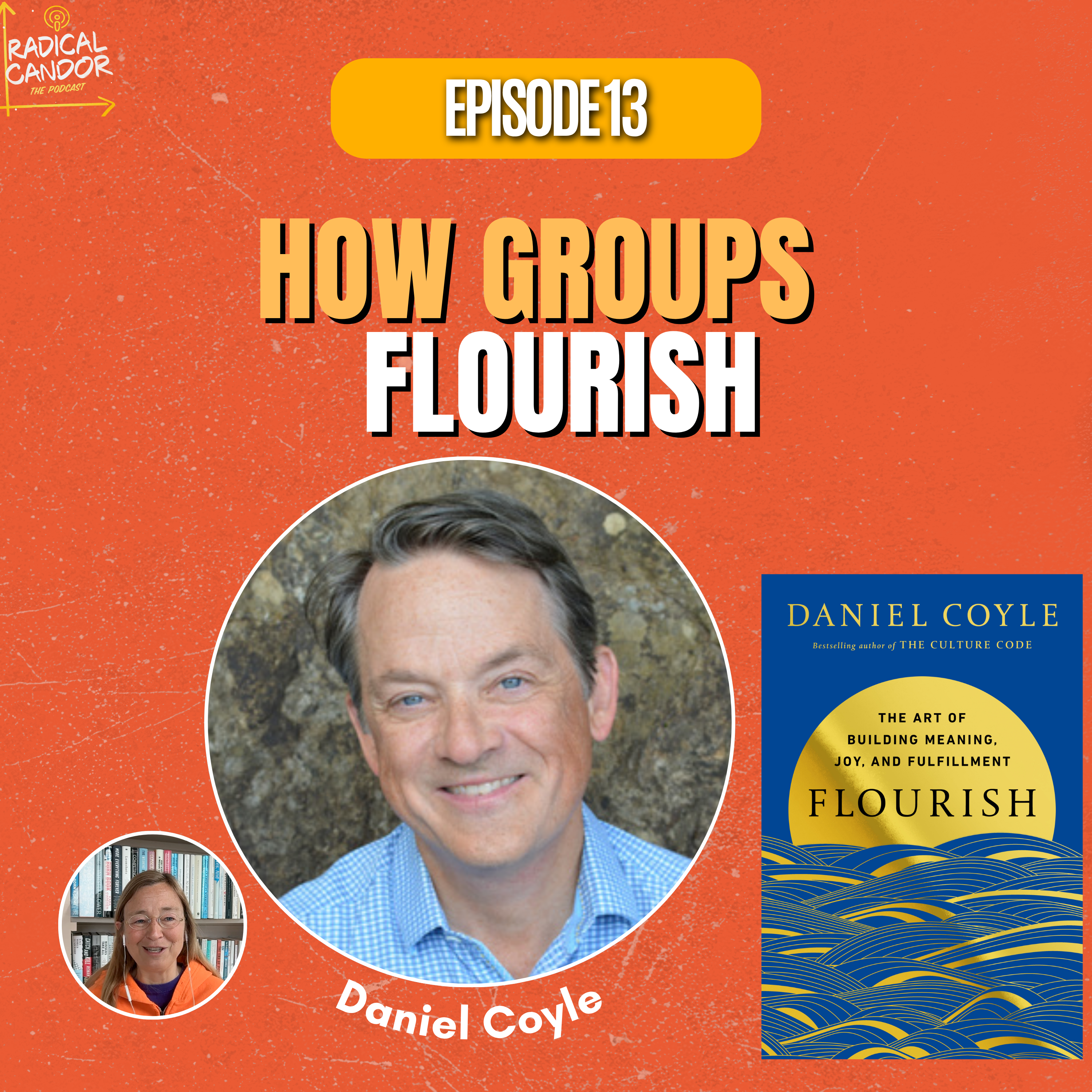
Table of Contents
While the podcast team is taking a Radical Sabbatical, Kim is interviewing authors of the books that have had a big impact on her in the past two years. In this episode, she's speaking with Daniel Coyle about his new book, Flourish: The Art of Building Meaning, Joy, and Fulfillment.
On this episode of the Radical Candor Podcast, Kim talks with Daniel Coyle about what it means to flourish — not just as individuals, but as teams, organizations, and communities. What is a meaningful life, and how do we make one? How do certain communities foster closeness, fulfillment, happiness, and energy? It turns out that the key isn't command and control. It's connection, curiosity, and the willingness to let go of power.
Watch the episode:
Daniel Coyle draws a sharp distinction between machine thinking and living-systems thinking. Machines are built to behave the same way every time — and that's great for cars. But when you're trying to create a culture, grow an organization, or lead a team of human beings, the machine model breaks down. "We're not going to build it, we're going to grow it," Coyle says.
The pattern he found across every flourishing community was the same: connection came first. Not strategy, not efficiency, not a charismatic leader with all the answers — relationships. And those relationships were built not through information exchange or status signaling, but through small moments of openness, curiosity, and genuine attention. As Coyle puts it, "Maybe we've had the map upside down. Maybe it's the relationships that create the productivity and the progress we're looking for."
Coyle opens his book with the story of 33 miners trapped 2,000 feet underground in Chile in 2010. The early narratives credited their survival to strong, charismatic leadership. The truth was more interesting. When the miners first realized they might not be rescued, foreman Luis Urzúa walked to the center of the circle, removed his symbolic white helmet, and said: "There are no bosses and no employees here."
It wasn't an answer that saved them — it was a question. What if there's something bigger waiting for us? That moment of surrender, of letting go of the hierarchy, allowed the group to self-organize into a brotherhood that sustained them for 69 days. Kim Scott connects this to her own work on Radical Candor: "Few things are more damaging to a relationship than a power hierarchy. You have to figure out how to lay that power down."
Dutch engineer Hans Monderman grew up fixing radios and became obsessed with a question: why do traffic accidents happen? His surprising finding was that the signals and stop signs meant to prevent accidents actually turned off drivers' brains. So he convinced a village to rip out every traffic signal and create an open space. Drivers had to self-organize — and accidents dropped.
Coyle sees the same principle in every flourishing organization he studied. Leaders who created the conditions for self-organization — autonomy, a clear horizon, and a sense of ownership — got dramatically better results than those who commanded from the top. The All Blacks rugby team has players organize practice. It's messier, but that messiness isn't waste — it's agency. "If it's not a little messy," Coyle says, "you're not doing it right."
In the 1970s, when school desegregation was sparking violence in Austin, Texas, PhD student Elliot Aronson created the "jigsaw classroom." Instead of a teacher lecturing at the front, students divided into small groups, each person responsible for teaching one piece of the lesson. The results were striking: better performance, warmer relationships, and incidents of racial prejudice and violence dropped dramatically. Average teachers using this method outperformed the best teachers using the old one.
In Kibera, Kenya, Kennedy Odede — a former street kid who built Shining Hope for Communities into a multimillion-dollar NGO — responded to thugs trying to steal school equipment not by fighting back, but by taking the injured attacker to the hospital and explaining: that school is for your kids. Kim Scott and Coyle land on the word reverence to describe this kind of leadership: approaching the people you lead with genuine awe for what they're capable of, rather than trying to control them into performing.
[00:05] Kim Scott: Welcome to the Radical Sabbatical podcast. I'm Kim Scott. And while the rest of the Radical team, Radical Canter team is on sabbatical, I am using my sabbatical to read great books and talk to the authors. And so I'm thrilled to say that with us today is Daniel Coyle, who is known probably to all of you as the author of The Culture Code and who has written a wonderful book that really meant a lot to me flourishing. Not that the culture code didn't mean a lot. It did, but I especially love your new book. So welcome Daniel.
[00:41] Daniel Coyle: Thanks, Kim. It's so fun to be here with you. gotta say, I'm a huge fan of your work and what you do and how you do it.
[00:46] Kim Scott: huge fan of your work. And so I feel very lucky to be spending some time with you today. One of the things that is so interesting about your book, for me at least, is that it totally redefines the role that leaders play in creating teams that flourish, or societies actually that flourish. It seems like your book in many ways is, is
[00:51] Daniel Coyle: Thank you. Me too. Mm-hmm.
[01:13] Kim Scott: an explanation of why neither command and control or charismatic leadership work and why founder mode is just a disaster. I don't know if you agree with that, strong opinions strongly help, but always open to disagreement. And autocratic leadership is just a flourishing killer in my book, at least, and it seems to me in yours.
[01:30] Daniel Coyle: Yeah. I like that. Yeah, no, I would agree with that. It's good for simple stuff, right? If you want to go from A to B, it's kind of good to have a machine. I think the main distinction we're talking about is between like algorithm machine world and living systems, things that are alive. And with things that are dead, like your car is not alive, right? To have it work in a certain way and be the same every single time and deliver the results we want it to deliver, like, that's awesome, that's great. But when you go to actually
[01:50] Kim Scott: Yeah. Yes. Yes. Yeah, yeah. Yeah.
[02:10] Daniel Coyle: I want to create a life or an organization or a community or a culture. That's not a machine.
[02:13] Kim Scott: Yeah. Or if I want to, yeah, and if I want to build a car, I need people to build a car. I just wrote a post recently about how we're treating AI the way that I think Detroit tried to treat workers at some point and lost out to the Japanese auto manufacturers who were treating workers like assets that should be invested in, not like...
[02:18] Daniel Coyle: Mm-hmm. That's right.
[02:41] Kim Scott: cost centers to be reduced.
[02:44] Daniel Coyle: Right, this distinction between living systems and non-living systems is really, really powerful when you understand that we're not going to build it, we're going to grow it. Which, your stance toward your group, you know, I know you have some new leaders listening to this and some CEOs listening to this, but this idea that what is your stance toward the people around you? Are you approaching them like objects, which so, that'll create a whole type, a whole type of attention, a whole type of action, or are you approaching them as living things that you're trying to actually build a relationship with?
[02:52] Kim Scott: Yes. Yeah. Yeah. Yeah. Yes.
[03:14] Daniel Coyle: That's the key, I think, that makes these places stand out in our world where so much has gone over to the algorithm. So much has become frictionless. These frictionful human interactions that they're creating, it makes us come alive. It creates that sense of aliveness that we've been looking at the map. Great performance will lead to fulfillment in relationships. Great performance, and then I'll have fulfillment in relationships.
[03:26] Kim Scott: Yeah. Yes.
[03:42] Daniel Coyle: Maybe we've had the map upside down. Maybe.
[03:43] Kim Scott: Yeah, maybe it's the relationships that create the productivity and the progress that we're looking for. Yeah.
[03:48] Daniel Coyle: That's right. Yeah. It's true. It's true. I mean, that's the pattern I saw in all the places that I visited. They were that connectiveness first. And if you can, which sounds woo woo and kumbaya when you first hear about it, like it sounds soft when you first hear about this stuff. And yet when you look at living systems, when you look at how ecology works, when you look at how a tree grows, when you look at how anything alive, they start with connection. They start with roots. They start with connection and they grow from there and they don't.
[04:00] Kim Scott: Yes. Yeah. Yeah. Yes.
[04:22] Daniel Coyle: command and control and authoritarian their way toward that growth. They nurture their way toward it. They create conditions where it can happen, which is really different than forcing it.
[04:26] Kim Scott: Yeah. Yeah. Yeah, yeah, you can't, one of my firmest beliefs is like as a manager, you're at the center of a wheel and then there's your relationships and then there's your responsibility and your culture comes from how you treat yourself, how you build relationships and therefore how you conduct your responsibilities. And if you think that you can, you know, I think A leader's main responsibilities are to solicit and give feedback or guidance, as I prefer to call it, to build a great team and to get shit done, you know, basically those three things. And if you think you can do those things without good relationships, I think you're just kidding yourself. know, command and control work really well in a baboon troop, but not so well in a group of, and even it's not clear that it serves the baboon so well.
[05:05] Daniel Coyle: Mm-hmm. Mm-hmm. Mm-hmm. Mm-hmm. That's right. Yes. No, right, right. These are complex problems we're trying to solve. And I love that spot line, the relationships. And the thing that I guess I didn't understand clearly about relationships before I started this work on this project was like relationships happen in moments. They don't happen in the form of a currency of information exchange or the currency of status establishment. The currency is where these moments of openness, these moments of noticing, these moments of seeing and being seen, all those soft moments.
[05:31] Kim Scott: yeah. Yes. Yeah. Yeah. Yeah.
[06:00] Daniel Coyle: moments of care, if you want to call it that, and where it got really moments of challenge. Yes, when you actually are kind of having that. And I kept seeing that in all these places I visited. It's like they were, most places are really good at getting stuff done, but these places were good at getting stuff done, but they were also good at the second piece of that, which is like pausing. Like they were like pausing geniuses. Like we're going to pause it. What are we doing again? Why does this matter? Why does this matter to you, Kim? Why does this matter to me?
[06:02] Kim Scott: Yeah, moments of challenge as well. Yeah. Yes. Yes.
[06:29] Daniel Coyle: what are where we headed, we're going to have these pauses that are almost like, I don't know, they're like the batteries get recharged, you get grounded, you connect in a deep way. And that connection is actually just a form of energy that lets you do the work.
[06:39] Kim Scott: Yeah. Yeah. And you have such good stories about the value of those pauses. I want to get to the miners in Chile in a second, but first let's talk about your definition of flourishing, which I thought was just really beautiful. You quote Robin Wall Kimmerer, all flourishing is mutual. And that is just the damn truth.
[06:50] Daniel Coyle: Mm. Isn't it? It's like we're social beings, right? We're social beings and yet that truth still caught me by surprise. You know, I spent my life studying performance and we all fall for this persistent illusion that greatness and performance is like individual, right? There's rugged individual and I did it and yet when you actually scratch the surface of every great performer, you end up always uncovering a community that helped them, right? You scratch that and that I did it. Somebody put it this way. They said,
[07:12] Kim Scott: Yeah. Yeah. Yeah. Yeah. Yeah.
[07:35] Daniel Coyle: every and you can say I did it and every word of that is a lie. Like, it wasn't you. You didn't actually do it. And whatever you thought you did wasn't just you doing it. It wasn't it. So it's like this this definition of flourishing, all being mutual and really flourishing being joyful, meaningful growth shared. That would be the definition, the scientific definition that I began the book with joyful, meaningful growth shared and this what it took me to was really
[07:40] Kim Scott: Yes. Yes. Yeah, it wasn't it either. Even it, yeah. Yeah. Yes.
[08:05] Daniel Coyle: these places that were, get their communities, real communities that are serving each other and serving a higher goal at the same time. And when we all, when we reflect on our life, it's not something that's that distant. It's something we've all experienced at some point. It's not like some magical castle in the sky. Like when you ask people, have you ever felt joyful, meaningful growth and share that with others? There's nobody that says, I got, I drew a blank, right? Never happened to me, right? It happened, we're built for it.
[08:28] Kim Scott: Yeah, that's never happened to me. Yeah, yeah,
[08:34] Daniel Coyle: Like, and
[08:34] Kim Scott: yeah.
[08:34] Daniel Coyle: that was the other big kind of insight and sort of ground truth of this book was these weren't stories of like huge transformations. There were stories of more unlockings. There were stories of more like a little bit more of an awakening that, you know, we are pre-wired for community. We evolved in community. All of our ancestors survived and got us here because they were good at this stuff. Like they were good at the community piece. They didn't, there weren't rugged individuals that like ruggeded their way.
[08:56] Kim Scott: Yeah. Yes. Yeah.
[09:02] Daniel Coyle: across a million years of indifferent nature and therefore our grandpa. Like no, grandpa grandpa made it because they were good at community. And our world has like kind of forgotten that a little bit. Like I think we've drifted away from these core experiences that awaken it.
[09:05] Kim Scott: Yeah. Yeah. Yeah. Yes. Yeah. Yeah. So one of my, you start with this really powerful story about the miners in Chile. So tell that story for folks because it is so, I mean, and then people should go read it in the book, I want to say, but tell that story because it is so eye-opening and so moving.
[09:41] Daniel Coyle: We know the, yeah, 2010, we mostly know the outlines of the story, right? If you had to pick somebody to be in the history of the world, you probably wouldn't pick being one of these 33 guys, roughnecks down 2,000 feet below the surface, 10 million tons of rock on top of them, very little hope of rescue. We all know how it ended. They all got out and they all were sort of a brotherhood. But the interesting part happened in the first 16 days where they didn't realize they didn't know they could be rescued. They thought it was over. They naturally thought they
[09:51] Kim Scott: Yeah, Mm-hmm. Yeah.
[10:10] Daniel Coyle: They were down there. And the question was, did they survive that time? How did they come together and form this kind of brotherhood that when they finally made contact with them with a phone line, they sang a song actually, and they asked about a truck driver who had been in the tunnel with them. They asked about someone else. Did they survive? And the first theories that came out of that, the first stories, narratives that came out were that they were led by these powerful, charismatic leaders that told everybody what to do. Turned out,
[10:14] Kim Scott: Mm hmm. Yeah. Yeah. Yeah. Yeah.
[10:38] Daniel Coyle: When you look deeper, when there were several studies done, that wasn't the case. What happened was they circled up, they sort of surrendered to each other. The leader walked into the center.
[10:48] Kim Scott: Well, the leader started by saying, I'm no longer, he took off his hat, right? Like that's such an incredible moment.
[10:51] Daniel Coyle: He and. And this was a thing that nobody expected this guy to do. His name was Luis, he was the stern foreman and he's in charge. Like we're down here, Luis, what should we do? He walks to the center of the circle, he takes off his symbolic white helmet, says, there are no bosses and no employees here. There are none, period, boom. And it's just this uneasy uncertainty, this pause really, where people have to actually let go of control, like we are together here. And then shortly after that, there was another moment where somebody counted heads and they realized they were the same.
[11:07] Kim Scott: Mm-hmm. Yeah.
[11:23] Daniel Coyle: It's 33, that number's meaningful. It's the same age that Christ was, these are Catholic folks, was when he was crucified. And maybe there's something, and he asked the question, maybe there's something bigger waiting for us out there. Maybe, just a question, it wasn't an answer, it was a question. Maybe somebody's bigger. These are both two questions. They thought what served to save them were answers, but in fact what saved them were these questions, deep questions. What if there were no leaders and no employees? What if there's something bigger waiting for us?
[11:24] Kim Scott: Yeah. Yeah. Yeah. Yeah. Yeah. Yeah.
[11:48] Daniel Coyle: Simple questions and that question shifted people's attention and allowed them to connect We think of those moments as being like magical moments, right? But they're not magical They're actually how our attention systems work were built to connect to other people but to do that We have to kind of let go of control a little bit. We have to surrender a little bit a lot exactly
[12:06] Kim Scott: Yeah, a lot actually, not just a little, know, take off the hat and say, there are no leaders here. Yeah. Yeah.
[12:13] Daniel Coyle: That's a hell of a thing. That's a hell of a moment. And that's how they survived. this idea that the last thing you want to do, letting go of control, is actually the thing that will save you. The thing that will save you is relationships. And relationships happen in openness. They don't happen through answers. They happen through questions, where you say, what if there's something bigger here? What if there were no bosses and employees? And mean it. And mean it. Not manipulate, not control, but mean it.
[12:18] Kim Scott: Mm-hmm. Yes. Yeah. Yeah. Yeah. Yeah. Yeah. Yeah.
[12:41] Daniel Coyle: So that's
[12:41] Kim Scott: Yeah.
[12:42] Daniel Coyle: why I started the book with that story, because I think sometimes it feels like we're down in the mine these days, right?
[12:46] Kim Scott: Yes. Yeah. Yeah. I mean, one of the things in radical canter that I talk about is you're just like, if relationships are at the core of your ability to succeed as a leader, there are a few things that are more damaging to a relationship than a power hierarchy. And so even though you're a manager and you still are a manager, you're, you know, you're not down in the mine. You can't, don't have the freedom to take your hat off. You do have the freedom to figure out how to lay that power down.
[13:04] Daniel Coyle: Mmm.
[13:16] Kim Scott: in some other way so that you get on a level playing field and work well with your team. Because if you don't take that hat off, if you don't lay that power down, people are not going to tell you what the truth is.
[13:24] Daniel Coyle: I love that. Lay that power down. That's right. That's exactly right. That's exactly right. And that idea that the relationship is this like living thing that you have to nurture through these moments. And those moments always end up kind of revolving around curiosity and questions. you know, again, that sounds kind of soft, but if you think of it in a chain, like, you know that the quality of your work life or your life is the quality of relationships. We know that, right? Well, the quality of relationships, let's dig into that. That's the quality of your conversations.
[13:45] Kim Scott: Yeah. Mm-hmm. Mm-hmm. Yes. You have bad relationship. Yeah.
[14:01] Daniel Coyle: Like, if you have bad conversations, you don't have good relationships. And then let's go one level deeper. The quality of your conversations depends on the quality of your questions. Like, you cannot get great conversations out of bad questions or having all the answers. And that depends on curiosity. it's like that curiosity isn't some nice little extra. It's like absolutely the...
[14:10] Kim Scott: Yes.
[14:27] Daniel Coyle: governing software of these moments. know, it is the essential moment that that they had in the mind and that I saw in all these places that I visited. And I think that you're capturing in in so much of your work, that moment of saying, What if I don't know what's going on here? What if I step into uncertainty alongside somebody?
[14:41] Kim Scott: Yeah. Yeah. And what if we stop trying to do things? Like, let's create the space in our day to have these conversations because conversations take time. You can't multitask and have a conversation. And that means you have to, it feels when you're having a conversation, like you're not doing anything. You're actually doing the most important thing, I believe. But
[14:54] Daniel Coyle: Yes. Mm-hmm. Mm-hmm. Yeah. Isn't it hard to let go of that? It's like, it feels inefficient. It feels like it's a waste of time. And yet that's your key tell that it is not a waste of time. It's like such a, it's like talk about a reversal. Yeah, it's super hard.
[15:16] Kim Scott: Yes. Yes. Yeah. Yeah. It's hard. Yeah. Yeah. And I think that so much of, this is a random segue, but I was watching this TV show about a cult. And one of the things the cult leader did was kept people so frantically busy that they didn't realize what was going on really, that they had no perspective. And I...
[15:45] Daniel Coyle: Well, yeah.
[15:47] Kim Scott: As I was watching this show, was like, this is kind of like high school. We got to create some time for people, especially young people. yeah, yeah, yeah, exactly. Yes, yes, exactly. Yeah.
[15:55] Daniel Coyle: I know, I know. I know, just to remind you of anyone, we're so busy, Brian's been in many situations, not the least of which is our national political one. yeah, and that phrase, creating space, like, I don't know about you, but I always looked on that space as like, that phrase, creating space, always smelled a little like patchouli to me, like it smelled a little hippie-ish, like creating space, like, come on, dude, like, you know, don't need to create space for me, let's just talk, like, don't be so groovy.
[16:16] Kim Scott: Yes. Yeah. Yeah. Yeah.
[16:24] Daniel Coyle: Actually, through the course of this research, I've come to believe that that is an accurate and analytical, beautiful description of what happens in healthy, flourishing cultures is that they're good at creating space, which is inviting people in like that miner did when he took off his helmet. He wasn't solving anything. He wasn't providing information. He wasn't guiding. He was creating space. And that's a hell of a move. And I think great leaders
[16:37] Kim Scott: Yeah. Yeah. Yeah. Yeah. Yeah.
[16:54] Daniel Coyle: are really, really good at it. Not just creating space for other people, but creating space inside their own day, inside their own reflections. It's really a beautiful art.
[16:57] Kim Scott: Yeah. Yeah. Yeah. Yeah, you're making time for it maybe is a better way. And you have to make the time. You have to clear some space in your calendar is kind of what I say, make space. What I'm imagining is actually just deleting some of the meetings off my calendar so that I have time to do what I should be doing. Yeah, yeah, maybe even a lot.
[17:09] Daniel Coyle: Yeah. Yeah, a little subtraction, right?
[17:30] Kim Scott: The other thing that that story of the miners in Chile reminded me of is, did you ever read Paradise Made in Hell or Created? Yeah, yeah, by Rebecca Solnit. That's a great book to read, to sort of understand how to flourish, even in really hard situations. And yes, yeah.
[17:40] Daniel Coyle: Yeah, absolutely. Yeah. my God. Solnit, yeah. Isn't it? Because of really hard situations even right like it made that book for readers who haven't seen it is just this this trip through some of the worst disasters ever and The beautiful communities that arose from the chaos and the ashes of these places and people reflecting like that was the greatest they feel guilty saying it actually because there's disasters people saying that was the most fulfilling time of my life when our whole town was ruined and we had to come together and make meals and take care of old people and
[18:03] Kim Scott: Yeah. Yeah. Yeah. Yeah.
[18:22] Daniel Coyle: And it made me think of like, as a parent, it's like, what are the funnest nights of the year as a parent? And it made me think, it made me realize actually that blackouts, when we lose power, and just like in her book, like, okay, wow, get the candles. What are we doing for dinner? What are we gonna do? We're gathered around a game or something, everybody candle it. It's a bad thing, but in fact, it's a beautiful constraint to bring us together and help us self-organize.
[18:28] Kim Scott: Yeah. Yes. Yes. Yeah. Yeah. Yeah. Yeah. Yeah.
[18:51] Daniel Coyle: which is at the core, agency self-organization is at the core of this feeling of aliveness.
[18:57] Kim Scott: Exactly. And how can we create those moments without having the disaster have to happen? Let's think about that. It's really important. So also sort of continuing on the thoughts that you had about relationships and how to create a great relationship. And something that really struck me in your book for reasons that will become obvious were your conversations.
[19:04] Daniel Coyle: I I know.
[19:25] Kim Scott: around the Gottman method and working with that, with the, well, I guess her name, what was her last name? Schwartz, Schwartz and Don Gottman. So describe why that works for relationships. And in particular, I'm going to want to predictably double click on the word criticism, because I talk a lot about the importance of giving criticism and they talk a lot about the danger of it. And I think it's just that we have a different definition of criticism.
[19:27] Daniel Coyle: Mmm. Julie Schwartz and John Gottman.
[19:55] Kim Scott: I don't want to go too far down this semantic rat hole, but what works for relationships and what are the four horsemen of relationship apocalypse?
[20:01] Daniel Coyle: Mm-hmm. Yeah, well, a little bit of backstory here with you know, there's there's been a lot of attempts to build sort of therapeutic models to help people have better relationships. And most of the a lot of them don't work very well. I mean, that's that's the scientific truth. The Gottman is the exception because it does. And the interesting thing about them, and he's a mathematician, and she's a clinician, they built, they had this thing called the love lab where they observed in detail, like in painstaking captured all the interactions of couples healthy and unhealthy, and then tracked if they
[20:15] Kim Scott: Yeah. Yeah.
[20:35] Daniel Coyle: stay together or not. And so they kind of got it down to the signature behaviors, the fingerprint behaviors. And one of the things that they've noticed is the importance of kind of attention in this. Basically, their method is about paying certain kinds of attention to your partner, where the key example that they give is around something called bids. When someone has a bid for their partner's attention, it's incredibly predictive. If the partner like,
[20:36] Kim Scott: Mm-hmm. Mm-hmm. Mm-hmm.
[21:05] Daniel Coyle: looks out the window and says, huh, the other partner can either answer the bid positively, they can be neutral, or they can be negative. And what they found is that healthy relationships that stay together, they answer the bid positively like 82 % of the time. Unhealthy relationships only answer the bid 33 % of the time. For attention, just the bid, just the little throat clearing and then, yeah, there's no information there, there's just.
[21:13] Kim Scott: Mm-hmm. Wow. for attention. Yeah. Yeah, like look out the window or, yeah. Yeah.
[21:33] Daniel Coyle: pure attention, just pure like, I'm listening, I care, I'm there, presence, you might say, presence. yeah, and then they also found that there are what they call the four horsemen of relationship apocalypse, which are sort of four behaviors that predict whether relationships will not do well. they are, think stonewalling is one of them. You'll have to name the other ones for me, I'm trying to make.
[21:37] Kim Scott: Yeah, yes, space. Yeah. Yeah, well, criticism, let's just talk about criticism for a second, because that was one of the four horsemen. And I'm saying criticism, in my book, I say criticism is really important for a good relationship. I think what I call criticism, they would call having a productive disagreement, but maybe that's my, but if, so in other words, there was a story you told about laundry on the floor and,
[22:03] Daniel Coyle: Yeah, yeah. Mm-hmm. Mm-hmm. Yeah, that's right. Mm-hmm.
[22:26] Kim Scott: And the way not to tell your spouse to pick up the laundry is you are so lazy. That's like what I would call personalized criticism. You're criticizing their personality attribute. And that is no good. Whereas I find it frustrating when there's clothes on the floor is another way to say it. Or just clothes.
[22:41] Daniel Coyle: Yeah, yeah.
[22:55] Kim Scott: Just like you've had this conversation before probably. It's like with my kids when they were not brushing their teeth. Rather than like delivering the same damn lecture on hygiene, dental hygiene, I would just say teeth and then they'd go brush their teeth.
[23:08] Daniel Coyle: Mm-hmm. Mm-hmm. Yeah. Right, right. It's a cue. you have beneath that is an understanding of why mom cares about this and why it's good and explaining that. And the Gottmans are very strong on explaining the meaning behind things so that you don't have to go through just the information exchange piece of it. And there's kind of a, I don't know, there's a lightness to it that I think you capture by just saying teeth. There's something playful about that, right?
[23:16] Kim Scott: Yeah. Yes. Yeah. Yeah, yeah,
[23:37] Daniel Coyle: which says we're in a relationship, you get it, I get it, right? I know this, know,
[23:38] Kim Scott: yeah. Yeah, yeah. I know that you don't wanna hear this again.
[23:44] Daniel Coyle: that's right. And I understand that. And so let's just have some, let's have a little lightness and a little fun to it. And that's what they bring to those things, that quality of attention that is not robotic and it's not machine like and it's not command and control. that's the other really, yeah, that's right. That's right.
[23:49] Kim Scott: Yeah. Yeah. Yeah. And it's not contempt. I think that was the other real dangerous horseman of relationship apocalypse. And I think that that, like to me, if you're gonna, if you really care about, if you don't respect someone, you're not going to, you're not going to show them that you care and you're also not gonna challenge them. And so respectful, maybe I should call it challenging and not criticism.
[24:18] Daniel Coyle: Mm-hmm. Yeah, I like that.
[24:26] Kim Scott: But like respectful, caring, challenging is important for all of this. It's important for any relationship, I think. And then, so then you move on in your book from individual relationships to sort of group flow, the systems that work, and you tell this wonderful story about traffic. So talk to me about traffic, because I love that story.
[24:31] Daniel Coyle: Right. That's right. That's right. Mm-hmm. Mm-hmm. Mmm. Yeah. I'm so glad. so glad. Well, it's kind of Hans Monderman. grew up fixing radios in the Netherlands and he got fascinated with roads and he saw roads as like the sort of like he saw radios, like these mysterious things that connect us. And he became a driving instructor and then a road engineer. And he got obsessed with this question, which is why do accidents happen? Like, why, why do people have accidents on the road?
[25:01] Kim Scott: Mm-hmm. Yeah. Mm-hmm. Yeah. And we all think we know the answer, but we don't.
[25:25] Daniel Coyle: Right, right. He digs into it and he sort of it brings him to the fact that the things that are meant to stop accidents, which is clear, really clearly marked lanes, very clear signals and stop signs actually are things that turn off people's brains that accidents happen because they're they just think the stop sign is the only thing they have to pay attention to and they miss the things right in front of them. They're we're on autopilot.
[25:38] Kim Scott: Stop sign. Yeah. Yeah.
[25:52] Daniel Coyle: like we are sometimes in our organizations or our family. We're on autopilot. So he decided to try. This is like in the eighties. He somehow, he must be a very persuasive guy. He convinced a village to rip out all the traffic signals and create just this big open space, almost like a giant roundabout. They used some plantings. It sent this signal that like you are now in a village and they removed even all the curbs. Everything is kind of flat and open. And when drivers come up on that, they
[25:52] Kim Scott: Mm-hmm. Yes. Yeah. Mm-hmm.
[26:22] Daniel Coyle: they sort of stop and they self-organize their way through it respectfully, carefully, moving around the kids, moving around the cafe tables. It's called the Open Space Revolution and it's been adopted on Kensington High Street in London and Savannah, Georgia and Palm Beach, Florida. And this idea is that the best solution to any kind of traffic situation is to create a context where people can organize themselves. People want to organize themselves. They don't wanna just be a robot. They don't wanna say, stop, go, stop.
[26:46] Kim Scott: Yeah, they don't want to be organized. Yeah.
[26:50] Daniel Coyle: go.
[26:50] Kim Scott: Yeah.
[26:50] Daniel Coyle: Traffic lights are frustrating for that. if I can kind of go into the flow, anybody who's ever walked on a New York City sidewalk experience this all the time. It's kind of fun, right? It's kind of frustrating. And it's a little static, but it's kind of fun. And you're, you're not obeying. No one's telling you to step here, you go left, you go right, the whole group like a flock of birds is organizing itself around obstacles. And we have the ability to do this. And so what I saw in the places that I visited that were flourishing is that they were
[26:59] Kim Scott: Yes. Yeah. Yeah. Yeah. Yeah.
[27:19] Daniel Coyle: leaders were super intentional about creating context with three key pieces. We need to give people autonomy and agency. We need to give them that freedom. We can't be telling them what to do, right? We need to, it does not work. We need to give them a really clear horizon to go toward. We gotta have them a really clear horizon, like we gotta be clear that we're going north, that we're moving this direction, that that's our horizon, our goal, we're going to our vision. And then,
[27:27] Kim Scott: Mm-hmm. Mm-hmm. Yeah, telling people what to do does not work.
[27:46] Daniel Coyle: You have to give them ownership and connection. You got to give them a sense that they own what they're doing, that they're partly responsible for this part. And so I saw it really vividly on a rugby team, the All Blacks rugby team of New Zealand, one of the best ones. They have players organize practice every so often, which it's not efficient. It's a little bit like Monderman's roundabouts. It's a little messy, but that messiness is not actually messiness. That messiness, it's ownership.
[27:59] Kim Scott: Mm-hmm. Yeah. Yeah. Yeah. Yeah. And creativity, you're going to do things a little differently. You're going to, you know, in order to clean up the mess, you learn something that actually prevents the next 15 messes.
[28:14] Daniel Coyle: It's agency, it's flow. Exactly right. You're treating people like human beings if we're to sum it up like that, not like cogs in a machine. And so I kept seeing that same pattern, which from a leadership perspective really kind of blew my mind a little bit because, know, like a lot of people, kind of, you know, grew up trained on the idea that the leader is the person with the answers and who knows the direction in the ocean we're going and who has his hands on the the on the steering wheel of the ship. And this these leaders were like, they were
[28:28] Kim Scott: Yeah, yeah, yeah. Yeah. Yeah.
[28:53] Daniel Coyle: more asking questions like what do you think the great looks like and where they were creating really firm guardrails, know, like players will organize practice this week, but not all the time and practices from two to four. And so clear constraints, clear horizons, and then a ton of agency and they would be comfortable, you know, I call it the rule of the beautiful mess. Like if it's not a little messy, you're not doing it right. And mess is the doorway toward creating something new.
[28:56] Kim Scott: Yeah. Yeah. Yeah. Yeah. Yeah. Yeah. Yeah. Yeah. And towards self-organizing. mean, think it feels very Eleanor Orstrom, know, the economist who wrote about the tragedy of the commons is not always the tragedy of the commons. There are many, many, many examples throughout human history of people being able to self-organize much better than any system of rules could ever do.
[29:41] Daniel Coyle: It's so true. we feel it, you know, if anybody is an athlete, they feel it in there. And, you know, what's the best way to get better at a skill? It's not to like paint by the numbers and I'm going to move this arm and that arm. No, it's best to like, if you're going to try to jump over something, you self-organize and you jump over it. That's the best way. You don't do it by the numbers. You actually, this way of creating a space and exploring into it is how all learning happens.
[29:59] Kim Scott: Yeah. Yeah, yeah. so leaders today need to think about their job as building good systems, but not command and control bureaucracies. And I think too often when you think about the word system, you think of some kind of terrible bureaucracy built by, you know, healthcare insurance or something. And those are not, those are, those are terrible bureaucracies. And I learned this, I think one of the other mistakes and I don't know,
[30:19] Daniel Coyle: Yeah, that's right. Right. Right. Right.
[30:39] Kim Scott: I don't know about you, but that I made about leadership early is I thought, you know, if I were in charge, everything would be better because I'm such a good person with such good intentions, you know, and it turns out that's completely false. Even a good person will create a terrible situation if they don't take the time to build systems that, yeah, yeah.
[30:52] Daniel Coyle: Yeah, right. Right. It's so true. Right, and to build living systems, not to build machine-like systems. to the leader, leader as designer is really an interesting kind of metaphor because I think it puts the spotlight on the fact there's a humility to being a designer. There's learning as you design that you adapt the design as you go. You don't just kind of issue it and good luck everybody. Good designers are having
[31:07] Kim Scott: Yeah. Yeah. Yes. Yeah. Yeah. Yeah. Yeah.
[31:29] Daniel Coyle: sort of a conversation with the people that they're being designed for. And that's the kind of personality that I kept seeing over and over again, a willingness to admit error, a willingness to be curious about how things were going, a clarity, a real clarity about where we were headed. I mean, that was huge, on the one hand, it's kind of intimidating to have leadership be complexified like that. Like that sounds more complicated than just knowing the answer and telling people.
[31:31] Kim Scott: Yeah. Yeah. Yeah.
[31:59] Daniel Coyle: to do.
[31:59] Kim Scott: except that you don't know the answer and telling people what to do doesn't work. yes.
[32:03] Daniel Coyle: It doesn't work. So you may as well do this. And I don't know about you, but I've had the same conversation with veteran leaders over and over again, when you ask them about their journey, right? Ask a great leader about their journey. And they will often say some version of, know, for the first 10 years, I really thought I needed to have all the answers. I thought I was doing a good job. But I reached a point where that stopped working for me or my job got so big and complex. And I realized I had to change from being
[32:09] Kim Scott: Yes. Yeah.
[32:32] Daniel Coyle: like the person with the answers to becoming like the person with the good questions.
[32:36] Kim Scott: The questions, yeah. Where your job is listening. I think another great example in your book of this is the Austin School District. I love that story. So talk to us about the Austin School District and what happened there.
[32:43] Daniel Coyle: Hmm Yeah, this is in the 70s. They started busing and there was a lot of racial tension all of a sudden in these suburban schools where kids are being bused from poor neighborhoods into middle class schools. And the kids were fighting and the parents were upset and there was all kinds of bad feeling and the teachers were just barely holding it together. And they contacted a PhD student at the University of Texas, Elliot Aronson, and they brought him into the school and they said, is there something you could
[32:54] Kim Scott: Mm-hmm.
[33:16] Daniel Coyle: Help us help us make this more peaceful help us make this right and so He decided to try an experiment where instead of having the teacher at the front of the class teaching the lesson That he would essentially flip it and he would divide the classroom up into small groups. He called it the jigsaw classroom each group would be in charge of part of the lesson if you were learning about the life of
[33:18] Kim Scott: Yeah, make this right. Mm-hmm.
[33:44] Daniel Coyle: Teddy Roosevelt, would, someone would learn about his youth, someone would learn about his wartime experience, and they divide up the lesson, and each person is responsible for a small part of that lesson. So it flips from being, the student being the passive vessel, the obedient vessel raising their hand saying, I know the answer, to the small cooperative groups where everyone's in charge of their certain piece, and the job is to teach it to their classmates. The job is to teach it. So, and in those classrooms that did that,
[33:54] Kim Scott: Mm-hmm. Yeah. Yeah. Yeah.
[34:13] Daniel Coyle: What they found was that they had better performance. They also had warmer relationships. Incidents of racial prejudice and violence dropped dramatically. And average teachers, average skilled teachers using this method taught better than the best teachers with the old method. So it was transformational moment that where kids went from being consumers to being citizens of their classroom, where they go from.
[34:30] Kim Scott: Wow. Yeah. Yeah.
[34:40] Daniel Coyle: being just sort of vessels to having to step into uncertainty alongside their fellow students. And it's the same pattern that I saw in so many of the places I visited where they're designing, it's a design choice, spaces where people can get into flow together, where people can each have a role, where they can have some agency, where they're going toward a clear horizon, and they're self-organizing. They're using their own ideas and energy.
[34:54] Kim Scott: Mm-hmm. Yeah.
[35:07] Daniel Coyle: to add to the conversation. They're not just passive. And it makes the classroom come alive. there's a real, in the book I include this really moving letter written by a formerly shy student. I think his name was Pablo. He ended up going to Harvard. And when he got to Harvard, he saw a little study that hit the study about his classroom. And he wrote Aronson a letter just saying, when I showed up, I didn't want to raise my hand. I didn't. like it. didn't like school. I didn't like my classmates. And this structure really made me realize that I was, they also were scared and we got to be friends and now I'm about to go to Harvard Law School. But like growth is never linear. Growth is never predictable. Growth is never command and control. so these, these places are good at designing for growth, I guess is the way to put it.
[35:34] Kim Scott: Yeah. Yeah. No. Yeah. Yeah. Yeah. And I love what you said about this experience where, where leaders stopped analyzing the parts of a system or of the people in the system to experiencing the whole. and I think it's sort of what Martin Buber calls an eye thou relationship. It's, it's not just respectful kind of leadership, but it's a leadership that's actually reverent to each of the people who.
[36:20] Daniel Coyle: Hmm.
[36:22] Kim Scott: You know, and that means you as a leader need to be, you're laying your power down because you're reverent to the people who are working for you.
[36:30] Daniel Coyle: What a good word that is. That really does capture it. It is a reverence because there's something bigger than you that you, it's not you, and you have to respect it and you have to give it the benefit of the doubt and you have to let it grow the same way you're kind of like reverent toward even a garden, right? A tree, like there's something there that's mysterious and cool and worth attending to. Yeah, it's really cool.
[36:36] Kim Scott: Yeah. Yeah. Yes, or a tree, you know. Yeah. Yeah, yeah, yeah, I love that. I know that we're coming up on time, but you have such a great story also in the book about the same kind of reverent leadership about the Kibera School for Girls that was getting built and how the leader of that, I think like the most effective NGO in the world handled a really hard situation.
[37:23] Daniel Coyle: Yeah. Yeah, his name is Kennedy O'Day days a former street kid that started this organization that now is multimillion dollar employees, 88 % local people in these local settlement in Kibera, Kenya. And one day they were building a school for Google Girls and as happened sometimes some thugs in the neighborhood came by to try to thugs is probably the right word I would use but some sort of mafia types almost in the neighborhood came by to try to steal
[37:49] Kim Scott: Yeah.
[37:53] Daniel Coyle: equipment and there was a brawl and one of them got hurt got slashed with a machete and Odete's response was not to fight them. It was to take that person to the hospital and pay for their medical care and also explain that that school is for their kids to like that school is for your kids and you're robbing from yourself and so the patients the curiosity that he brought to that moment is what he's
[38:07] Kim Scott: Wow. Right. Yeah, you're robbing from yourself. Mm-hmm.
[38:21] Daniel Coyle: brought to every moment. he's one of the key reasons that this this we're talking about Shofko, it's called Shining Hope for Communities. But that level of reverence, I guess, is what he had there where he you know, other people would see someone who's trying to rob them and, and he was able to let go of that, take off his white helmet, so to speak, and, and connect with this person. And the person did end up at a human level. I mean, incredibly difficult to do, and incredibly powerful.
[38:22] Kim Scott: Yeah. Yeah. Yeah. Yeah. at a human level, yeah. Yeah. And you interviewed a bunch of people who had worked for him and it sounded like they all had a similar description of his leadership style. He never told people what to do. Yeah.
[39:00] Daniel Coyle: listening, listening, listening. He's like, listening is the superpower. And he's really clear too, because he actually was educated at Wesley and he came over and did his college over here. And he just is a really clear litmus test on the difference on what Western education kind of does to you. He made me, he pointed out to me like, boy, he's like the Western people, you've kind of, you've lost touch with your soul a little bit is what he said. And
[39:09] Kim Scott: Mm-hmm. Yeah.
[39:29] Daniel Coyle: I think there's a deep truth in that. these places all taught me that same lesson that we're not going to think our way and analyze our way and command and control our way forward through this situation we're in now. We're going to have to like human and conversation and curiosity our way forward. I'm not sure if I invented a couple of new words there, but we're going to curiosity our way forward.
[39:41] Kim Scott: Mm-hmm. Yeah, I think that's good. All nouns are verbs now. Yeah, we do have, I mean, because I think that's, I mean, so interesting that he pointed out how Western education really hurt his ability to be, he had to unlearn some of what he learned when he went to college here. And that is the...
[40:08] Daniel Coyle: That's right. That's right.
[40:13] Kim Scott: taking us back to watching my kids being too damn busy and thinking they're in the cult. don't know what the cult of capitalism may be, high school in America right now, leading to college in America. Yeah.
[40:23] Daniel Coyle: I know. Isn't that the truth? mean, and so, but I think we're in the process and maybe AI will help hasten this. I'd be curious to get your take, but like, does it feel like people are moving that there's a clarity now between kind of the treadmill to nowhere and kind of these human communities and kind of team human stuff that I'm seeing. I'm, I have older kids from 30 to 24 and I'm seeing them kind of they have more clarity around that stuff than maybe five or 10 years ago. Like I feel they're moving toward their craving community and they're creating.
[40:56] Kim Scott: Yeah, yeah. Yeah, yeah. And their understanding flow and laying down power. think that, I don't know, AI will either help with it or it'll destroy us depending on whether we manage it or we let it manage us. And it's still possible for us to manage it and also to make sure that we don't allow the next wave of technical progress to do what the last one did, which is to
[41:08] Daniel Coyle: Okay. I know.
[41:28] Kim Scott: vastly exacerbate the gulf between the rich and the poor. If AI yields the top, the richest 100 people all the money and takes it away from the rest of everyone else, then it won't have helped. But it has the capacity to help, for sure, for sure. Let's end on your...
[41:35] Daniel Coyle: True, right.
[41:55] Kim Scott: on the sequel to Moneyball, your experience with the Guardians, because it's a great story and a very different environment to the other ones we've talked about, I think.
[41:58] Daniel Coyle: So, right. Thanks. Cleveland Guardians, formerly the Indians are, it's actually where Moneyball originated. Billy Bean hired analysts from the Guardian, from now Guardians, who were really good. They figured out the algorithm is to identify good players. Well, like any good algorithm, it gets shared. And so like the advantage is fleeting, is absolutely fleeting. And so about 13 years ago, I'd written a book about talent development, and the Guardians brought me in.
[42:13] Kim Scott: Mm-hmm. Yeah. Mm-hmm. Yeah.
[42:36] Daniel Coyle: as a consultant because they realize if we do it like other people, we're going to lose. We have to be less moneyball more Montessori ball is a way they thought about it. Because we have to have kids learn we have to have these these are this is a school system. It's a high performance school system you play in big stadiums. But ultimately, there's there's these teams, we've got to make great players. And slowly, but but surely, it's worked the over the last
[42:44] Kim Scott: Yeah. Yeah. Yeah. Yeah.
[43:04] Daniel Coyle: 13 years, we've won as many games as the New York Yankees and we spent $1.5 billion less. So we're adding up to more, we're developing good players, we haven't won the World Series yet, but the way we've done it, it's coming, it's coming, but the way we've done it is to continually kind of reverse engineer command and like flip it from command and control into intrinsic motivation, growth mindset, small groups, kind of the cardinal example of it would be.
[43:10] Kim Scott: Wow. Yeah. It's coming, it's coming. Yes. Yeah.
[43:32] Daniel Coyle: when we realized we need to improve our coaching, if we're going to create great players, we need have the best coaches in the world. And how do we do that? Well, our first instinct was to bring in great coaches and have them tell our guys what to do. Like we brought in Michael Phelps' coach, we brought in a Navy SEAL commander, brought in all these great coaches and they told him, and it didn't move the needle one bit. We were trying to coerce them into change. Guess what? Nobody likes that. So, doesn't work, period.
[43:43] Kim Scott: Yeah. Yeah, yeah. No, no telling people what to do doesn't work. The theme of our conversation.
[44:00] Daniel Coyle: The theme, so, but it takes a long time to learn that and relearn that. So finally, someone suggested, wait a minute, what if we put them in small groups and ask them a simple question? Who is the best coach you ever had? And what did they do? And all of a sudden, what had been like people in their defensive shell, all of a sudden, the conversations just started bubbling like champagne. was like they're telling stories and they're recognizing things and they're seeing things. And we took those conversations, we captured them.
[44:11] Kim Scott: Mm-hmm. Mm-hmm. Wow.
[44:26] Daniel Coyle: and we turned them into the model of excellence that we use today for coaching excellence. And it comes from them. It's their language. It's their words. It's their truths. And combine that with the best in evidence-based science, and you end up with something really, really powerful. Because groups of people are not machines. They're like rivers. And we were able to kind of tilt that river toward something good. And it continues to help grow coaches and players.
[44:33] Kim Scott: Yeah. Now it's coaches who had reverence for the players rather than trying to tell them what to do.
[44:58] Daniel Coyle: That's right. That's right. stuff lights up the players and it lights up the scoreboard. So, yeah, so far so good.
[45:03] Kim Scott: Yeah. I love it. Well, Daniel, thank you so much for writing Flourish. I'm going to hold up for people. I listen to all books on Libro FM now, so I don't have the book behind me. love the book. You have the book behind you. You can hold it up. There you go. For people who still want the copy of the book, which I recommend getting. And often I'll.
[45:14] Daniel Coyle: Awesome.
[45:31] Kim Scott: read it and listen to it at the same time.
[45:34] Daniel Coyle: That's awesome. Well, thanks so much for your work. And this is such a fun conversation. Thank you so much for making it happen.
[45:39] Kim Scott: Thank you, loved chatting with you. Let people know where they can find out more about you and your work and how to follow you, how best to follow you.
[45:47] Daniel Coyle: Yeah, daniocoil.com. not really followable, but you can send me an email. about that? Yeah.
[45:52] Kim Scott: I love it. love it. Yeah, it's good. Very. I think it's I think getting off of social media is a great idea. All right, thank you so much, Dan.
[46:04] Daniel Coyle: Thanks, Kim.
Flourishing is "joyful, meaningful growth shared." Coyle argues it's not about individual greatness but about mutual growth within communities — echoing Robin Wall Kimmerer's insight that "all flourishing is mutual."
The key wasn't command and control. Foreman Luis removed his white helmet and declared "there are no bosses and no employees here." By asking questions instead of giving orders, he created space for the group to self-organize into a brotherhood that sustained them until rescue.
Dutch engineer Hans Monderman removed all traffic signals from a village intersection, forcing drivers to self-organize. Accidents dropped. Coyle draws a parallel to organizations: when leaders remove rigid controls and create clear context, people naturally coordinate better than when following top-down rules.
The Gottman Method studies relationship health through "bids for attention" — healthy couples respond positively 82% of the time vs. 33% in unhealthy ones. Personalized criticism ("you're lazy") destroys relationships, while caring, respectful challenge strengthens them — the same principle behind Radical Candor.
Instead of bringing in expert coaches to tell people what to do, the Guardians asked their coaches one question: "Who was the best coach you ever had, and what did they do?" The resulting conversations became their model of coaching excellence — built from their own language and truths, not imposed from above.
Three ways to put this into practice.

Difficult conversations don’t get easier by avoiding them—but they can get better when you prepare for them by getting curious. On this episode of ...
We all love the convenience of our digital devices and connected services. But what about the ever-expanding pile of digital breadcrumbs we leave...
When tech is at its best, it’s a group of people working together to solve hard problems in a way that makes the world a better place. That goal is...
Share your perspective
Leave a comment below.